Retail clustering is the concentration of multiple retail stores within the same geographic area. These clusters can be planned, such as malls and retail parks, or form organically along high streets and commercial corridors.
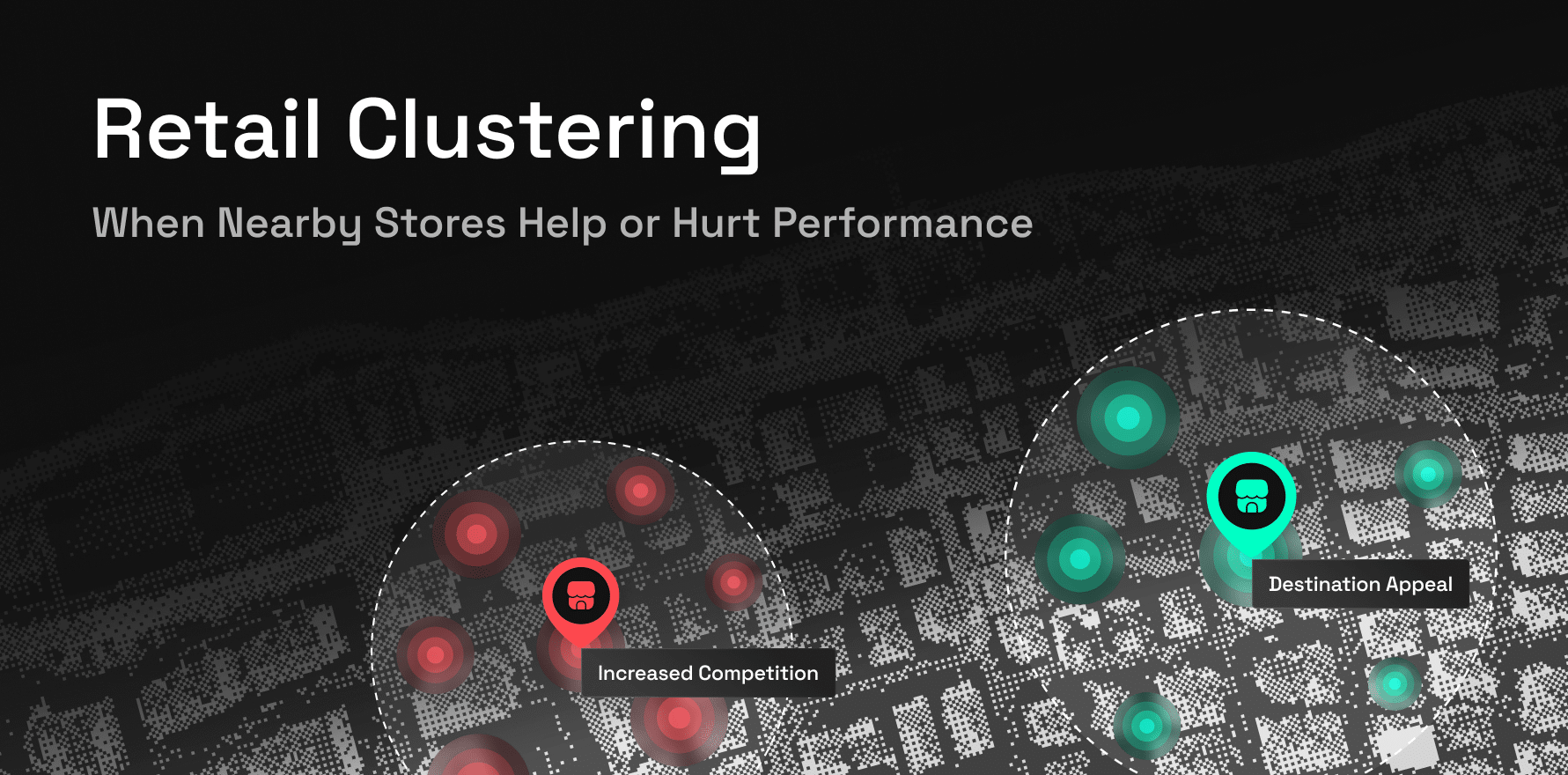
Clustering can strengthen a location by creating destination appeal, increasing customer choice, and encouraging cross-shopping. It can also increase competition for the same customers.
For retailers, the key is understanding whether a cluster creates incremental demand or simply adds more supply around the same audience.
Retail clustering can also refer to grouping similar stores for assortment or merchandising decisions. In location strategy, spatial retail clustering describes retailers operating near one another within the same geographic area.
Key Takeaway
- Retail clustering can increase destination appeal, customer choice, and cross-shopping while also increasing competition for the same demand.
- Store density alone does not define cluster quality because category mix, audience fit, cross-visitation, and trade-area reach also matter.
- Direct competitors, differentiated competitors, and complementary retailers can affect a location in very different ways.
- Strong retail clusters can expand trade areas by giving customers more reasons to travel farther.
- Two clusters with the same number of stores can have very different foot traffic, customer overlap, cross-shopping, and incremental demand.
- Retail clustering should be evaluated alongside retail voids and cannibalization to separate market opportunity from supply concentration and network overlap.
- The strongest clusters are those where destination appeal, audience fit, and complementary demand outweigh competitive capture and customer overlap.
What Makes a Group of Stores a Retail Cluster?
A few nearby stores do not automatically create a meaningful retail cluster.
A strong cluster usually combines:
- Geographic proximity
- Sufficient store density
- Related or complementary categories
- Shared customer flows
- Accessibility
- Destination strength
Research on retail agglomerations shows that retail concentrations can take both planned and unplanned forms. Tenant mix, accessibility, and other location characteristics influence how attractive those clusters become.
A mall is an obvious planned cluster. A restaurant district, auto row, luxury shopping street, or furniture corridor can form organically.
What matters is not just proximity. The businesses need to participate in the same customer ecosystem.
Why Retail Clustering Can Increase Demand
Retailers often locate near other retailers because a concentration of stores can make the entire area more attractive.
Destination Appeal
One store may not justify a longer trip. A collection of stores can.
As more relevant businesses concentrate in one location, customers gain more reasons to visit. This can increase visits and expand the catchment.
Lower Customer Search Costs
Shoppers often compare several options before purchasing.
Clustering makes that easier because customers can visit multiple retailers during one trip. This is especially relevant for furniture, automotive, jewelry, fashion, and home improvement.
Cross-Shopping
One retailer can generate a trip that benefits another.
A grocery visit may lead to a pharmacy visit. A cinema trip may create restaurant demand. A gym can support nearby food or wellness businesses.
POI data can help identify competitors, complementary businesses, and other trip generators around a location.
Anchor Effects
Large retailers, supermarkets, entertainment venues, and other destination businesses can generate activity that surrounding stores benefit from.
A CBRE analysis also examines co-location patterns and how they can inform retail location decisions.
The value depends on who creates the traffic and whether those visitors are relevant to the retailer.
When Retail Clustering Becomes Competition
The same concentration that creates demand can also increase pressure.
A dense cluster can lead to:
- Customer overlap
- Share redistribution
- Price competition
- Higher occupancy costs
- Excess category supply
- Parking or access constraints
- Weaker differentiation
A 2026 study found that clustering does not affect every store or market in the same way.
That makes cluster value a balance between positive and negative forces.
A Simple Retail Cluster Value Framework
Cluster Value = (Destination Attraction + Shared Traffic + Cross-Shopping + Complementary Demand) − (Competitive Capture + Customer Overlap + Additional Cost)
This is not a forecasting formula. It is a decision framework.
If a cluster generates substantial traffic but direct competitors capture most of the relevant demand, the location may still be weak for a particular brand.
Not Every Nearby Competitor Has the Same Effect
Stores in the same broad category can have very different competitive relationships.
Direct Substitutes
These businesses compete for similar customers, budgets, and purchase occasions.
More direct substitutes can divide existing demand.
Differentiated Competitors
Two retailers may operate in the same category while serving different price points, customer groups, or use cases.
Their proximity may increase choice without creating complete overlap.
Complementary Retailers
These businesses serve different needs within the same trip.
Examples include:
- Grocery + pharmacy
- Cinema + restaurant
- Gym + healthy food
- Furniture + home improvement
Competitor count alone is not enough.
Retailers also need to understand how nearby businesses influence the trip and how much of the same demand they compete for.
Four Retail Cluster Patterns
Retail clusters can also be grouped by the type of customer behavior they create.
| Cluster type | Main customer behavior | Example |
| Convenience cluster | Frequent local trips | Grocery, pharmacy, services |
| Comparison cluster | Shoppers compare alternatives | Furniture, automotive, jewelry |
| Complementary cluster | One visit encourages another | Entertainment + dining |
| Destination cluster | Customers travel specifically to the area | Major mall, outlet district |
Different retailers benefit from different patterns.
A convenience retailer may depend on frequent nearby demand. A destination retailer may rely more on a large catchment and customers willing to travel farther.
Measure the Cluster, Not Just the Store Count
Store density is easy to measure.
Cluster strength is not.
Retailers need to combine several signals.
Retail Density and Category Mix
How many businesses operate nearby?
More importantly, how many are direct substitutes, complementary businesses, or unrelated retailers?
Foot Traffic
How much activity does the area generate?
Total visits should be broken down by:
- Weekday versus weekend
- Time of day
- Repeat visitation
- Seasonality
- Long-term trend
Foot traffic data becomes more useful when it shows how activity differs across competing clusters instead of producing a single visit count.
Cross-Visitation
Do customers visit multiple stores within the same cluster?
Strong cross-visitation can signal a connected customer ecosystem.
Low cross-visitation may show that nearby businesses share geography without sharing meaningful customer demand.
Visitor Origins
Where are visitors coming from?
A destination cluster may attract customers from well beyond the surrounding neighborhood.
Trade area analysis helps measure whether the cluster is expanding the reachable market and how far customers are willing to travel.
Openings and Closures
A dense cluster can still be declining.
Tracking openings, closures, and category changes can show whether an area is strengthening, stable, or losing relevance.
Similar Store Counts Can Hide Very Different Clusters
Consider two areas with 25 retailers each.
Cluster A
- High foot traffic
- Heavy same-category concentration
- Low cross-shopping
- Small catchment
- Significant customer overlap
Cluster B
- Moderate foot traffic
- Complementary tenant mix
- High cross-shopping
- Larger destination catchment
- Lower direct substitution
A store-count analysis makes them look similar.
Customer behavior tells a different story.
Cluster A may generate more activity while dividing demand across many substitutes. Cluster B may produce fewer total visits but create a stronger environment for a specific retailer.
That is why location data should be combined with real-world behavior.
Retail Clustering Can Change the Trade Area
Retail clusters do more than sit inside existing trade areas. Strong clusters can expand them.
A standalone store may attract customers mainly from nearby neighborhoods. A destination cluster can provide enough choice and convenience to justify a longer trip.
Clustering can therefore affect:
- Customer travel distance
- Catchment size
- Visitor composition
- Trip purpose
- Visit frequency
This becomes important when two candidate markets look similar demographically but behave differently in the real world.
Retail Clustering vs. Retail Void Analysis
Retail clustering and retail void analysis examine different market conditions.
| Analysis | Core question |
| Retail clustering | Does existing retail concentration strengthen or weaken the location? |
| Retail void analysis | Is supply missing relative to potential demand? |
Both conditions can exist together.
A shopping district may already form a strong retail cluster while still lacking enough supply in a specific category.
Retail void analysis helps test whether that gap represents genuine unmet demand.
Retail Clustering vs. Cannibalization
Retail clustering looks at the effect of being near other businesses.
Cannibalization looks at whether a new location takes demand from stores already owned by the same retailer.
A retailer can benefit from entering a strong cluster while still reducing the performance of an existing nearby store.
Retail cannibalization analysis helps separate gross store potential from incremental network demand.
The two effects should be evaluated separately.
Five Tests Before Entering a Retail Cluster
Before selecting a site inside a cluster, evaluate five areas.
1. Attraction
Does the cluster attract more visitors than comparable surrounding locations?
2. Audience Fit
Do those visitors match the retailer’s target audience?
3. Complementarity
Do surrounding businesses create useful cross-shopping opportunities?
4. Competition
How much demand is already captured by direct substitutes?
5. Incrementality
Will the proposed location add demand to the network?
A strong cluster performs well across several of these dimensions. High foot traffic alone is not enough.
What Data Is Needed to Analyze Retail Clustering?
| Question | Useful data |
| Where are retail clusters? | POI and business-location data |
| How dense are they? | Store count and category density |
| Are they active? | Aggregated mobility and foot traffic |
| Who visits? | Audience and people data |
| Where do visitors come from? | Origin and trade-area data |
| Do stores share visitors? | Cross-visitation data |
| Is the cluster changing? | Historical openings and closures |
| Will the site overlap the network? | Trade areas and mobility |
No individual metric determines whether a cluster is attractive.
A better analysis connects the businesses in the area with the customers who actually visit them.
How Factori Helps With Retail Clustering
Factori combines Places, Mobility, People, and other real-world signals to help retailers identify retail concentrations and understand the behavior around them.
Teams can compare tenant mix, foot traffic, visitor origins, trade areas, competition, and network overlap across potential markets and locations.
Conclusion
Retail clustering changes the economics of a location because stores influence one another.
Some clusters create stronger destinations, encourage comparison, increase cross-shopping, and pull customers from a wider area. Others concentrate too much competing supply around the same demand.
The difference becomes visible only when store density is combined with customer behavior. Foot traffic, category mix, cross-visitation, visitor origins, trade-area reach, and network overlap show whether a cluster is creating additional opportunity or simply concentrating competition.
For retail location teams, that makes cluster quality far more useful than cluster size alone.
FAQs
What is retail clustering?
Retail clustering is the concentration of multiple retail businesses within the same geographic area. Clusters can be planned, such as malls, or develop organically through shopping streets and commercial districts.
Why do competing retailers locate near each other?
Competing retailers may locate close together because the combined concentration attracts shoppers, reduces search effort, and allows customers to compare alternatives during one trip.
What are the benefits of retail clustering?
Potential benefits include stronger destination traffic, cross-shopping, greater customer choice, larger trade areas, complementary demand, and activity generated by anchor businesses.
Can retail clustering hurt store performance?
Yes. It can increase customer overlap, category saturation, price competition, and occupancy costs. The impact depends on the retailer, surrounding businesses, and available demand.
How do you measure a retail cluster?
Retailers can analyze store density, category mix, foot traffic, cross-visitation, visitor origins, audience fit, trade areas, openings and closures, competition, and network overlap.