Talk to the real world with Factori MCP - Get Started Now
Talk to the real world with Factori MCP - Get Started Now
Factori helps enterprise AI teams plug clean, real‑world data into their models and applications—so predictions, copilots, and agents understand how people move, shop, work, and live in the physical world.
Trusted by





Trusted by
Most enterprise AI runs on logs and tables from inside the business. That misses the thing your users care about most: what’s happening out there.
Factori adds that outside‑in layer, so you can:
No more one‑off scrapes, spreadsheets, or fragile vendor feeds.
Enterprise AI development services often stall because models are trained on internal history alone.
Mobility, events, economic shifts, and local demand signals give forecasting models the external context they need to move with the real world, not just react to it.

Enterprise AI development that powers ops, real estate or planning tools needs more than text.
Structured location data, foot traffic and place-level context let copilots answer "what's happening around this site?" with actual data behind it.

Feeding agents real-world signals on markets, neighborhoods, and routes means outputs are specific, grounded, and easier for teams to act on.

Regional leaders and store managers make better calls when their dashboards show more than internal KPIs.
Adding real-world context alongside performance data is one of the clearest wins in enterprise AI development and one of the simplest to implement.

One of the biggest inefficiencies in enterprise AI development is rebuilding external data pipelines for every new model. A single, clean real-world data layer that joins with your locations and markets removes that duplication and speeds up every subsequent project.

You bring the models and use cases. Factori brings consistent real‑world signals.
Each dataset is designed to be easy for data teams to understand and simple to join to your own locations and markets.



Search and commerce interest by brand, product, and category.
Add external signals around stores, branches, hotels, depots, routes, and markets to cut error and explain variance.
Use the same real‑world layer to support forecasting, pricing, site selection, workforce, and supply chain models.
Feed copilots and decision agents with structured location, event, and market context so answers are specific and defensible.
Skip months of sourcing and cleaning external data; start from documented, production‑ready datasets.
Build models on top of concepts everyone understands: traffic, events, nearby businesses, local income, and spend.
What changed around this store that might explain last week’s drop?
Which new sites look most like our top performers in the real world?
If we open a depot here, how does that affect service levels and cost?
Where should we test this promo next, based on demand and competition?
What’s the risk profile of this branch or region compared to similar areas?
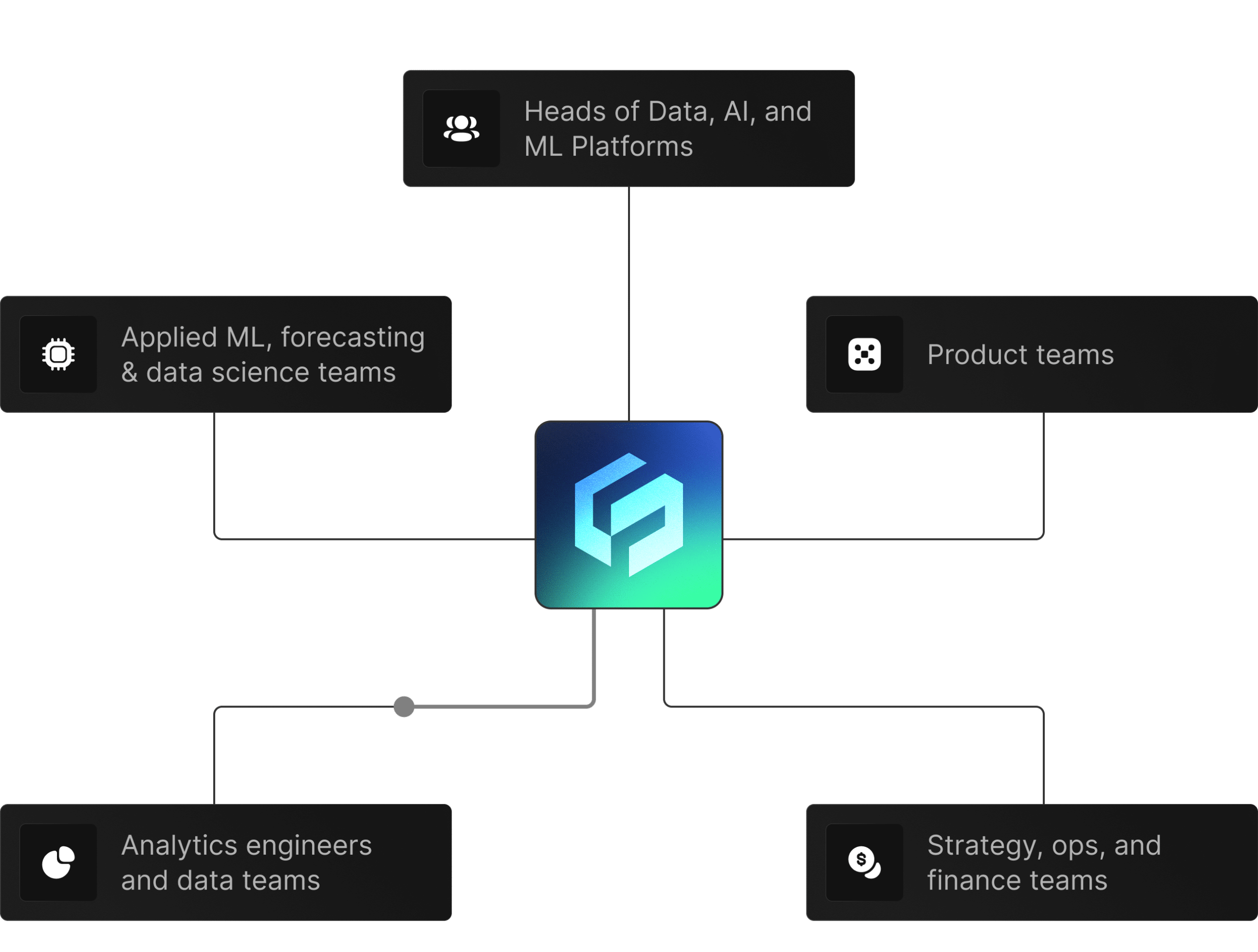
 Heads of Data, AI, and ML Platforms
 Applied ML, forecasting, and data science teams
 Product teams building internal AI tools and copilots
 Analytics engineers and data teams who own the warehouse/lakehouse
 Strategy, ops, and finance teams who rely on AI‑powered decisions
For example: demand forecasting, site selection, workforce planning, or a planning copilot for operators.

Start with 2–4 that clearly match your use case—for example, Mobility + Events + Economic for demand, or Places + People + Business for site planning.
Compare your current approach to “current + Factori data,” and review impact on accuracy, explanations, and user trust.
Enterprise AI development is the process of building AI models, copilots, agents, forecasting systems, decision tools, and automation workflows using trusted internal and external data.
Factori gives enterprise AI teams ready-to-join external features across mobility, places, events, people, economic conditions, market demand, retail sales, property, business, and geo data. These features add real-world context to AI models and applications.
How can AI teams build more accurate and explainable models with Factori?
Factori helps AI teams move faster by removing the burden of sourcing, cleaning, normalizing, joining, and governing external datasets. Teams can focus on model performance, product workflows, explainability, and business impact.
Products
Solutions By Use Case
By Use Case
By Industry
© 2026 Factori. All rights reserved.