Talk to the real world with Factori MCP - Get Started Now
Talk to the real world with Factori MCP - Get Started Now
Factori helps marketing teams use real‑world data—movement, audience, events, interest, and spend—to decide where to show up, how much to invest, and what to say in each market across paid social, search, OOH, and CTV.
Trusted by





Trusted by
Most plans still rely on past performance and platform tools alone. That leads to:
Factori gives you a simple, outside‑in view of each market so you can:
Good marketing planning starts with knowing where your audience actually belongs.
Real audience profiles, mobility patterns, and spend data help build geo segments for paid social, search, and programmatic that reflect real demand, not just radius targeting.

Picking the right screens is a core part of marketing and planning. Mobility, traffic, and places data help identify the corridors and locations where your audience moves, lives, and shops, so every placement has a reason behind it.

Marketing planning tools that incorporate market interest and spending power help decide which DMAs get heavier budgets and where new creative is worth testing.

Real-world audience and neighborhood data give marketing and planning teams the context to tailor promos and messaging by area, rather than running one blanket line across every market.

Marketing planning works best when budget follows real signals. Rising market interest, foot traffic trends and local spend data help shift investment away from cooling areas and into markets where demand is actually building.

You bring your channels, audiences, and creative. Factori brings the geo‑level context.
You decide which pieces matter for your plan; we make them easy to explore and compare.



Privacy‑safe consumer graph covering demographics, income bands, lifestyle and interest indicators.


How people move through the physical world—visits and patterns around stores, venues, and neighborhoods.


Local events that move demand: concerts, sports, conferences, school calendars, public holidays, and more.





Combine People, Mobility, and Retail Sales to build geo clusters that reflect real demand and audience fit, not just radius targeting.
Use Mobility, Traffic, and Places to pick high‑value corridors and screens around key stores, venues or trade areas.
Use Market and Economic data to choose which DMAs or regions get heavier CTV spend, and where to test new creative.
Use Events and Mobility to plan store‑level activations, local offers, and co‑marketing with nearby brands.
When a campaign over‑ or under‑delivers, layer in Factori data to see whether it was market interest, local economics, or execution.
Which ZIPs or neighborhoods should we prioritize for this launch?
Which DMAs deserve more CTV budget this quarter?
Where is category interest rising but our presence or share is still low?
Where should we buy OOH/DOOH if we want to reach young, affluent, high‑intent audiences?
How should we adjust messaging between these two cities that look similar on paper but perform differently?
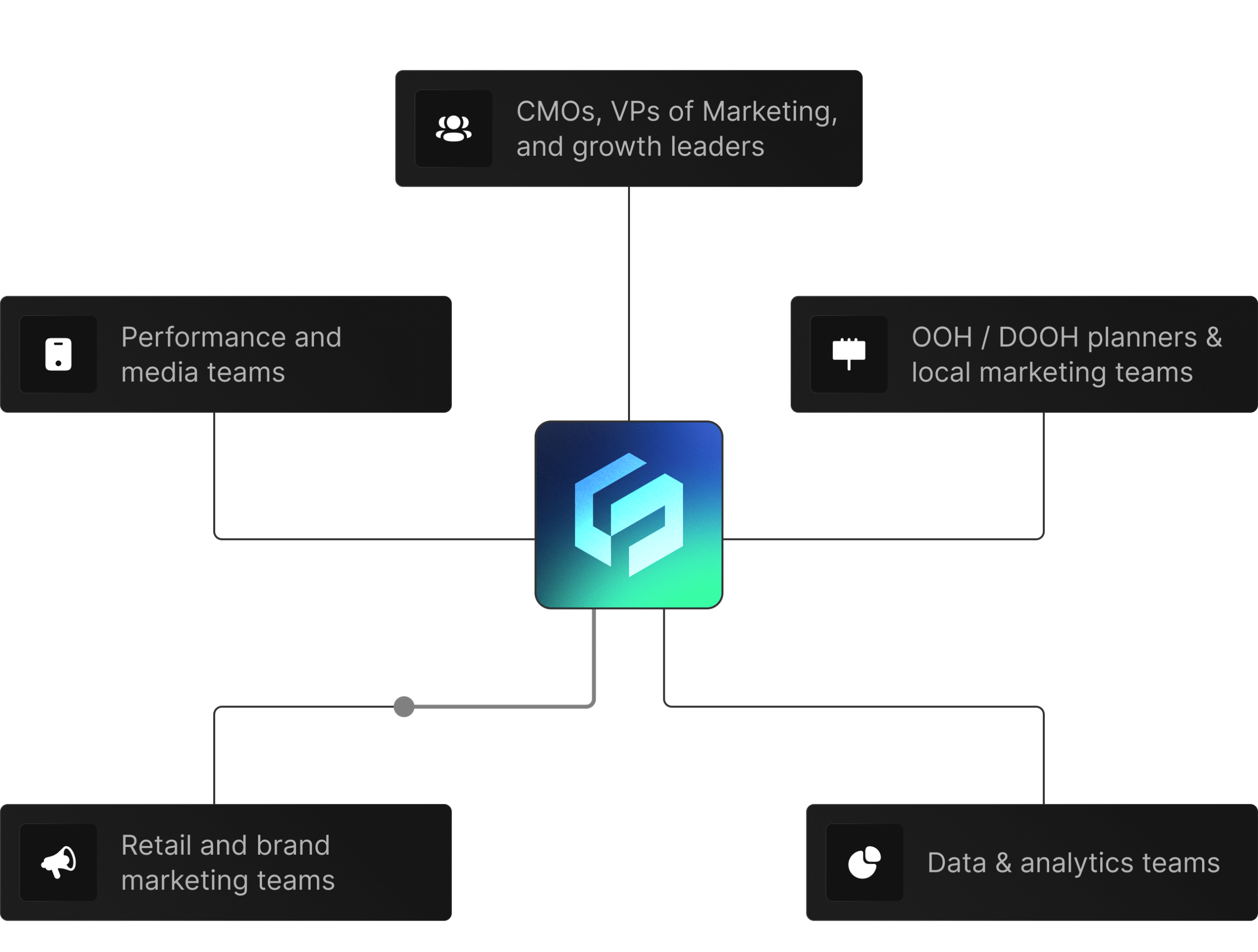
 CMOs, VPs of Marketing, and growth leaders
 Performance and media teams (paid social, search, programmatic, CTV)
 OOH / DOOH planners and local marketing teams
 Retail and brand marketing teams running store‑driven or geo‑based campaigns
 Data & analytics teams supporting marketing with better external signals
Choose an upcoming launch, always‑on program, or a set of priority markets.

For example: People + Market + Retail Sales for channel mix, or Mobility + Events + Traffic for OOH and local activations.
Use our data to shape targeting, budget, and messaging—then use the same context to interpret results and refine the next cycle.
Marketing planning is the process of deciding where, when, and how to invest media, promotions, campaigns, offers, and local activations to reach the right audiences and drive measurable business outcomes.
Factori helps marketing teams plan campaigns using audience, mobility, market, retail sales, events, places, economic, and geo signals. These signals help identify high-potential markets, audience concentrations, local demand trends, and moments when campaigns are more likely to perform.
Factori connects marketing decisions to real-world demand context. Instead of planning only from past campaign data or broad audience assumptions, teams can use local signals to prioritize markets, channels, messages, offers, and timing.
Marketers can use Factori to identify demand-rich geographies, align campaigns with events and local activity, target stronger audience segments, and compare performance across exposed and control markets. This improves planning precision, measurement depth, and marketing ROI.
Products
Solutions By Use Case
By Use Case
By Industry
© 2026 Factori. All rights reserved.