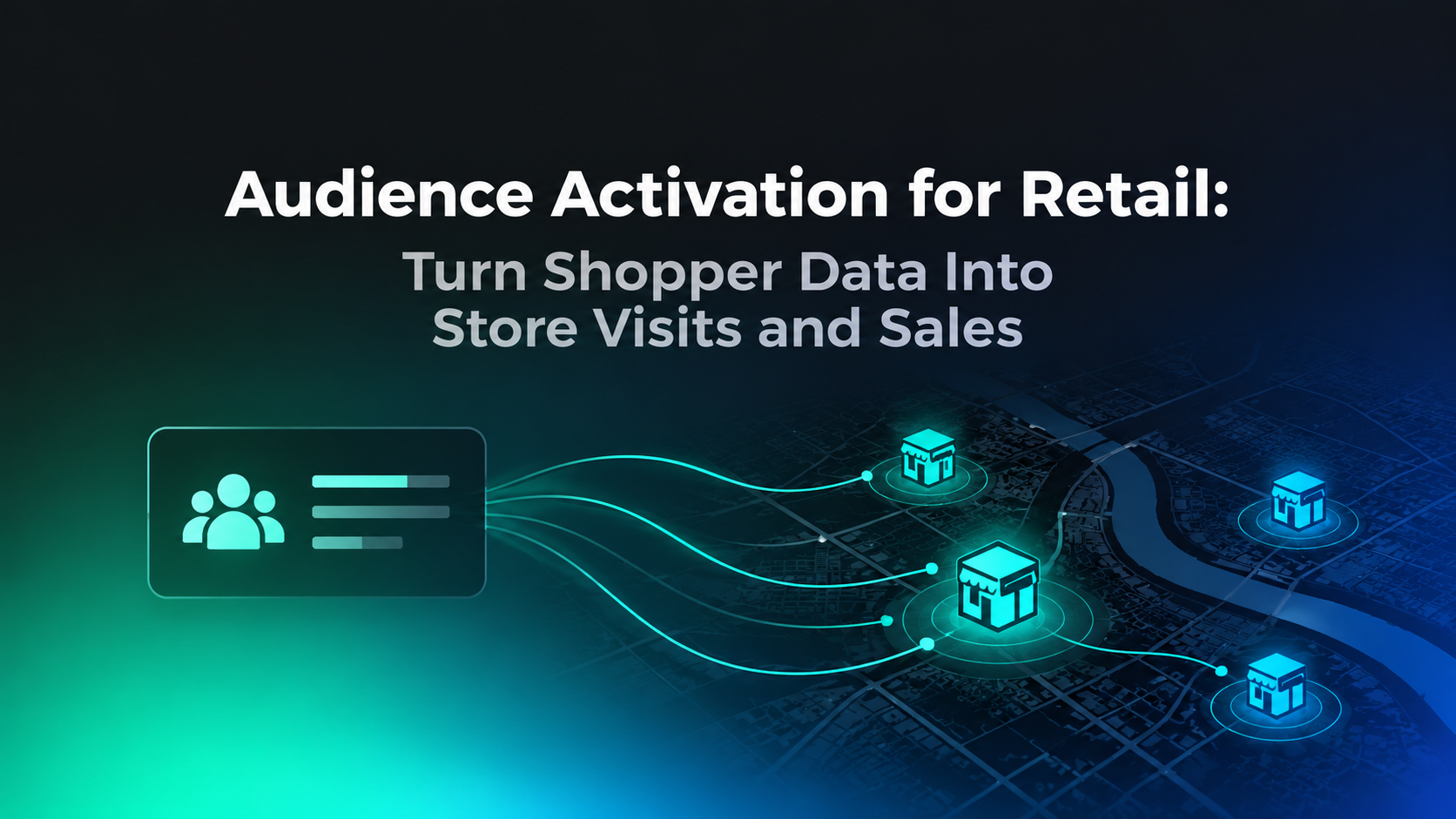
Audience activation for retail is the process of putting shopper segments into marketing channels to encourage store visits, purchases, or repeat buying. It connects audience eligibility with a relevant message, a permitted destination, and a measurable shopping action.
Consider an outdoor retailer introducing backpack-fitting appointments at selected Denver stores. The campaign needs to reach relevant shoppers, give them a reason to attend, and establish whether the resulting purchases justify the investment.
Key Takeaway
- Retail audience segmentation becomes activation when shopper criteria determine campaign delivery, messaging, or exclusions.
- Purchase records establish buying behavior, while real-world data adds store and trade-area context.
- Activation routes depend on data permissions and destination requirements, not simply whether an audience can be exported.
- Omnichannel campaigns need coordinated updates so shoppers stop receiving invitations after booking or purchasing.
- Incremental purchasers, cost per incremental purchase, and contribution margin determine whether activation creates profitable demand.
How Do You Build Retail Audiences From Shopper Data?
Start retail audience segmentation with the shopping action the campaign should encourage. Purchase history, category engagement, and location context answer different questions, so select signals that establish relevant eligibility.
| Retail objective | Data required | Audience rule | Campaign action |
| Reactivate customers | Purchase dates and category repurchase patterns | Previous buyers beyond the usual repurchase window | Relevant return reminder |
| Encourage category trial | Category engagement and purchase history | Eligible shoppers without a recorded category purchase during a defined period | Product demonstration or fitting invitation |
| Support a store opening | Store locations and local audience context | Relevant prospects within a practical service area | Local opening campaign |
For the Denver retailer, outdoor-category engagement can inform the invitation, while purchase records identify recent backpack buyers to exclude. Treat inferred category interests as hypotheses, not verified purchase intent.
How Does Location-Based Marketing Support Store Visits?
Location-based marketing connects campaign decisions with relevant places and geographic audiences. A trade area, also called a catchment, is the geographic area from which a store attracts customers or visitors.
Trade area analysis can help prioritize neighborhoods around participating Denver stores rather than apply the same radius everywhere. Factori’s aggregated, privacy-safe Mobility Data adds visitor-origin and visitation context.
Use that context to choose relevant markets, not to infer which visitors purchased. The retailer’s booking system should establish appointment capacity, and inventory systems should confirm product availability.
How Does Audience Studio Support Retail Audience Activation?
Factori Audience Studio helps teams build and review U.S. consumer audiences using plain-language descriptions or structured criteria. Planners can refine the audience and review estimated reach and geographic distribution.
Completed audiences can be pushed to HubSpot or Salesforce or exported to Amazon S3. Audience Studio supports preparation and handoff; connected campaign systems manage delivery and booking or purchase exclusions.
For a separate Denver prospecting audience, review local relevance and the approved activation route before allocating budget. Keep that audience distinct from the first-party customer pilot described below.
How to Activate Retail Audiences Across Channels
Choose activation channels according to the audience’s permissions, available identifiers, and intended action. An omnichannel approach coordinates messages and eligibility across channels rather than treating every destination as a separate campaign.
Email, SMS, and app messaging can support opted-in customer communication, while eligible customer audiences may also support paid search, social, display, or CTV campaigns. Retail media uses retailer-owned advertising placements and retailer-enabled offsite inventory to connect advertising with shopping audiences.
Google’s Customer Match policy permits uploads of information collected in a first-party context. Importing externally purchased records into a CRM does not change their origin or make them eligible for Customer Match.
For the Denver pilot, use permitted first-party records for coordinated email and eligible paid-media invitations. Check rejected records, matched audience size, and delivered reach separately because an accepted upload does not establish actual campaign delivery.
How Can Retail Campaigns Turn Audience Reach Into Store Visits?
Give shoppers a specific in-store benefit and a clear next action. A relevant audience still needs an offer the participating store can deliver.
The Denver invitation should lead to a booking page showing participating stores, appointment availability, and backpack options. Once a shopper books, replace acquisition reminders with confirmation and preparation information.
Update exclusions after a qualifying purchase and pause invitations when appointments fill. Measure bookings and attendance separately so a successful registration campaign is not mistaken for additional store visits.
How Can Retailers Protect Shopper Data During Activation?
Keep permitted uses, privacy choices, retention rules, and exclusions attached to audience eligibility throughout activation. For mobility-based analysis, use aggregated, privacy-safe outputs and sensitive-place filtering.
A data clean room is a controlled environment where organizations analyze approved datasets together under access and output restrictions. It can support partner measurement, but the technology does not replace appropriate permissions or governance.
How Do You Measure Incremental Sales From Audience Activation?
Measure incremental sales by comparing campaign outcomes with a credible estimate of what would have happened without the campaign. Attribution assigns credit under a rule, while incrementality estimates additional business caused by marketing.
Store visit attribution links measured or estimated visits to eligible ad exposures within a defined time window. It does not, by itself, prove that advertising caused the visit or that a purchase occurred.
Randomly assign eligible shoppers to campaign and holdout groups where feasible, and keep the holdout out of the campaign’s channels. Compare all assigned shoppers over the same outcome window rather than only those who clicked or attended.
Denver Example: From Campaign Budget to Incremental Margin
Suppose the Denver pilot budgets $4,000: $2,500 for media, $500 for data and technology, and $1,000 for additional store staffing. It randomly assigns 10,000 eligible first-party shoppers to the campaign and 10,000 to a holdout.
| Measure | Campaign group | Holdout group |
| Eligible shoppers | 10,000 | 10,000 |
| Purchasing shoppers | 400 | 300 |
| Purchase rate | 4% | 3% |
The difference is one percentage point, giving an estimate of 100 incremental purchasers. Campaign cost per incremental purchaser is therefore $4,000 ÷ 100 = $40.
Contribution margin is net sales minus variable costs, leaving an amount available to cover fixed costs and profit. Assume each purchasing shopper places one $200 net order and that the product contribution margin is 35%, before the separately budgeted campaign costs.
| Commercial result | Calculation | Amount |
| Incremental purchases | 400 − 300 | 100 |
| Cost per incremental purchase | $4,000 ÷ 100 | $40 |
| Incremental net sales | 100 × $200 | $20,000 |
| Contribution before campaign costs | $20,000 × 35% | $7,000 |
| Incremental contribution after campaign costs | $7,000 − $4,000 | $3,000 |
Under these assumptions, the campaign adds $3,000 toward fixed costs and profit after its budget. Treat this as a point estimate: assess statistical uncertainty, measurement completeness, and possible holdout exposure before scaling.
This evaluates the combined audience, offer, and campaign execution. To isolate the benefit of a different audience definition, run a separate test holding the offer and execution comparable.
Conclusion
Audience activation for retail works when shopper evidence changes who receives a campaign, what they are offered, and which store action follows. The commercial test is whether those choices create additional purchases at a cost the retailer can sustain.
Start with one audience, one shopping action, and a measurable comparison. Scale when incremental contribution supports the decision, not because the audience file uploaded successfully.
FAQs
What’s the Difference Between Audience Segmentation and Activation?
Audience segmentation organizes shoppers into groups with relevant shared characteristics. Activation uses selected groups in campaigns to determine messages, delivery, or exclusions.
Which Channels Can Retailers Activate Audiences On?
Options include email, SMS, app messaging, paid social, search, display, CTV, retail media, and location-led OOH or DOOH planning. Each channel requires an appropriate audience method, permissions, and destination compatibility.
How Do You Measure Incremental Lift?
Compare outcome rates between a campaign group and a credible control group over the same period. Relative lift is the rate difference divided by the control rate, so 4% versus 3% represents a one-percentage-point increase or approximately 33.3% relative lift.
Does Audience Activation Require a CDP?
No, audience creation can begin without a customer data platform. Teams still need a reliable way to manage permissions, destination connections, audience updates, and measurement.
Can Retailers Activate Audiences Without First-Party Data?
Yes, approved external Audience Data can support prospecting through compatible destinations. Channel rules still apply, and Google Customer Match requires first-party customer information.