Audience data helps businesses understand who their audiences are, what they care about, how they behave, and how they interact across channels and locations.
It gives marketing, analytics, and strategy teams a clearer way to group audiences, enrich customer records, improve targeting, measure performance, and make better decisions.
As businesses rely more on first-party data, privacy-safe enrichment, and predictive analytics, audience data has become more than a marketing input. When combined with movement patterns, place visits, consumer attributes, and behavioral signals, it can help teams build a more complete view of their audience.
Key Takeaway
- Audience data helps businesses understand who their audiences are, how they behave, where they are active, and what matters to them.
- First-party data is a strong starting point, but external audience data can add broader context around behavior, movement, visits, and interests.
- Audience data supports key use cases such as data enrichment, audience targeting, media planning, market intelligence, and predictive analytics.
- Combining audience data with location, mobility, visit, and consumer signals can create a more complete view of customers, prospects, and markets.
- The most useful audience data is accurate, fresh, privacy-safe, easy to integrate, and aligned with a clear business goal.
What Is Audience Data?
Audience data is information used to understand, group, and activate audiences.
It helps businesses identify who their customers, prospects, visitors, or market groups are and how they behave across different environments.
In marketing, audience data is often used for segmentation, personalization, media planning, and campaign measurement. In analytics and strategy, it can support market analysis, customer understanding, regional planning, and business growth.
Audience data may include demographic attributes, interests, purchase behavior, browsing activity, location patterns, place visits, device signals, consumer preferences, and identity-linked interactions.
These signals become more useful when they are organized around a clear business goal.
For example, a retailer may use audience data to understand which consumer groups visit stores in a specific trade area. A travel brand may use it to identify audiences interested in certain destinations. A financial services company may use it to compare customer groups across branches or regions.
At its core, audience data helps businesses answer five questions:
- Who is the audience?
- Where are they active?
- What do they care about?
- How do they behave?
- How can the business engage them more effectively?
Why Audience Data Matters
Businesses often collect data across separate systems.
Customer records may sit in a CRM. Campaign data may live in ad platforms. Website activity may be stored somewhere else. Offline behavior may be missing completely.
This creates an incomplete view of the audience.
Without audience data, marketers may target groups that are too broad. Analysts may struggle to explain why performance changes across markets. Strategy teams may miss demand patterns that become visible only when customer, behavioral, and location signals are connected.
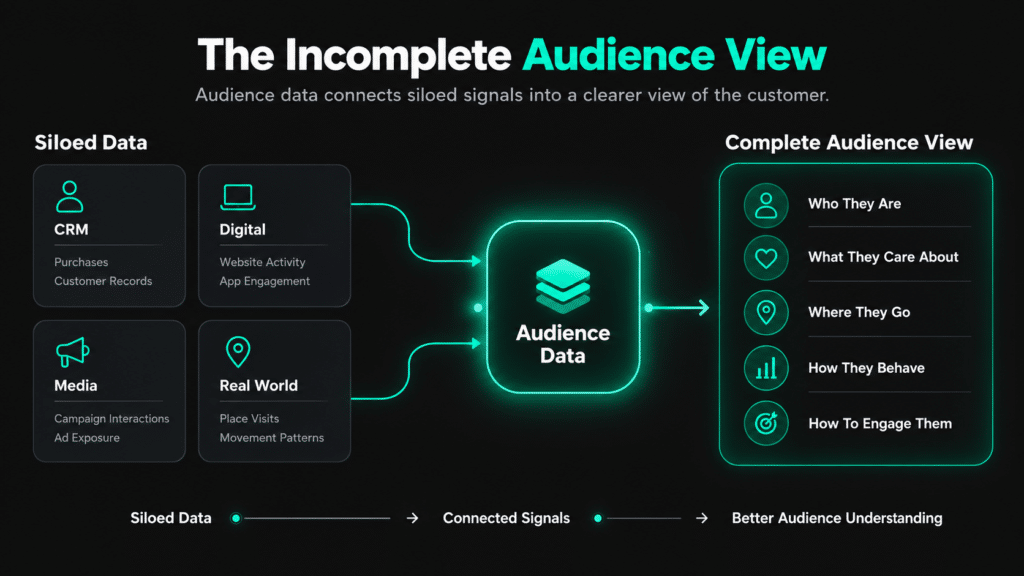
Audience data helps close these gaps.
It can support:
- Audience segmentation
- First-party data enrichment
- Campaign targeting
- Personalization
- Media planning and measurement
- Market and trade area analysis
- Predictive analytics
This makes audience data useful beyond advertising. It can also support retail planning, financial services strategy, travel demand analysis, product growth, and forecasting.
Types of Audience Data
Audience data can come from different sources. Each type provides a different view of the audience.
| Type of Audience Data | What It Shows | Common Use |
|---|---|---|
| First-party data | Direct customer interactions | CRM enrichment, retention, personalization |
| Second-party data | Partner data shared through trusted relationships | Audience extension and partnerships |
| Third-party data | Data from external providers | Enrichment, prospecting, and scale |
| Behavioral data | Actions, visits, browsing, movement, and engagement | Targeting and prediction |
| Location and visit data | Where audiences go and how places are visited | Retail, media planning, and site strategy |
| Demographic and consumer data | Age bands, income ranges, lifestyle, and interests | Segmentation and market analysis |
First-party data is often the strongest starting point because it comes from direct customer relationships.
However, it may not show the full picture.
A brand may know what a customer bought but not where else they shop, how they move across a market, or what broader audience group they belong to.
This is where enrichment becomes useful.
By adding privacy-safe external audience data, businesses can build a broader view of customers, prospects, and markets.
Audience data is also broader than customer data. Customer data usually refers to known records such as purchases, CRM activity, loyalty data, or app interactions.
Audience data can include customers, prospects, visitors, market groups, and lookalike audiences.
Key Use Cases of Audience Data
Data Enrichment
Audience data can make first-party data more useful.
A CRM record may contain basic customer information. Data enrichment can add more context, such as interests, lifestyle attributes, movement patterns, place visits, and broader consumer behavior.
This helps teams understand not only who a customer is, but also how that customer behaves.
For example, a retailer can enrich customer records with audience and visit intelligence to understand which segments are more likely to shop in certain trade areas or respond to location-based campaigns.
Audience Targeting
Audience data helps marketing teams build more relevant segments.
Instead of targeting broad groups, businesses can create audiences based on behavior, interests, location patterns, visit activity, and consumer attributes.
This can improve campaign relevance across digital, mobile, connected TV, DOOH, and omnichannel media.
A travel brand, for example, could build an audience around people who frequently visit airports, hotels, or leisure destinations.
Better targeting can help reduce wasted media spend and improve the chances of reaching audiences that are more likely to engage or convert.
Media Planning and Measurement
Audience data can support both campaign planning and campaign measurement.
Before a campaign runs, teams can study where relevant audiences are active, which markets show stronger demand, and which locations or channels may be more useful.
After a campaign, audience data can help teams measure changes in real-world activity, such as store visits or footfall.
This is especially useful for retail media, DOOH, mobile advertising, and omnichannel campaigns where online exposure and offline behavior need to be understood together.
Market Intelligence
Audience data can also help businesses compare markets.
Teams can study regions, trade areas, cities, competitors, and customer groups to identify growth opportunities.
A retailer may compare visitor profiles around existing stores with potential new locations. A bank may study audience activity around branches and ATMs. A hospitality brand may compare visitor patterns across airports, hotels, tourist districts, and entertainment areas.
This makes audience data useful for market planning, competitive analysis, territory design, and expansion strategy.
Predictive Analytics
Audience data can strengthen predictive models by adding behavioral and real-world context.
Historical sales or campaign data may show what happened. Audience data can help explain why demand changed and where it may shift next.
Movement patterns, place visits, consumer attributes, and behavioral signals can support use cases such as demand forecasting, footfall prediction, propensity modeling, and location planning.
When combined with machine learning and analytics workflows, audience data can help businesses move from reporting past performance to making more forward-looking decisions.
How Factori Helps Businesses Use Audience Data
Factori helps businesses enrich, analyze, and activate audience data using privacy-first datasets, platform access, APIs, and MCP.
Teams can connect audience intelligence with real-world signals about people, places, movement, visits, and markets instead of working with each dataset separately.
Factori’s datasets include mobility, visit and location intelligence, POI and places, people, consumer, audience, identity, web stream, cross-device, and high-fidelity data.
These datasets can support use cases such as data enrichment, audience targeting, media planning, campaign measurement, retail optimization, market intelligence, financial services strategy, and predictive analytics.
Factori’s platform, APIs, and MCP also make it easier to bring audience data into existing workflows.
Conclusion
Audience data helps businesses understand customers, prospects, visitors, and markets more clearly.
It can support stronger segmentation, better targeting, richer first-party data, improved media planning, and more informed business decisions.
As customer journeys become more fragmented, audience data gives teams a way to connect signals across channels, places, and behaviors.
When used responsibly and combined with real-world intelligence, it can become a strong foundation for growth, measurement, and predictive analytics.
FAQs About Audience Data
What Is an Example of Audience Data?
An example could be a group of people who frequently visit fitness centers, shop at premium grocery stores, and show interest in health and wellness products.
Businesses can use this type of audience data for targeting, enrichment, and market analysis.
How Is Audience Data Collected?
Audience data can come from customer interactions, websites, apps, transactions, surveys, partner relationships, and privacy-safe external data providers.
Businesses should use data that is collected and activated responsibly.
Is Audience Data Only Used for Advertising?
No.
Audience data can also support market intelligence, retail planning, data enrichment, product strategy, financial services analysis, demand forecasting, and customer analytics.
How Does Audience Data Improve Personalization?
Audience data helps businesses understand audience interests, behaviors, preferences, and context.
This makes it easier to create more relevant messages, offers, content, and experiences.
What Should Businesses Look for in an Audience Data Provider?
Businesses should look at accuracy, coverage, freshness, privacy practices, sourcing, matchability, useful audience attributes, and integration options.
The right provider should make it easier to use audience data in existing platforms, APIs, and analytics workflows.