Retail demand forecasting helps retailers predict what customers are likely to buy, where demand will occur, and when inventory will be needed.
It affects inventory, replenishment, pricing, promotions, and supply chain planning.
But forecasting in retail is becoming harder. Historical sales still matter, but they do not always explain sudden changes across stores, markets, or customer groups.
A stronger retail demand forecast combines internal sales data with more current signals about store performance, customer behavior, and local market activity.
What Is Retail Demand Forecasting?
Retail demand forecasting is the process of predicting future demand for products across stores, channels, and time periods.
Retailers use these forecasts to decide:
- How much inventory to stock
- Where inventory should be allocated
- When products should be replenished
- Which products may need promotion
- How supply should be distributed
Forecasting can happen at different levels.
| Forecast Level | What It Predicts | Typical Decision |
|---|---|---|
| SKU level | Demand for individual products | Replenishment |
| Store level | Demand at specific locations | Inventory allocation |
| Regional level | Demand across markets | Distribution |
| Network level | Demand across the business | Supply chain planning |
A useful retail forecast therefore needs to match the level at which the business will make a decision.
Why Does Demand Forecasting in Retail Matter?
Demand forecasting in retail helps balance two costly problems: too little inventory and too much inventory.
Under-forecasting can lead to:
- Stockouts
- Missed sales
- Poor customer experience
Over-forecasting can lead to:
- Excess inventory
- Higher storage costs
- More markdowns
- Working capital tied up in stock
Retail inventory forecasting helps teams plan how much product each location may need before demand occurs.
Retail sales forecasting also supports broader decisions around pricing, promotions, assortment, distribution, and staffing.
As retail operations become more complex, forecasting is no longer only a planning task. It directly affects margins and operational efficiency.
What Drives Retail Demand?
Retail demand is shaped by both internal business decisions and external consumer behavior.
Internal Demand Drivers
Most retail forecasting models begin with:
- Historical sales
- Pricing
- Discounts
- Promotions
- Merchandising
- Product lifecycle
- Inventory availability
These signals provide the foundation for forecasting.
But most are based on what has already happened.
Behavioral and Location Signals
Retailers can also use real-world signals to understand why demand may differ between locations.
Mobility data can show how people move through trade areas.
Visit intelligence can show differences in store activity and foot traffic.
Places or POI data can provide context about nearby businesses, competitors, and commercial activity.
Audience data can help explain who is visiting different markets or locations.
Together, these signals provide more context for changes that historical sales may not fully explain.
What Are the Main Retail Demand Forecasting Methods?
Different retail demand forecasting methods work for different business needs.
Time-Series Forecasting
Time-series models use historical demand to identify recurring patterns.
These may include:
- Weekly trends
- Seasonality
- Holiday demand
- Long-term growth or decline
Time-series forecasting works best when historical patterns remain useful indicators of future demand.
Google Cloud describes forecasting models as models that predict a sequence of future values and gives future retail product demand for inventory planning as a common example. Google Cloud forecasting documentation
Causal Forecasting
Causal models add variables that may influence demand.
Examples include:
- Pricing
- Promotions
- Discounts
- Assortment changes
Instead of only detecting a pattern, these models try to account for factors associated with the change.
Machine Learning Forecasting
Machine learning models can process larger sets of variables and identify more complex relationships.
They can combine product, store, customer, pricing, and other signals at a more granular level.
This can be useful when retailers need forecasts across many products and locations.
Short-Term vs. Long-Term Forecasting
Retail forecasts also vary by time horizon.
| Forecast Type | Typical Use |
|---|---|
| Short-term | Replenishment, inventory, staffing |
| Long-term | Assortment, capacity, expansion |
No single method works for every retail problem.
The method should match the available data, forecast horizon, and business decision.
How Can Retailers Improve Retail Forecasting?
Improving retail forecasting is not only about choosing a more advanced model.
The quality and structure of the inputs matter just as much.
1. Unify Data Across Systems
Sales, inventory, pricing, promotions, and store performance data are often stored in different systems.
Fragmented data can create incomplete forecasts.
Bringing these signals together creates a more consistent view of demand.
2. Forecast at the Right Level
A national retail forecast may hide major differences between stores.
SKU- and store-level forecasting can reveal local demand patterns that broader forecasts miss.
This can improve retail inventory forecasting and allocation.
3. Add Behavioral Signals
Historical sales show what customers bought.
They do not always explain what is changing around a location.
Mobility patterns, visits, POI data, and audience signals can provide additional context.
4. Use Models That Can Adapt
Demand patterns change.
Forecasting models should be reviewed and updated as new data becomes available.
Static assumptions can become less useful when markets, customers, or store performance change.
5. Connect Forecasts to Decisions
A forecast has little value if teams cannot act on it.
Retail forecasts should feed into decisions such as:
- Inventory allocation
- Replenishment
- Pricing
- Promotions
- Store operations
This turns forecasting from an analytical output into an operational tool.
What Should Demand Forecasting Tools for Retail Businesses Support?
Demand forecasting tools for retail businesses should help teams move from raw data to decisions.
Important capabilities include:
| Capability | Why It Matters |
|---|---|
| Multiple data inputs | Creates a broader view of demand |
| Store and SKU granularity | Captures local variation |
| Model evaluation | Shows whether forecasts are improving |
| Frequent updates | Helps forecasts respond to new patterns |
| Integration | Connects forecasts with planning workflows |
AWS’s retail demand forecasting guidance also describes combining retail data from systems such as point-of-sale, CRM, ERP, distribution, and third-party sources when developing forecasts. AWS Demand Forecasting for Retail guidance
The best tool is therefore not simply the one with the most complex model.
It is the one that fits the retailer’s data, level of forecasting, and operational workflow.
How Does Real-World Data Improve Retail Demand Forecasting?
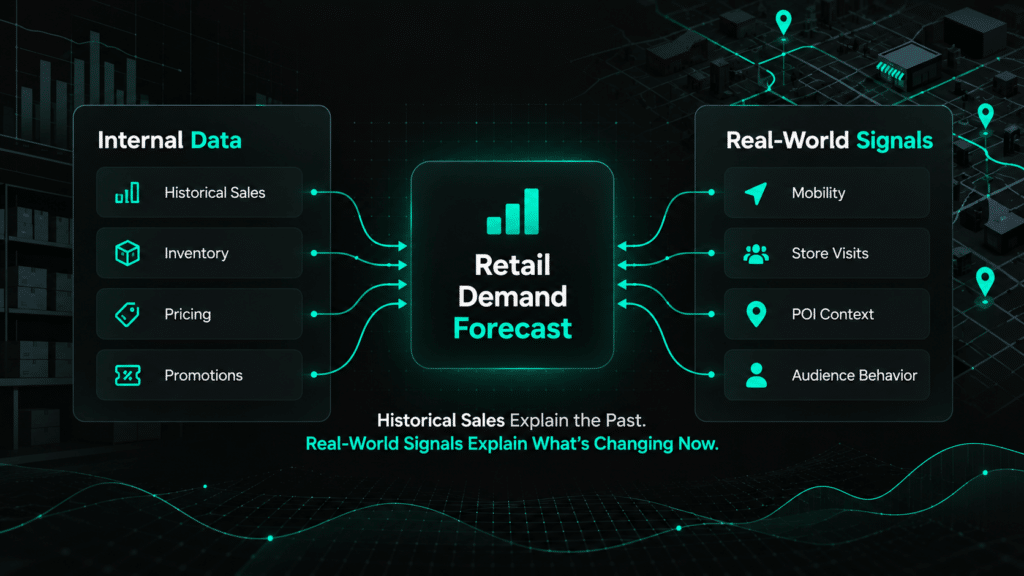
Traditional retail sales forecasting depends heavily on internal records such as sales, inventory, and promotions.
These signals explain past performance.
Real-world data adds context about what may be changing outside those systems.
What Different Data Layers Add
| Data Layer | What It Can Add to a Forecast |
|---|---|
| Mobility | Changes in movement across markets and trade areas |
| Visit intelligence | Store-level activity and footfall trends |
| POI data | Nearby businesses, competition, and location context |
| Audience data | Differences between customer groups and markets |
These signals can help retailers understand why demand varies from one location to another.
They can also help teams detect changes that may not yet be visible in historical sales alone.
When combined with internal data, real-world signals can support:
- Earlier identification of demand changes
- More granular store-level forecasts
- Better inventory allocation
- Stronger understanding of local demand drivers
The goal is not to replace historical sales.
It is to give the retail demand forecast more context.
How Factori Supports Retail Demand Forecasting
Factori provides real-world datasets that can add behavioral and location context to retail forecasting models.
Teams can combine internal operational data with signals such as mobility, visits, Places, and audience intelligence.
This can help retailers understand differences across locations, trade areas, and customer groups.
Factori data can support demand forecasting, inventory planning, store performance analysis, and market strategy through datasets, APIs, platform access, and integration workflows.
Conclusion
Retail demand forecasting is no longer only about extending historical sales trends into the future.
Retailers need to understand demand across products, stores, markets, and customer groups.
Historical sales remain an important starting point. But stronger forecasting can come from combining internal data with more granular behavioral and location signals.
Better data, appropriate retail demand forecasting methods, and closer links between forecasts and business decisions can help retailers respond faster to changes and allocate inventory more effectively.
FAQs
What Is Retail Demand Forecasting?
Retail demand forecasting is the process of estimating future customer demand across products, stores, channels, or time periods.
Retailers use these forecasts for inventory, replenishment, pricing, promotions, and supply planning.
What Is the Difference Between Retail Demand Forecasting and Retail Sales Forecasting?
Retail sales forecasting estimates future sales.
Retail demand forecasting focuses more broadly on expected customer demand, which can then inform sales, inventory, and supply decisions.
What Are the Main Retail Demand Forecasting Methods?
Common retail demand forecasting methods include time-series forecasting, causal models, and machine-learning models.
The best method depends on the available data, forecast horizon, and business problem.
How Can Retailers Improve Retail Forecasting?
Retailers can improve retail forecasting by combining data across systems, forecasting at a more granular level, adding behavioral signals, updating models regularly, and connecting forecast outputs to operational decisions.
How Does Retail Demand Forecasting Help Inventory Management?
Retail demand forecasting helps estimate how much inventory may be required at different stores and times.
This can support replenishment and reduce the risk of both stockouts and excess inventory.