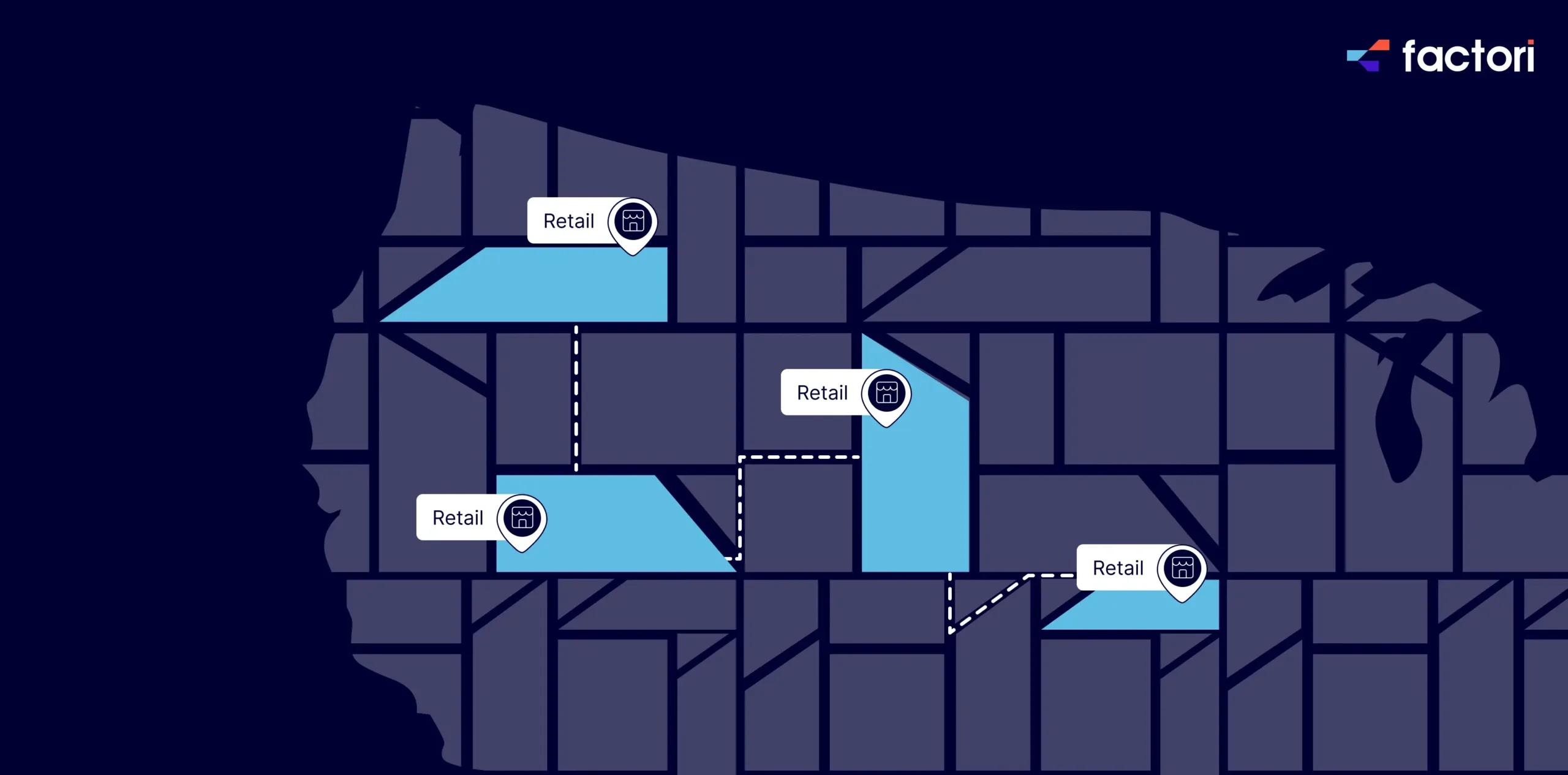

Most retailers measure footfall at the store level. Some track trade areas by ZIP code or city-wide movement patterns. But the insights that often explain performance emerge at a much smaller scale: micro-catchments, the pockets of streets and blocks where demand actually forms.
These micro-zones shift constantly. A new competitor opens, a residential building fills up, a transit stop gets busier, or an office cluster returns to higher occupancy. When retailers only monitor footfall at the store level, they often react after the shift has already happened. Micro-catchment analysis helps surface those changes earlier and with more precision.
This blog breaks down how micro-catchment footfall works, why it matters, the numbers behind its impact, and how retailers can use it to make better decisions across marketing, operations, merchandising, and expansion.
What is Micro-Catchment Footfall?
Micro-catchment footfall is the measurement of demand in small, hyper-local zones around a store, such as street blocks, intersections, or grid cells. Instead of treating the full trade area as one unit, it helps retailers understand which nearby zones are driving visits, which ones are weakening, and where new demand is forming.
This matters because retail demand rarely shifts evenly across an entire catchment. A store can appear stable at a headline level while the underlying demand around it is already moving from one set of blocks to another.
Why Micro-Catchments Matter More Than Ever
Store-level footfall shows how many people come to or near a store, but it does not fully explain where those visitors are coming from or which nearby blocks are strengthening or weakening. Micro-catchment analysis fills that gap by helping retailers understand demand at a much more actionable geographic level.
But this growth isn’t evenly distributed. Within a single store’s catchment:
- A small share of surrounding blocks often drives a disproportionately large share of potential customers
- A nearby competitor can shift footfall patterns quickly
- High-traffic blocks can show materially higher visit rates than adjacent blocks with similar demographics
- A new residential building or upgraded transit stop can materially increase block-level footfall
These shifts don’t always show up immediately in sales or store-level footfall — meaning the retailer sees the impact late.
Micro-catchment analysis surfaces these changes early, so teams can respond before performance moves.
Read About:Using Mobility Data for Better Travel Insights
What Micro-Catchment Footfall Actually Reveals
Breaking the store’s local area into small blocks or micro-grids helps retailers see patterns that standard footfall reports often miss.
1. Street-by-street demand
You can see which exact blocks drive the highest flow of people around your store.
Example: Two adjacent blocks might differ significantly in daily footfall.
2. Sudden local spikes
A new gym, café, office tower, or transit change can increase footfall on one side of a store even while total store traffic appears stable.
3. Early signs of competitive pressure
A nearby competitor may begin pulling foot traffic from only certain streets or approach corridors at first.
4. Pockets of untapped demand
Some blocks show consistent increases in activity but very little conversion, making them strong zones for hyper-local marketing or promotion testing.
5. Catchment fragmentation
If your store previously pulled consistently from a set of strong blocks but suddenly pulls from fewer, you’re losing influence even if total store footfall looks stable.

How Retail Teams Use Micro-Catchment Footfall
1. Hyper-Local Marketing
Instead of running ads for a 1–3 mile radius, retailers target the exact blocks experiencing demand lift.
Examples:
- Blocks with week-over-week growth become priority zones for paid media
- DOOH screens placed at high-velocity blocks can improve cost-per-visit efficiency
- Promotions tailored around rising residential or office-worker pockets can boost conversion
Explore how Factori’s marketing planning solution helps retailers target high-potential micro-zones with precision campaigns.
2. Inventory and Merchandising
Footfall moves earlier than transactions.
- A block with sustained growth for several weeks is often a leading indicator of category demand rising
- Merchandisers can adjust stock accordingly and reduce the risk of stock-outs and overstocks
- Seasonal items can be stocked based on how certain blocks behave, such as weekend spike zones, office-heavy zones, or transit corridors
3. Staffing and Operations
Align staffing to when traffic actually appears around the store.
Retailers using footfall-driven staffing instead of historical sales alone often see:
- Better alignment to peak micro-zone activity
- Better customer service during high-demand periods
- Lower labor cost per transaction during slow periods
This is especially important for high-frequency categories like convenience, QSR, pharmacy, or specialty retail.
4. Expansion and Relocation
Micro-catchment footfall is invaluable for real estate teams.
- The true center of demand is rarely at the geometric center of a trade area — it’s wherever the top-performing blocks cluster
- A proposed location should sit within or adjacent to the strongest micro-blocks, not just the average of a radius
- If two proposed stores share too many of the same micro-blocks, cannibalization risk rises
Learn how to identify and avoid store cannibalization when two proposed locations share too many of the same high-value micro-blocks.
This level of insight can reduce risk in long-term network and site-planning decisions.
5. Competitive Intelligence
Micro-catchment footfall shows:
- Where traffic is shifting toward a competitor
- Which blocks you are losing influence in
- Whether new tenants are reshaping the neighborhood
- Whether your store is still the most convenient anchor in the area
Retailers that track these changes early can respond before the impact becomes obvious in store-level KPIs.
How to Run Micro-Catchment Footfall the Right Way
Here is a simple, repeatable workflow:
1. Define the catchment
Typically 0.5–1 mile around each store
2. Break it into micro-cells
Street blocks or small grid tiles.
3. Overlay movement and place intelligence
Footfall trends, surrounding amenities, POI clusters, residential vs office zones.
4. Analyze block-level patterns
Rising blocks, declining blocks, seasonal shifts, anomalies.
5. Link to store outcomes
Understand which blocks convert well, which require marketing support, and which predict future demand.
6. Take action
Targeted marketing, DOOH, staffing, assortment, promotions, site selection.
7. Review weekly or monthly
Micro-catchments evolve quickly in dense or competitive markets.
Where Retailers See the Fastest ROI
Micro-catchment footfall delivers the most immediate impact for:
- Urban and suburban stores with dense street networks
- Retailers in categories with high visit frequency
- Markets where competition shifts rapidly
- Areas with changing residential, office, or commuter patterns
- Stores with volatile or unexplained performance swings
See how retail demand forecasting at the micro-catchment level helps retailers in high-frequency categories stay ahead of local demand shifts.
This is where retailers often see value sooner because local demand shifts are more frequent and easier to detect.
How Factori Helps Retailers Operationalize Micro-Catchment Footfall
Micro-catchment analysis depends on exceptionally accurate, high-resolution real-world data and this is where Factori becomes essential.
Factori provides retailers with the movement and location intelligence needed to map demand at block level, enriched with the contextual layers that explain why patterns shift.
Factori enables retail teams to:
- Understand how people move through specific street blocks around their stores
- Identify the exact micro-zones driving the strongest demand
- Interpret shifts through enriched place and POI intelligence
- Connect real-world signals into existing analytics, forecasting, inventory, and marketing workflows
- Access 10+ datasets instantly through APIs or platform tools, with consistent structure, global coverage, and high accuracy
- Work with data that is normalized, easy to join, and privacy-safe by design
Instead of surface-level visibility, Factori gives retailers the granular, actionable understanding needed to react quickly, plan confidently, and forecast more accurately.
It turns micro-catchment analysis into a repeatable, automated part of decision-making, not a one-off experiment.
Ready to explore micro-catchment footfall? Get Started for Free and explore how Factori transforms location intelligence into real results.
About Factori
Factori is a partner-powered real-world data platform offering 13 standardized, enterprise-ready datasets including:
Mobility | Places | People | Audiences | Identity | Retail | Market | Economic | Events | Property | Business I Geo
Each dataset is governed, privacy-safe, and designed to join cleanly with your existing data stack, whether you’re working in SQL, a data warehouse, a BI tool, or an ML pipeline. No black boxes, no mystery sources, just real-world signals about how people move, shop, work, and live, delivered the way your team works: via API, raw data, app, MCPs, or agentic workflows. Explore datasets suitable for your use case and available for your market.
Talk to an Expert
FAQ
1. What is micro-catchment footfall?
Micro-catchment footfall measures how people move through small, hyper-local zones around a store, such as individual blocks, intersections, or clusters of nearby streets. Instead of treating an entire trade area as one unit, it shows exactly where demand is rising, falling, or shifting. This helps retailers detect localized changes earlier and act with more precision.
2. How is micro-catchment footfall different from store-level footfall?
Store-level footfall tells you how many people entered or passed by a store, but it does not explain where those visitors came from or which nearby zones are driving change. Micro-catchment footfall breaks the area around a store into smaller grids so teams can identify demand pockets, weak zones, and emerging patterns that store-level numbers often hide.
3. Why does micro-catchment analysis matter for retailers?
Retail demand rarely changes evenly across an entire catchment. A new office hub, transit stop, competitor, or residential development can shift footfall on just a few nearby blocks while the wider trade area looks stable. Micro-catchment analysis helps retailers spot those shifts early and improve decisions in marketing, staffing, merchandising, and expansion planning.
4. What retail decisions can improve with micro-catchment footfall data?
Retailers can use micro-catchment footfall to target high-potential zones with more relevant campaigns, allocate inventory based on neighborhood-level demand, schedule staff around localized traffic peaks, and make better site selection or relocation decisions. It is especially useful when small geographic changes have an outsized impact on store performance.
5. How does Factori help with micro-catchment footfall analysis?
Factori helps retailers operationalize micro-catchment analysis by combining movement data with place, property, and neighborhood context in a consistent geographic framework. This allows teams to move beyond broad trade-area assumptions and identify the specific zones influencing demand. The result is faster, more explainable decisions across growth, operations, and forecasting.