Audience segmentation is supposed to make marketing more relevant. But when segments are built on broad assumptions, outdated profiles, or a single type of customer data, targeting can still waste budget.
Effective segmentation goes beyond putting customers into demographic buckets. It helps marketers understand who their audiences are, what differentiates them, how they behave, and which groups are worth prioritizing. That creates a stronger foundation for personalization, campaign planning, customer acquisition, and measurement.
Key Takeaway
- Effective audience segmentation groups customers based on meaningful differences in behavior, characteristics, location, or value.
- Segmentation should start with a clear business objective, not with the amount of data available.
- Combining demographic, behavioral, geographic, and other signals creates stronger audience profiles than relying on one data type alone.
- Useful segments must be actionable, measurable, and distinct enough to justify different targeting or messaging.
- Strong segmentation helps improve relevance, reduce wasted spend, and make audience targeting more effective.
What Is Audience Segmentation?
Audience segmentation is the process of dividing a broad consumer or business audience into smaller groups based on shared characteristics, behaviors, locations, interests, or needs.
For example, a retailer could divide its audience into:
- Frequent customers
- Occasional shoppers
- High-value customers
- Lapsed customers
- Customers within specific geographic markets
- Consumers showing interest in particular categories
The purpose is not simply to create more audience groups. It is to identify meaningful differences that should change how a brand communicates, targets, or allocates marketing spend.
What Is Marketing Segmentation?
Marketing segmentation applies the same principle to a broader market. Businesses divide potential customers into groups and determine which groups are most relevant to a particular product, campaign, or objective.
Three concepts work together:
Segmentation: Identifying distinct customer groups.
Targeting: Selecting which segments to prioritize.
Positioning: Deciding how the product or message should appeal to the selected segment.
This relationship between market segmentation and targeting is what turns audience data into campaign decisions.
How to Find Your Target Audience
Before deciding how to segment your audience, marketers first need to understand who they are trying to reach.
So, how do you identify your target audience?
Start with the people already showing meaningful signals around your business.
Analyze Existing Customers
CRM records, transactions, product usage, campaign interactions, and repeat purchases can reveal characteristics shared by valuable customers.
Look beyond total customer volume. Identify which groups:
- Buy most frequently
- Generate higher customer value
- Respond to campaigns
- Purchase particular products
- Remain engaged over time
Understand Who They Are
Demographic information such as age, income, household characteristics, occupation, or education can provide useful context.
This can help businesses understand how to identify a target market, but demographics alone rarely explain why someone will purchase.
Look at What They Do
Behavior adds another layer.
Purchase history, website interactions, product usage, loyalty, and engagement patterns can help distinguish active prospects from broad demographic groups.
Real-world behaviors and geographic patterns can provide additional context for businesses where physical locations matter.
Identify Meaningful Patterns
The goal of audience segmentation research is to find patterns that have an impact on marketing decisions.
Two customers may share similar demographics but behave completely differently. One may be highly loyal, while another frequently switches between competing brands.
That difference may be far more useful for targeting than age or income alone.
Types of Audience Segmentation in Digital Marketing
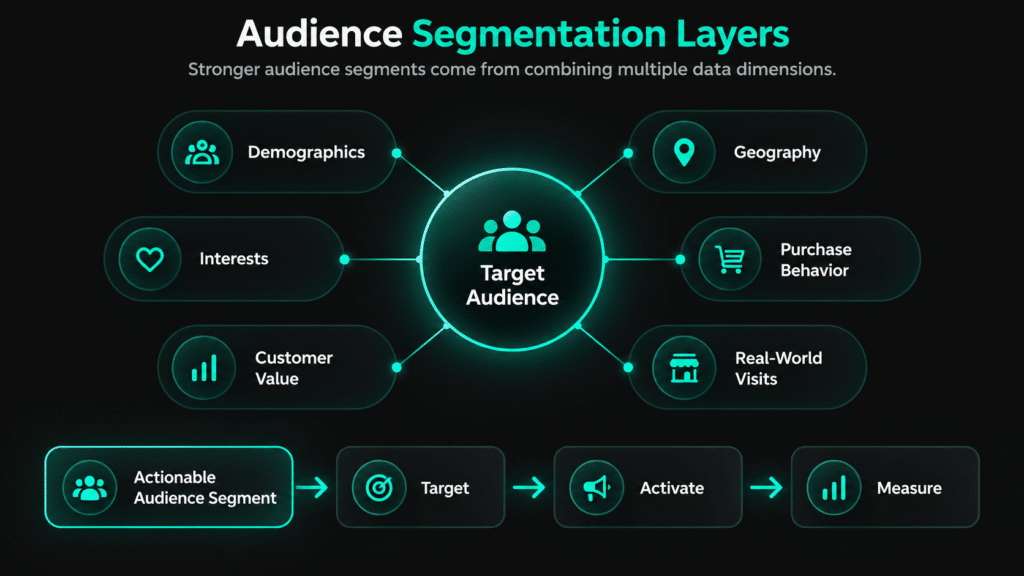
Different business goals require different segmentation approaches.
| Segmentation Type | Based On | Example |
|---|---|---|
| Demographic | Age, income, occupation, household characteristics | Marketing different products to different life stages |
| Geographic | Country, state, city or neighborhood | Running market-specific campaigns |
| Behavioral | Purchases, engagement, usage and loyalty | Separating frequent customers from occasional buyers |
| Psychographic | Interests, attitudes, values and lifestyle | Creating messages around shared interests |
| Customer Value | Purchase frequency, revenue or lifetime value | Prioritizing high-value customers |
| Location and Visit-Based | Visitation and geographic behavior | Understanding audiences visiting relevant physical locations |
These types of audience segmentation in digital marketing can also be combined.
A retailer, for example, might start with geographic segmentation, add demographic characteristics, and then separate customers based on visit or purchase behavior.
This produces stronger audience profiling and segmentation than relying on one dimension alone.
How to Segment Audience Data
A practical target audience segmentation process starts with the marketing outcome, not the data.
1. Define the Objective
Determine what segmentation needs to improve.
Examples include:
- Acquiring new customers
- Increasing repeat purchases
- Reducing wasted media spend
- Re-engaging inactive customers
- Improving campaign personalization
- Entering new geographic markets
The right segmentation variables depend on the objective.
2. Select Relevant Data
Audience segmentation can draw from sources such as:
- CRM data
- Transaction histories
- Website or app analytics
- Survey responses
- Demographic attributes
- Geographic information
- Behavioral data
- Third-party data sources
The original segmentation approach should also be enriched when internal information cannot provide enough context about the broader audience.
3. Find Meaningful Differences
Good audience segmentation analysis asks whether a characteristic actually changes expected behavior.
Creating separate groups based on every available attribute leads to over-segmentation.
Instead, prioritize differences that influence:
- Purchase likelihood
- Product preference
- Customer value
- Channel preference
- Engagement
- Location behavior
4. Make Segments Actionable
Before creating a segment, ask:
- Can we reach this audience?
- Is it large enough to activate?
- Does it require different messaging?
- Can we measure its performance?
- Does it support the campaign objective?
If two segments will receive exactly the same campaign, separating them may add complexity without adding value.
5. Measure and Refresh
Audience behavior changes.
Segments should be reviewed using actual campaign results and refreshed when the underlying data or customer behavior changes.
Audience Segmentation Examples
The value of segmentation becomes clearer when it changes a marketing decision.
Retail
Instead of targeting everyone around a store, a retailer could differentiate between loyal customers, occasional customers, category shoppers, and consumers in relevant geographic markets.
Each group represents a different opportunity.
Automotive
An automotive marketer could differentiate general automobile enthusiasts from consumers actively researching vehicles or engaging with automotive content.
The latter may deserve different messaging and investment.
Sports and Fitness
A sports brand could combine demographic information with interests and behavioral signals to distinguish casual consumers from highly engaged fitness enthusiasts.
These audience segmentation examples show why effective segmentation depends on relevance, not simply the number of audience attributes available.
What Is Audience Targeting?
Audience targeting happens after segmentation.
Segmentation identifies the available audience groups. Targeting determines which group should receive a particular campaign.
For example:
- A business identifies several customer segments.
- Analysis shows one segment represents a strong acquisition opportunity.
- The marketer chooses that segment for a campaign.
- Creative and messaging are adapted to that audience.
- Performance is measured against the campaign objective.
Knowing how to target an audience therefore starts with understanding which segments deserve investment.
Weak segmentation leads to weak targeting, regardless of how sophisticated the advertising platform is.
How to Choose an Audience Segmentation Platform
Marketers often evaluate platforms based on how many audiences or attributes they provide. A better question is whether the platform makes those audiences useful.
When considering how to choose an audience segmentation platform, evaluate:
Data Quality
Are audience attributes sufficiently accurate, complete, and current for the intended use?
Data Breadth
Can you combine demographic, geographic, consumer, behavioral, or other relevant signals?
Integration
Can audience information work with your CRM, analytics, marketing, or data workflows?
Flexibility
Can marketers create custom segments instead of relying entirely on predefined audiences?
Activation
Can useful segments move into the channels where campaigns are executed?
Measurement
Can you compare segment performance through conversion, engagement, customer value, or other business metrics?
Privacy
Segmentation strategies should use responsible data practices, appropriate aggregation, and privacy-aware audience activation.
The strongest platform is not necessarily the one with the largest list of audience segments. It is the one that helps marketers move from data to usable audiences faster and with greater confidence.
Common Audience Segmentation Mistakes
Over-Segmentation
Creating too many small groups can make campaigns difficult to manage without improving results.
Using Outdated Data
Segments lose relevance when the underlying behaviors or customer attributes have changed.
Depending on One Data Type
Demographics can explain who someone is but not necessarily what they do. Behavioral information without additional context can also provide an incomplete picture.
Building Segments That Cannot Be Activated
A theoretically interesting audience has little marketing value if the business cannot reach or measure it.
Failing to Measure Performance
Strong marketing segmentation strategies should result in measurable differences between audiences.
Track metrics such as:
- Conversion rate
- Engagement rate
- Cost per acquisition
- Customer lifetime value
- Repeat purchase rate
- Return on ad spend
How Factori Helps With Audience Segmentation
Factori helps marketers add richer data context to their segmentation and marketing planning workflows.
By combining existing customer information with relevant external data, teams can improve marketing audience segmentation, build more useful audience profiles, and better understand behavioral and geographic differences between customer groups.
This can support use cases such as data enrichment, audience targeting, media planning, market analysis, and campaign optimization while keeping privacy-aware data use at the center of the strategy.
Conclusion
Audience segmentation works when the groups created actually change a business decision.
Effective segmentation starts by determining the target audience, identifying the characteristics and behaviors that matter, and building segments that can be activated and measured.
Instead of creating increasingly narrow groups simply because more data is available, marketers should focus on segments that improve relevance, reduce wasted spend, and make targeting more effective.
The result is a clearer path from audience data to better marketing decisions.
FAQs
What is target market segmentation?
Target market segmentation is the process of dividing a broader market into smaller groups based on shared characteristics, needs, or behaviors so a business can determine which groups to prioritize.
How do you identify your target audience?
Analyze existing customers, demographic characteristics, purchase behavior, engagement, geographic patterns, and other relevant signals. Look for patterns that distinguish valuable or high-intent customers from the wider market.
How do you determine your target audience?
Start with the business objective, examine who currently buys or engages with the product, identify their shared characteristics and behaviors, and test which groups demonstrate the strongest relevance or potential value.
What is the difference between audience segmentation and audience targeting?
Audience segmentation identifies meaningful groups within a larger audience. Audience targeting selects which of those groups a particular campaign should prioritize.
How do you segment audience data?
Define the business objective, select relevant data sources, identify meaningful differences, create actionable groups, activate those segments, and continuously measure and refine their performance.