AI can turn a campaign brief into an audience much faster than a manual segmentation workflow. It can interpret intent, recommend criteria, surface patterns, and help marketers move from a broad objective to a usable audience definition.
But a plausible-looking audience is not automatically a trustworthy one. Before putting media budget behind an AI-generated segment, decision-makers need to understand what data the system used, why it recommended that audience, whether the logic can be inspected, and whether AI actually improves on the targeting process already in place.
Key Takeaway
- AI audience targeting should be evaluated on data quality, explainability, and testability, not speed alone.
- Marketers should understand what signals influenced the audience recommendation and which are modeled or inferred.
- AI-assisted targeting should keep the audience visible and editable rather than hide it behind a black box.
- AI audience targeting is different from lookalike modeling and simple taxonomy search.
- The strongest test is whether AI produces a better audience decision than an established manual or production baseline.
What Is AI Audience Targeting?
AI audience targeting is the use of artificial intelligence or machine learning to identify, recommend, refine, or construct audience segments using customer, consumer, behavioral, geographic, and other campaign-relevant data.
Unlike manual segmentation, AI can help interpret a campaign brief, identify relevant signals, recommend combinations of criteria, or surface audience patterns that a planner may not have selected manually.
That does not mean the AI should make the final decision. Its output still needs to be evaluated against the quality of the data, the logic behind the recommendation, and the campaign objective.
The First Question Is Not “How Accurate Is the AI?”
The first question should be:
What is the AI actually allowed to learn from?
A sophisticated model working with weak or poorly suited data can still return a confident recommendation.
For audience targeting, the available inputs may include People Data, first-party customer signals, geographic context, category affinity, behavioral data, visitation patterns, or other campaign-relevant attributes.
The important point is not how many fields are available. It is whether the underlying signals are appropriate for the targeting problem.
Decision-makers should understand where the data comes from, how often important fields are refreshed, how consistently the data performs across priority markets, and which attributes are observed, modeled, inferred, or derived.
Modeled attributes can provide useful directional context, but they should not be treated as verified facts.
Can You Trace Why the Audience Was Recommended?
AI audience targeting becomes difficult to trust when the recommendation cannot be explained.
There is a meaningful difference between:
“Use this audience.”
and:
“This audience was recommended because these signals align with the campaign objective.”
If an AI system recommends a particular segment, the marketer should be able to understand what influenced that recommendation. Was it driven by category affinity, geographic context, observed behavior, visitation patterns, first-party outcomes, or a combination of signals?
This is especially important when AI surfaces an audience the team would not have selected manually.
The recommendation may be useful. But without traceability, marketers cannot easily distinguish a meaningful pattern from an artifact of the data.
The NIST AI Risk Management Framework emphasizes characteristics such as transparency, explainability, validity, reliability, privacy, and accountability when evaluating AI systems.
For marketing teams, the practical requirement is simpler:
The audience should be understandable enough to challenge.
AI Recommendation or Black Box?
Some AI audience systems expose the logic behind the recommendation. Others return a segment with very little visibility into why it was chosen.
That difference matters.
A transparent workflow may show the audience definition, the signals used, and the criteria the system believes are relevant. A black-box workflow may only say that an audience is “high value” or “likely to convert.”
Those labels can sound useful while hiding important assumptions.
For enterprise teams, this creates governance questions. Media, analytics, legal, privacy, and strategy teams may all need to understand how an audience was created before it is approved for use.
AI targeting should reduce the time required to build an audience. It should not make the audience harder to inspect.
How Much of the Audience Definition Can the Marketer Change?
AI should help create the first version of the audience, not make the final decision impossible to edit.
Marketers may need to remove a criterion, change a geographic condition, compare two audience definitions, or exclude signals that do not fit the campaign.
This is where AI-assisted audience building becomes more useful than fully automated targeting.
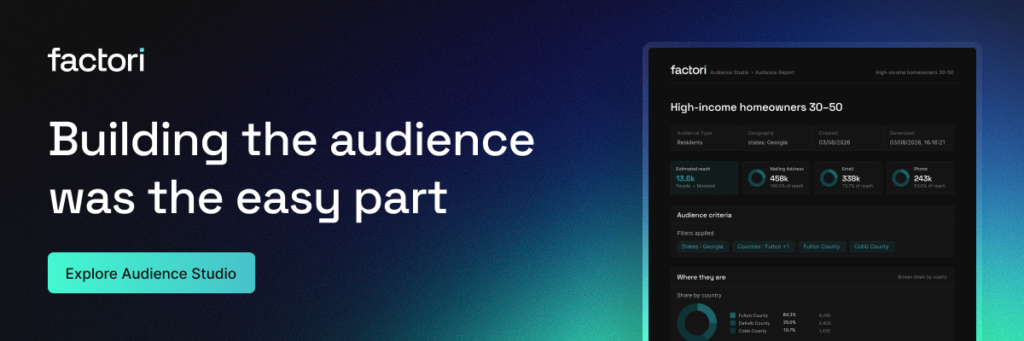
Factori Audience Studio follows this type of workflow. A marketer can begin with a plain-language audience brief, review the resulting criteria, refine the audience using available data, and decide whether the final definition makes sense before using it downstream.
The important distinction is:
AI-assisted does not have to mean AI-controlled.
That matters for teams that want the speed of natural-language audience creation without giving up visibility into how the segment was constructed.
Is the AI Discovering an Audience or Just Repackaging a Taxonomy?
Not every system described as “AI audience targeting” does the same thing.
Some tools use AI mainly to interpret a prompt and map it to existing predefined segments. The workflow becomes faster, but the underlying audience taxonomy remains largely unchanged.
Other systems may combine multiple signals, recommend new audience definitions, rank candidate segments, or learn from campaign and customer outcomes.
Those are different capabilities.
A buyer evaluating an AI audience product should understand whether the system is:
- searching an existing taxonomy more efficiently;
- recommending combinations of existing audience attributes;
- learning from known campaign outcomes;
- constructing a new segment definition;
- predicting which audience is more relevant to an objective.
The distinction matters because the value of AI depends on what work it is actually performing.
A faster search box and an audience-discovery system should not be evaluated in the same way.
AI Audience Targeting vs Lookalike Modeling
AI audience targeting and lookalike modeling are related, but they are not the same thing.
| Approach | Starting point | Typical output |
|---|---|---|
| Manual segmentation | Planner-selected criteria | Defined audience segment |
| Lookalike modeling | Known seed audience | Consumers with similar characteristics |
| AI audience targeting | Brief, objective, data, or seed | Recommended or constructed audience |
Lookalike modeling usually begins with a known group such as existing customers, converters, or another seed audience. The model then identifies other people who share similar characteristics.
AI audience targeting can start earlier in the process.
A marketer may provide a campaign objective or audience brief, and the AI can help determine which criteria or combinations are worth exploring.
That makes AI audience targeting useful even when the team does not yet have a strong seed audience.
The two approaches can also work together. AI may help define or refine the seed audience before a lookalike model is used for expansion.
What Happens When AI Finds a Pattern Humans Would Not Have Chosen?
One potential advantage of AI is its ability to surface patterns a planner may not have considered.
That does not mean those patterns should automatically be trusted.
Suppose an AI system recommends an unexpected combination of audience signals. The team should investigate whether there is a plausible business explanation, whether the relationship holds across markets or time periods, and whether it remains useful when tested on new data.
Unexpected does not mean wrong.
But unexpected also does not mean insightful.
The important question is whether the recommendation is stable, explainable, and testable.
This is where human judgment remains important. Marketers understand the campaign objective, brand context, market constraints, and commercial implications in ways that a model may not fully capture.
Watch for Proxy Signals and False Confidence
AI can produce a highly confident recommendation for the wrong reason.
A model may rely heavily on a proxy that happens to correlate with past outcomes without being a useful or durable targeting signal.
It may also amplify patterns from historical campaigns that reflected previous media choices rather than genuine audience preference.
For example, if a brand historically spent most of its budget in a certain type of market, an AI system trained heavily on past conversions may learn that market pattern and treat it as an audience insight.
That may simply reflect where the brand spent money.
This is why teams should distinguish between:
a signal that predicts an outcome
and
a signal that explains why the audience should be targeted.
The two are not always the same.
Senior decision-makers should be especially cautious when a model appears highly precise but the reasoning behind the result is difficult to defend.
Can the Same Brief Produce a Stable Audience?
Consistency is another useful validation check.
If the same campaign brief is entered multiple times, does the system return broadly similar audience logic? If small wording changes produce completely different audience definitions, that may indicate that the targeting workflow is too sensitive to the prompt.
Some variation is expected in AI-assisted systems.
But the core targeting logic should be stable enough that a media team can explain what it is buying.
This matters for repeat campaigns, internal approvals, testing, and governance.
A useful AI audience workflow should allow the team to save the final audience definition rather than rebuilding it from scratch every time.
Compare AI Against a Manual or Existing Baseline
The strongest test of AI audience targeting is not whether the system can generate a segment.
It is whether the AI improves on the process the team already uses.
That baseline might be a manually defined audience, an existing production segment, a traditional taxonomy-based workflow, or a current lookalike model.
The comparison should look at more than campaign performance.
Teams can also evaluate how long the audience takes to build, how understandable the definition is, whether different users arrive at similar outputs, and how much manual work is required before activation.
Campaign outcomes still matter, but they should be interpreted carefully.
Creative, bids, budget, timing, channel mix, and market conditions can all influence performance. The goal is not to attribute every change to AI.
The useful question is:
Did AI improve the audience decision enough to justify changing the existing workflow?
When Should You Trust an AI-Generated Audience?
Trust should come from evidence, not from how sophisticated the interface appears.
An AI-generated audience becomes more credible when the data sources are understood, the recommendation can be traced, modeled signals are clearly identified, the marketer can edit the definition, and the output is stable enough to reproduce and test.
It should also be possible to compare the AI-assisted audience against an established alternative.
If the system cannot explain what it used, why it made the recommendation, or how the final audience differs from the existing approach, then the value of AI is difficult to evaluate.
The goal is not to remove uncertainty entirely.
It is to make the audience decision transparent enough that a marketing team can understand the trade-offs before committing budget.
Conclusion
AI audience targeting can reduce the time required to move from a campaign objective to an audience definition. But speed is not the same as trust.
Before using an AI-generated audience, marketers should validate the data behind it, trace why the segment was recommended, understand whether the system is genuinely discovering audiences or simply searching an existing taxonomy, and keep enough control to challenge or refine the result.
The strongest AI audience workflows make the reasoning easier to inspect, not harder. They help marketers discover and test better audience ideas while keeping the final decision in human hands.
FAQs
Can AI audience targeting work without first-party data?
Yes. AI audience targeting can use external People Data, behavioral signals, geographic context, visitation data, and other relevant sources. First-party data becomes especially useful when the goal is to learn from known customers, conversions, or existing campaign outcomes.
What is the difference between AI audience targeting and predictive targeting?
Predictive targeting focuses on estimating the likelihood of a future outcome, such as conversion or churn. AI audience targeting is broader and may include interpreting campaign briefs, recommending audience criteria, constructing segments, or ranking different audience options.
Is AI audience targeting the same as lookalike modeling?
No. Lookalike modeling typically starts from a known seed audience and finds similar consumers. AI audience targeting can begin with a campaign brief, objective, dataset, or seed and help construct or recommend the audience itself.
How can marketers tell whether an AI-generated audience is explainable?
The team should be able to see which signals or criteria influenced the recommendation and understand how those signals relate to the campaign objective. If the system only provides a score or recommendation without supporting logic, explainability is limited.
Should AI-generated audiences always replace manually built segments?
No. A useful approach is to test AI-assisted audiences against an established manual or production baseline. AI should replace an existing process only when it produces a meaningful improvement in quality, efficiency, or campaign outcomes.