Businesses already know a lot about what customers do inside their own systems. CRM records show interactions, transaction data shows purchases, and digital analytics shows online activity.
What these sources do not always explain is the wider context around customers, audiences, and markets.
People data adds that context. It helps businesses understand audience characteristics, interests, behaviors, lifestyles, and market patterns. These insights can improve targeting, segmentation, media planning, forecasting, and market analysis.
Key Takeaway
- People data helps businesses understand customers, audiences, and markets beyond their first-party systems.
- People analytics usually refers to workforce analysis, while people data analytics focuses on customer and market intelligence.
- The main types of people data include demographic, behavioral, consumer, location-based audience, identity and cross-device, and digital behavior data.
- People data insights can support targeting, segmentation, media planning, site selection, market analysis, and forecasting.
- People data for targeting should focus on relevant audience-level signals and responsible privacy practices.
- More attributes do not automatically create better insights. Accuracy, relevance, freshness, coverage, and integration matter.
- The strongest people data use cases start with a clear business question and use only the signals needed to answer it.
What Is People Data?
A practical people data definition is structured information that helps businesses understand groups of consumers, customers, or audiences.
People data can include demographic traits, household characteristics, interests, consumer preferences, behavioral patterns, brand affinities, and geographic context.
Its value does not come from collecting more attributes.
The value comes from finding patterns that help answer a business question.
For example, a retailer may use people data to understand which customer profiles are common around its best-performing stores. A media team may use it to find markets with a higher concentration of relevant audiences.
Types of People Data
Different types of people data answer different business questions.
| Type of People Data | What It Shows | Business Use |
|---|---|---|
| Demographic data | Age range, gender, income bands, household traits, and life stage indicators | Helps teams segment audiences, size markets, and understand customer profiles |
| Behavioral data | Interests, preferences, activity patterns, and engagement signals | Supports personalization, campaign planning, and audience targeting |
| Consumer data | Purchase affinity, lifestyle indicators, spending behavior, and product preferences | Helps businesses enrich customer records and identify high-value segments |
| Location-based audience data | Aggregated patterns around where audience groups live, work, visit, or spend time | Supports retail planning, media planning, trade area analysis, and market intelligence |
| Identity & cross-device data | Privacy-safe connections across identifiers, devices, or audience touchpoints | Improves match rates, omnichannel activation, and customer journey analysis |
| Web stream & digital behavior data | Online browsing, engagement, and digital interaction signals | Supports attribution, intent modeling, personalization, and campaign measurement |
These signals become more useful when they are connected to a clear business need.
Demographic data may help define who an audience is. Behavioral and consumer data can explain what those groups are interested in. Location-based audience data can add context about where those audiences are concentrated.
Explore Factori’s audience segments to see how pre-built audience data can support segmentation and targeting.
How Does People Data Analytics Work?
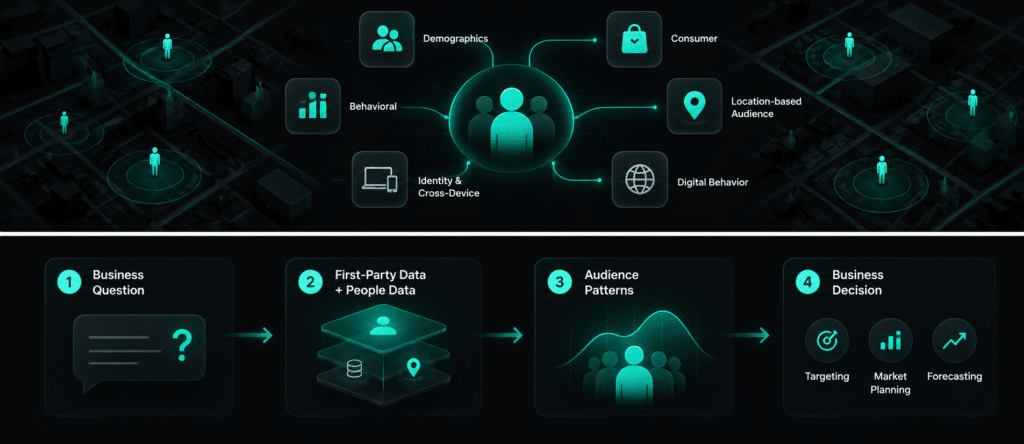
People data analytics turns audience attributes into insights that support decisions.
A typical process has four steps.
1. Define the Business Question
Start with the decision, not the dataset.
A team may want to know which customer groups to prioritize, which markets have stronger audience fit, or where media investment should increase.
Starting with the question helps avoid collecting data that does not support the final decision.
2. Combine Relevant Data
Businesses may combine internal CRM, transaction, campaign, or store data with external demographic, consumer, behavioral, or market information.
External people data can add context that first-party data does not contain.
This is where data enrichment becomes useful. It allows businesses to add relevant external attributes to existing customer or business data.
3. Analyze the Patterns
Teams can compare customer groups, markets, behaviors, and audience profiles.
The analysis may reveal concentrations, affinities, similarities, market gaps, or changes over time.
4. Turn People Data Insights Into Action
People data insights can support segmentation, campaign planning, market selection, personalization, forecasting, and other workflows.
The value comes from what the business changes after the analysis.
What Can People Data Insights Reveal?
Strong people data insights go beyond basic customer profiles.
They can help businesses understand:
- Which characteristics separate different audience groups
- Where target customers are concentrated
- How customer profiles differ by market
- Which interests or behaviors appear across segments
- Which markets may have stronger acquisition potential
- How audience composition relates to store or campaign performance
- Which external signals may improve predictive models
The goal is not to create the largest possible profile.
It is to find the signals that improve a specific decision.
People Data Use Cases
People data use cases range from audience targeting to market planning and predictive analytics.
Data Enrichment
First-party data only contains information a business has collected through its own interactions.
People data can add demographic, lifestyle, consumer, behavioral, or geographic context.
This can improve segmentation, customer analysis, personalization, and predictive modeling.
Factori’s data enrichment use case helps teams add external data to existing customer and business datasets.
People Data for Targeting
People data for targeting helps marketers create more relevant audience segments.
Teams can build segments using combinations of demographic, interest, lifestyle, consumer, behavioral, or geographic characteristics.
The objective is not narrower targeting for its own sake. It is to improve relevance and reduce spend on audiences that are less likely to respond.
Factori’s audience targeting capabilities help marketing teams use audience data for campaign planning and activation.
Targeting should also use appropriate privacy safeguards and avoid sensitive or discriminatory characteristics.
Media Planning
People data can help media teams understand how audience composition changes between markets.
This can support decisions about which regions to prioritize, where target audiences are concentrated, and which segments should be activated.
When combined with location and mobility data, it can add real-world context to OOH, DOOH, CTV, mobile, and omnichannel planning.
Factori’s marketing planning solution can help teams bring audience and market data into media decisions.
Market Intelligence
Population size does not always show whether a market contains the right audience.
A large market may contain fewer consumers aligned with a product. A smaller market may have a much stronger audience fit.
People data can help teams compare markets based on customer characteristics rather than population alone.
It can also be combined with Market Data to provide broader context around demand and market conditions.
Site Selection and Retail Planning
Foot traffic can show whether people visit an area. People data can add context about who those audiences are.
Combining audience composition with Places Data, mobility, visits, competition, and store performance can create a stronger view of potential locations and trade areas.
Factori’s retail site selection solution brings these signals together to support location decisions.
Predictive Analytics
People data can also become an input into forecasting and predictive models.
Demographic, consumer, behavioral, and market characteristics can add external context to historical sales or campaign data.
Teams can then test whether these signals help explain demand, campaign response, or differences between markets.
Factori’s demand forecasting use case combines external signals with existing business data to support forecasting workflows.
Examples of People Data Analytics
A few examples of people analytics in a customer context show how audience data can support decisions.
Retail: A retailer compares the audience profiles around its highest-performing stores with potential new markets.
Media: A media team identifies markets with a higher concentration of its target audience and adjusts campaign budgets.
Travel: A travel company compares audience profiles across origin markets to understand where relevant travelers are concentrated.
Forecasting: An analytics team combines sales history with audience and market characteristics to test whether external people data improves its model.
These are examples of people data analytics rather than traditional HR people analytics because the analysis focuses on customers and markets, not employees.
What Makes People Data Useful?
The number of available attributes does not determine data quality.
Businesses should evaluate:
- Accuracy: Does the data represent the intended audience?
- Coverage: Does it cover the markets and segments you need?
- Freshness: Is it updated often enough?
- Consistency: Are attributes and categories standardized?
- Relevance: Does the data help answer the business question?
- Integration: Can it connect with existing workflows?
- Privacy: Is it designed for responsible use?
Relevant and understandable signals are more useful than unnecessary complexity.
Privacy and Responsible Use of People Data
People data should help businesses understand audience patterns without encouraging invasive monitoring.
Responsible use includes aggregation where appropriate, clear business purposes, suitable access controls, privacy-aware data providers, and reviews for discriminatory outcomes.
Sensitive attributes and sensitive-place information should not be used for inappropriate targeting.
Privacy should be part of the data strategy from the beginning.
How Factori Helps Businesses Use People Data
Factori helps businesses understand audiences and markets through demographic, socio-economic, consumer, lifestyle, behavioral, and geographic context.
Teams can combine People Data with Factori’s Mobility, Visit/Location Intelligence, Places, Consumer, and Audience datasets.
These datasets can support people data use cases such as enrichment, audience targeting, media planning, site strategy, market intelligence, and predictive analytics.
Factori provides access through its platform, APIs, datasets, and MCP integrations, helping marketing, analytics, and data teams bring audience context into existing workflows.
Factori uses privacy-aware approaches designed to support responsible audience and market analysis.
Conclusion
People data becomes useful when it turns audience information into better business decisions.
By connecting demographic, consumer, behavioral, lifestyle, and geographic signals, businesses can understand which audiences matter, where opportunities are concentrated, and how customer groups relate to performance.
The goal is not simply to collect more data about people. It is to generate useful people data insights that improve targeting, planning, forecasting, and growth decisions.
FAQs
What Is People Data?
People data is structured information used to understand groups of customers, consumers, or audiences. It may include demographic, behavioral, consumer, location, identity, and digital behavior signals.
What Is the Difference Between People Analytics and People Data Analytics?
People analytics usually refers to employee and workforce analysis.
People data analytics focuses on customers, audiences, consumers, and markets for applications such as targeting, segmentation, planning, and forecasting.
What Are the Main Types of People Data?
The types of people data covered here are demographic data, behavioral data, consumer data, location-based audience data, identity and cross-device data, and web stream and digital behavior data.
What Are Common People Data Use Cases?
Common people data use cases include data enrichment, audience targeting, media planning, market intelligence, site selection, retail planning, and predictive analytics.
What Are Examples of People Analytics Outside HR?
For customer applications, these are more accurately described as examples of people data analytics.
They include comparing audience profiles across markets, identifying target audience concentrations, analyzing customer segments, and adding audience characteristics to forecasting models.