People data providers, also commonly referred to as consumer data providers, supply external data that helps businesses understand consumers, enrich customer records, build audiences, analyze markets, and improve targeting.
The category includes providers focused on consumer enrichment, demographics, identity, audience intelligence, behavioral signals, and external data. The right provider depends on the type of consumer insight required, how the data will be used, and how easily it fits into existing analytics, marketing, and data workflows.
Key Takeaway
- People data providers help businesses enrich customer data, understand audiences, build segments, and support market and customer analysis.
- Consumer data providers vary significantly in coverage, data structure, delivery methods, and intended use cases.
- Factori is relevant for teams that need consumer People Data alongside Audience, Identity, Places, Mobility, and other real-world datasets.
- Some providers specialize in customer enrichment, while others focus on marketing lists, predictive analytics, or external data enrichment.
- Buyers should evaluate coverage, freshness, granularity, match quality, integration, licensing, and privacy before selecting a provider.
Best People and Consumer Data Providers at a Glance
The providers below serve different parts of the consumer-data market. The best choice depends on what your team needs to build rather than which provider has the largest database.
| Provider | Best suited for | Primary approach | Data access | Best fit if you need |
|---|---|---|---|---|
| Factori | Consumer intelligence, audience, and data teams | People Data connected with broader real-world data | Platform, APIs, cloud delivery, MCP | Consumer enrichment, audience analysis, market intelligence |
| Redmob | Advertising and mobile ecosystem teams | Mobile advertising and audience signals | Enterprise integrations | Mobile audience and advertising workflows |
| Explorium | Data, AI, and enrichment teams | External data enrichment | API, MCP, bulk data, integrations | Adding external data to analytical and AI workflows |
| Alesco Data | Direct marketing and acquisition teams | Consumer and marketing data | Data delivery and marketing services | Consumer lists, customer enrichment, direct marketing |
| Versium | Marketing and enrichment teams | Consumer enrichment and audience activation | APIs and platform workflows | CRM enrichment, audience creation, activation |
This comparison should be treated as a starting point. The providers differ in what they sell, how the data is structured, and which workflows they are designed to support.
1. Factori
Best for: Consumer intelligence connected to broader real-world context
Factori is a people and consumer data provider for teams that need external consumer intelligence for enrichment, audience analysis, market planning, and analytics.
Factori’s People Data covers 300M+ U.S. consumer profiles and can be used alongside Audience Data, Identity Data, Places Data, Mobility Data, Business Data, Economic Data, Events Data, and Property Data.
This broader data layer is useful when a business needs to understand more than who its target consumers are.
A retailer, for example, may want to identify a relevant audience, understand where that audience is concentrated, compare nearby markets, analyze surrounding businesses, and evaluate real-world activity around candidate locations.
Instead of sourcing and normalizing each dataset separately, teams can connect these external signals within the same broader real-world data environment.
Factori supports access through APIs, cloud delivery, the Factori Platform, and MCP-based workflows, allowing data to fit into existing analytics, BI, warehouse, and AI environments.
From Consumer Data to Audience Planning
Audience Studio provides an additional layer for teams that want to move from consumer data to usable audiences.
Teams can define audience criteria, estimate audience scale, compare segments, understand geographic concentration, and visualize those audiences on a map before moving them into downstream planning or activation workflows.
That changes the question from:
“How many people match this profile?”
to:
“How large is this audience, where is it concentrated, and where should we focus?”
This is especially useful for media planning, retail market analysis, audience strategy, and location-based campaigns.
2. Redmob
Best for: Mobile advertising and audience workflows
Redmob operates primarily within the mobile advertising ecosystem. Its current offering focuses on connecting publishers and advertisers while filtering low-quality traffic and improving how mobile ad inventory is evaluated.
That makes Redmob more relevant for teams working with mobile advertising supply and audience activity than for companies primarily looking to enrich internal consumer databases.
Buyers comparing Redmob with broader consumer data providers should therefore first determine whether their requirement is audience and advertising infrastructure or a reusable consumer dataset.
3. Explorium
Best for: External data enrichment and AI workflows
Explorium provides external data that organizations can use to enrich existing datasets, build models, and support AI applications.
Its data network covers business entities, professional profiles, geospatial information, and thousands of external signals. Data can be delivered through APIs, MCP, bulk data, and integrations.
Explorium is particularly relevant when the main requirement is bringing multiple external datasets into analytics, AI, or go-to-market workflows.
Teams whose primary requirement is consumer audience intelligence should compare the exact dataset available for their use case rather than treating all enrichment data as equivalent.
4. Alesco Data
Best for: Consumer acquisition and direct marketing
Alesco Data is more focused on consumer marketing data, customer acquisition, append services, and direct-marketing use cases.
It can be relevant for businesses that need consumer records to support customer acquisition, direct mail, database enrichment, or campaign execution.
For buyers evaluating Alesco or similar providers, the key questions are not only how many records are available but also how recently they were validated, which fields can be supplied, how matching works, and what the licensing permits.
5. Versium
Best for: Consumer enrichment and audience activation
Versium focuses on consumer and business data enrichment.
Its consumer tools can append contact information, demographic information, household and financial data, lifestyle information, and online audience identifiers to existing customer or prospect records. It also supports consumer audience creation and activation through APIs and its REACH platform.
This makes Versium relevant when a company already has first-party records and wants to enrich them or prepare those audiences for marketing workflows.
Its API documentation also makes an important point for buyers: not every consumer dataset has the same geographic coverage. For example, its demographic API currently documents U.S. support, reinforcing why coverage needs to be checked at the individual dataset level rather than at the company level.
What Do Consumer Data Providers Actually Provide?
People data and consumer data can support several different business workflows.
The underlying data may include demographic information, household characteristics, consumer interests, audience information, identity data, geographic intelligence, purchasing signals, or other external attributes.
What matters is how those inputs answer a business question.
For example, a company may use consumer data to:
- enrich existing customer records;
- identify high-value audience segments;
- understand where target consumers are concentrated;
- improve media and campaign planning;
- compare consumer characteristics across markets;
- support customer and market intelligence models.
A consumer data provider should therefore be evaluated against the decision being made rather than simply the number of fields or records advertised.
How to Choose a People Data Provider
The strongest people data provider is the one that fits your use case, geography, data architecture, and privacy requirements.
Coverage
Start by checking whether the provider actually covers the markets and consumers you need.
A large global headline number can be misleading if the fields required for your analysis are only available in certain countries or regions.
Ask for coverage at the dataset and field level, not only at the company level.
Granularity
Understand what one row of data represents.
Depending on the provider, the output may represent an individual consumer, household, audience segment, geographic area, or modeled population.
This affects how the data can be joined with CRM, sales, location, media, or other first-party information.
Freshness
There is rarely one meaningful refresh rate for an entire consumer dataset.
Different fields change at different speeds.
A household attribute, contact point, audience membership, location characteristic, and modeled behavior may each have different update cycles.
Ask providers to explain freshness by major field group rather than relying on a single “real-time” or “frequently updated” claim.
Match Quality
For enrichment workflows, coverage alone is not enough.
A provider may have a very large database but still match poorly against your customer records.
Before committing, test representative first-party data and measure:
- percentage of records matched;
- percentage receiving the required fields;
- accuracy of returned attributes;
- incremental coverage compared with existing sources.
The useful metric is usable enriched records, not just database size.
Data Delivery and Integration
The provider should fit the infrastructure your team already uses.
Depending on the workflow, this may mean APIs, bulk files, cloud delivery, a data platform, CRM integration, or access through AI and agentic workflows.
The faster the data can be joined with existing systems, the shorter the time from acquisition to usable analysis.
Licensing and Permitted Use
Two technically similar datasets can have very different licensing terms.
Before buying, confirm whether the data can be used for:
- internal analytics;
- customer enrichment;
- audience activation;
- machine learning;
- client-facing products;
- derived data products.
This becomes especially important when consumer data will be incorporated into models or commercial outputs.
Privacy and Governance
Consumer data requires clear governance.
Buyers should understand how data is collected, what privacy controls are applied, how sensitive information is handled, and which uses are restricted.
For location and mobility-related workflows, teams should prefer aggregate analysis, sensitive-place filtering, appropriate geographic thresholds, and privacy-safe collaboration models where applicable.
Why Consumer Data Becomes More Useful With Real-World Context
Consumer data can tell a business a great deal about who its customers or target audiences are.
Many decisions also require context about where those consumers are, what surrounds them, and what is happening in the physical market.
Consider a retailer evaluating two expansion markets.
Consumer data may show that both markets contain similar target demographics. That alone does not tell the retailer:
- which market has stronger relevant foot traffic;
- whether competitors are concentrated nearby;
- how surrounding POI mix differs;
- whether audiences are concentrated around the proposed trade area;
- how local economic or event conditions affect demand.
Connecting consumer information with other real-world datasets makes those comparisons more useful.
A workflow could combine:
People Data + Audience Data + Places Data + Mobility Data + Economic Data
to create a more complete view of a market.
The goal is not to maximize the number of datasets being used. It is to add external signals that improve the decision.
Conclusion
Choosing a people data provider starts with understanding what the data needs to accomplish.
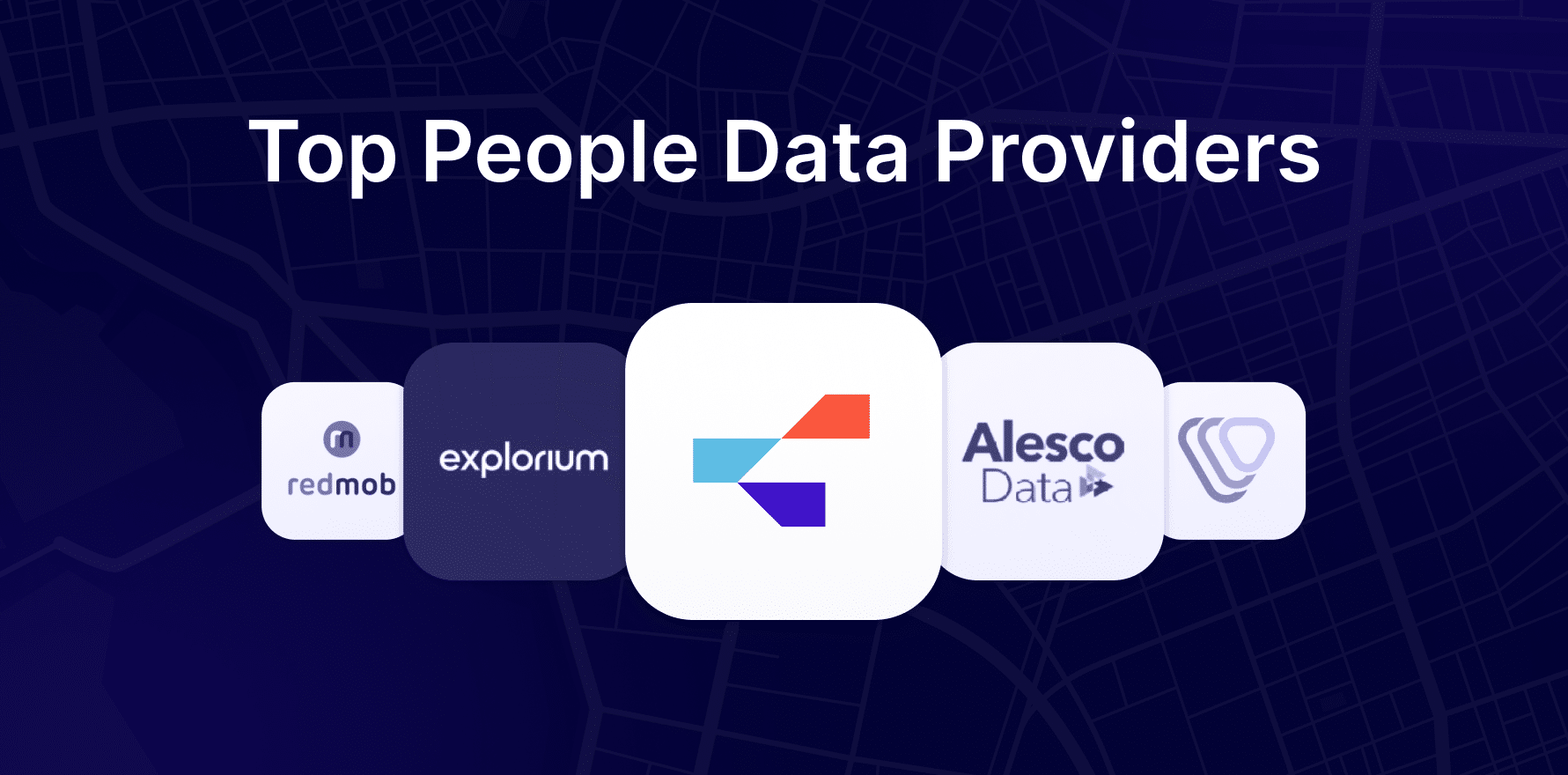
Factori is relevant when consumer People Data needs to connect with audience intelligence and broader real-world datasets. Redmob is more aligned with mobile advertising workflows. Explorium focuses on external data enrichment, Alesco Data supports consumer marketing and acquisition, and Versium provides consumer enrichment and audience tools.
The strongest provider is therefore not necessarily the company with the largest database.
Buyers should compare coverage, granularity, freshness, match quality, delivery, licensing, privacy, and interoperability against their actual use case.
Before signing a long-term data agreement, test a representative sample. Measure whether the provider improves the quality, speed, or coverage of the workflow you are trying to build.
FAQs
What is a people data provider?
A people data provider supplies structured consumer information that businesses can use for enrichment, audience analysis, segmentation, market research, targeting, and other analytical workflows.
Are people data providers and consumer data providers the same?
In many marketing, audience, and customer-intelligence use cases, the terms are used interchangeably. The important consideration is the actual data being supplied, its granularity, and how it can be used.
What should I look for in a consumer data provider?
Evaluate coverage, data granularity, freshness, match quality, integration options, permitted uses, privacy practices, and compatibility with your existing data systems.
How should I test a people data provider?
Use a representative sample of your own records or target markets. Measure match rate, required-field completion, accuracy, geographic coverage, and the amount of useful information added compared with your existing data.
How is consumer data used for audience targeting?
Consumer data can help teams define, enrich, size, and analyze target audiences. Depending on the provider and permitted use, those audiences may then support media planning, CRM workflows, market analysis, or downstream activation.