Choosing the right place to open a store is one of the most important decisions a retailer can make.
This is where retail location analysis becomes useful.
A location may look strong based on population, income, or market reports. But that does not always mean customers will actually visit the store.
Modern retail store location analysis goes beyond static demographics. It combines customer movement, nearby businesses, accessibility, trade areas, and audience characteristics to understand how a location performs in the real world.
Key Takeaway
- Retail location analysis helps retailers compare potential store locations using multiple data signals.
- Demographics alone do not show how customers actually move through or interact with an area.
- Retail store location analysis should combine foot traffic, mobility, POI, demographics, trade areas, and competition.
- Retail location data helps reveal whether demand is active around a specific site.
- Demographics for retail site selection are useful for measuring audience fit but work best alongside behavioral data.
- A retail location database can make it easier to compare stores and markets using consistent criteria.
- Fixed-radius trade areas can oversimplify where customers actually come from.
- High foot traffic does not automatically mean a strong retail site.
- A structured retail site selection guide helps teams evaluate candidate locations more consistently.
- The strongest retail site location analysis combines demand, audience fit, competition, accessibility, and real-world movement.
What Is Retail Location Analysis?
Retail location analysis is the process of evaluating potential store locations using data.
The goal is to understand whether a location can attract the right customers and support consistent demand.
A location analysis for retail store decisions usually looks at questions such as:
- Are enough people moving through the area?
- Do visitors match the target customer?
- What competitors are nearby?
- What businesses and amenities surround the site?
- How easy is the location to reach?
- How far will customers travel?
A strong retail site location analysis combines these signals instead of relying on one dataset.
Traditional Retail Analysis vs. Real-World Data Analysis
Traditional retail location analysis has often relied on static market information.
This may include demographics, income levels, population characteristics, and market surveys.
These indicators are useful because they describe the people living around a location.
However, they do not always show how people actually move through an area or where they choose to shop.
Modern retail location analysis adds behavioral signals such as movement patterns, foot traffic, and visit activity.
| Aspect | Traditional Retail Location Analysis | Real-World Data Analysis |
|---|---|---|
| Data used | Demographics, income levels, population data, market surveys | Mobility data, foot traffic, visit activity, POI data |
| Customer understanding | Shows who lives in an area | Shows how people move through and interact with an area |
| Demand measurement | Estimates demand using static market indicators | Adds behavioral signals that show real-world activity |
| Movement patterns | Limited visibility into customer movement | Shows visitor flows and high-activity areas |
| Location behavior | Focuses mainly on nearby population characteristics | Shows where people actually visit, shop, and spend time |
| Site evaluation | Based mainly on market characteristics | Combines market context with real-world customer behavior |
This shift gives retailers a clearer view of how locations actually perform.
Why Traditional Retail Location Analysis Can Fall Short
Two retail sites may have similar population, income, and demographics.
On paper, both may appear to have similar demand.
But after opening, one store may attract steady visits while the other struggles.
The difference can come from factors such as:
- How people move through nearby streets
- Whether the site fits normal travel routes
- Nearby businesses that attract or reduce traffic
- Where customers prefer to shop
- How easy the location is to access
Static data may miss these patterns.
That is why retail location data increasingly includes both demographic and behavioral signals.
Also read: Retail Store Cannibalization: Why New Store Openings Drain Sales and How to Stop It
What Data Is Used in Retail Store Location Analysis?
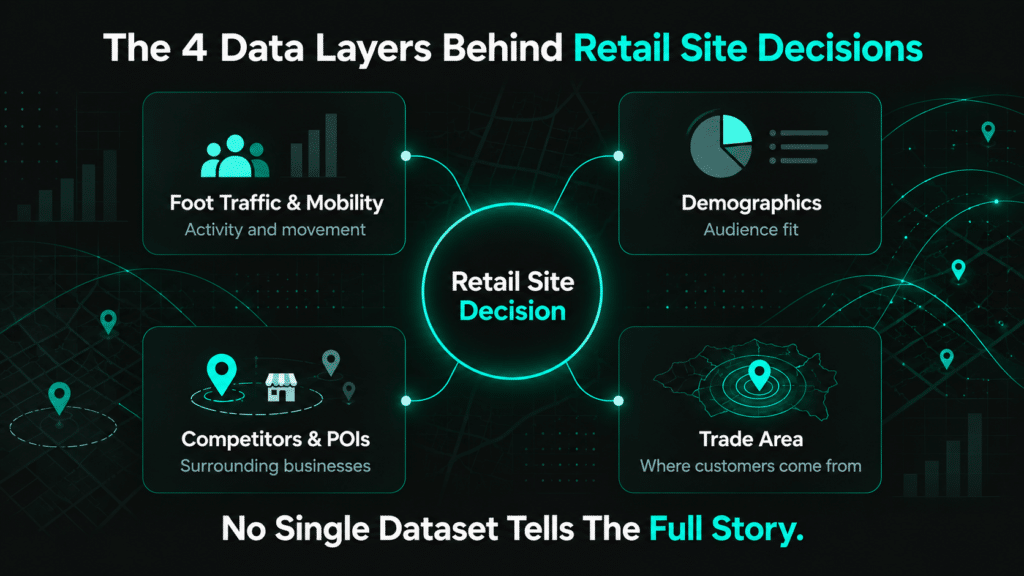
Retailers usually need several data layers to understand a location.
1. Foot Traffic and Mobility Data
Foot traffic analytics and mobility data show how people move through an area.
Retailers can use these signals to understand:
- How active a location is
- When activity peaks
- Which streets attract movement
- Whether traffic remains consistent
This helps distinguish locations that look busy from locations that regularly attract potential customers.
2. Demographics for Retail Site Selection
Demographics for retail site selection help retailers understand who lives in or visits an area.
This may include:
- Age
- Household income
- Household composition
- Population characteristics
- Spending capacity
Demographics provide valuable context.
For U.S. analysis, the American Community Survey provides regularly updated demographic, social, economic, housing, and transportation information that can help teams understand local market characteristics.
But they are stronger when combined with movement and visit data.
A location may have the right population nearby but still fail to attract that audience.
3. Competitor and POI Data
POI data shows the businesses and amenities around a potential location.
This can include:
- Competitors
- Restaurants
- Offices
- Shopping centers
- Entertainment venues
- Other retail stores
The surrounding commercial environment can influence demand.
A strong cluster of complementary businesses may attract more visitors. Too many direct competitors may indicate a crowded market.
The U.S. Census Bureau’s Census Business Builder also combines demographic, economic, geographic, and business information that can support market and competition research.
4. Trade Area and Catchment Data
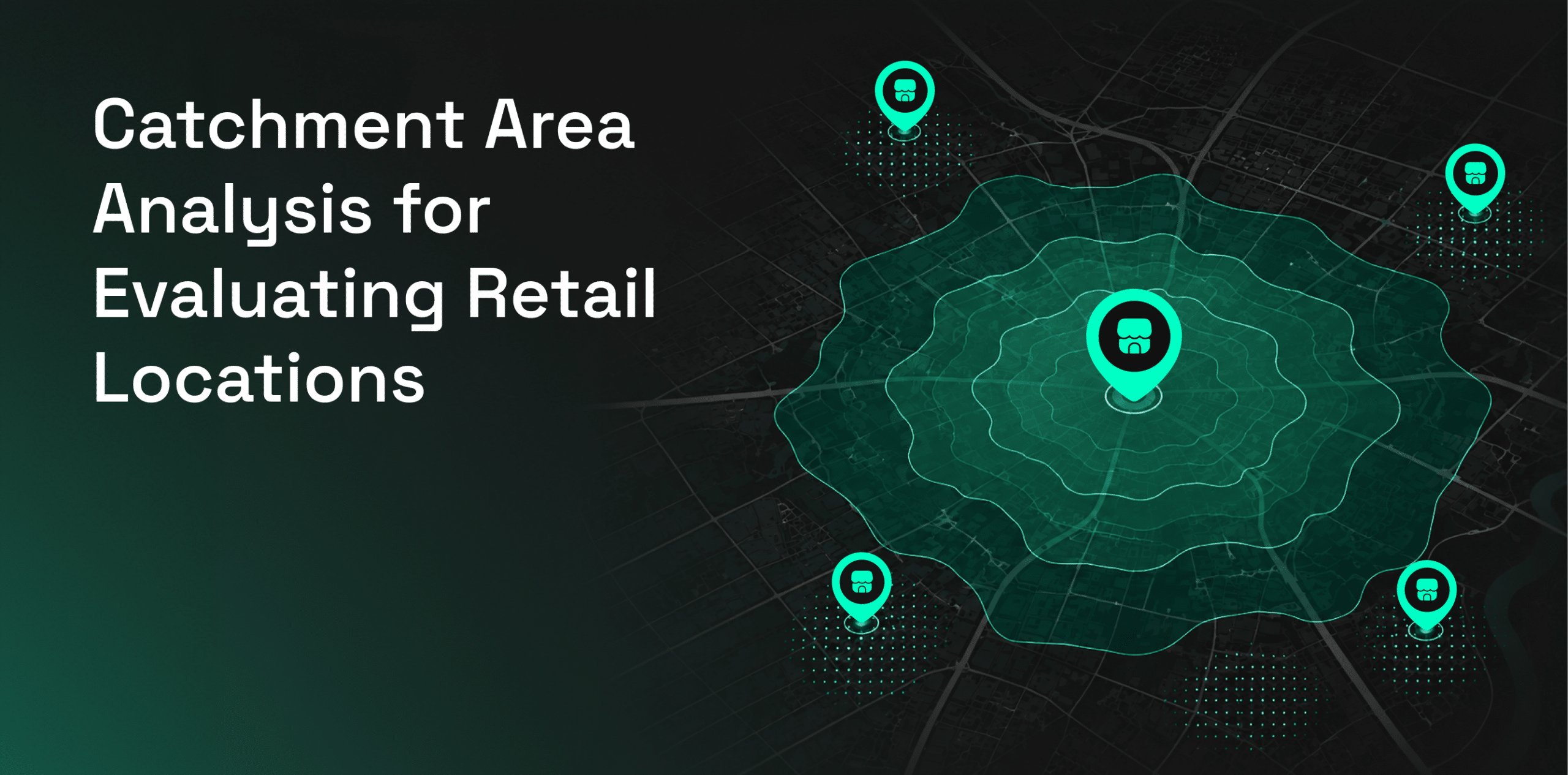
Trade area analysis shows where potential customers are likely to come from.
Instead of assuming that everyone within a fixed radius is part of the market, retailers can study actual travel patterns.
This can help answer:
- How far customers travel
- Which neighborhoods contribute visits
- Where trade areas overlap
- Whether nearby stores may compete for the same customers
This gives retailers a more realistic view of store reach.
What Is a Retail Location Database?
A retail location database brings different location-related records into one structured dataset.
Depending on the use case, it may include:
- Store locations
- Competitor locations
- POIs
- Demographic information
- Mobility signals
- Visit data
- Trade areas
- Market information
A retail location database makes it easier to compare multiple sites using the same criteria.
It can also reduce the need to evaluate each location through separate reports or systems.
Retail Site Selection Guide: A Step-by-Step Process
A structured process makes retail location analysis easier to repeat across markets.
Step 1: Define the Target Customer
Start with the customer the store is designed to serve.
Retailers may consider demographics, spending patterns, and lifestyle characteristics.
This helps narrow the search to markets where the right audience is likely to be present.
Step 2: Analyze Foot Traffic and Mobility
Next, evaluate how people move through each area.
Retail location data can show:
- Visitor volume
- Peak times
- Movement patterns
- High-activity streets
- Commercial zones
High traffic can be useful, but volume alone does not prove strong demand.
The people moving through the area also need to be relevant to the store.
Step 3: Map Trade Areas
Trade area analysis helps show where potential customers may come from.
It can reveal whether customers are likely to travel from nearby neighborhoods or from much farther away.
This step is especially useful when comparing stores that serve different types of trips.
Step 4: Evaluate Competitors
Retailers should identify both direct competitors and complementary businesses.
A competitor may reduce available demand.
A nearby restaurant, gym, office cluster, or shopping center may increase activity.
The goal is to understand the full commercial environment.
Step 5: Assess Accessibility
A strong market can still be a weak site if customers cannot reach it easily.
Retailers should consider:
- Road access
- Public transport
- Parking
- Visibility
- Travel patterns
The Federal Highway Administration notes that retail businesses often consider access to customer markets and transportation when evaluating business locations, because location and travel choices influence trip patterns.
Accessibility often influences whether nearby demand converts into store visits.
Step 6: Compare Candidate Sites
The final stage is to compare shortlisted locations using the same criteria.
A retail site location analysis may compare:
| Factor | Question |
|---|---|
| Foot traffic | Is activity high and consistent? |
| Audience fit | Are the right customers present? |
| Competition | Is the market crowded? |
| Trade area | Where will customers come from? |
| Accessibility | Can customers reach the store easily? |
| Surrounding businesses | Does the area support retail demand? |
This creates a more consistent way to prioritize locations.
Common Mistakes in Retail Location Analysis
Better data does not automatically lead to better decisions.
Several mistakes can still weaken the analysis.
Relying Only on Demographics
Strong income and population numbers do not guarantee store visits.
Retailers also need to understand movement and shopping behavior.
Using Fixed-Radius Trade Areas
Customers do not move in perfect circles around stores.
Roads, transport, work trips, competitors, and destination strength all affect how far people travel.
Looking at Foot Traffic Alone
A busy location is not automatically a strong retail location.
Retailers also need to understand who the visitors are and why they are in the area.
Overestimating Demand
One strong signal can make a site look more attractive than it really is.
Foot traffic, demographics, competition, accessibility, and customer fit should be evaluated together.
Retail store location analysis works best when no single metric is treated as the full answer.
How Factori Supports Retail Location Analysis
Factori helps retailers combine multiple types of retail location data into a clearer view of each market.
Mobility data can show how people move across neighborhoods and commercial areas.
Visit data can show which locations attract consistent activity.
Places and POI data can reveal nearby competitors, complementary businesses, offices, restaurants, and other destinations.
People data can help retailers understand whether visitors match the intended customer profile.
Together, these data layers can support:
- Retail location analysis
- Trade area analysis
- Competitor analysis
- Store comparison
- Expansion planning
- Retail site selection
This allows retailers to move from assumption-based site decisions toward a more structured approach based on real-world activity.
Conclusion
Choosing a retail location requires more than population statistics and market reports.
Demographics can explain who lives in an area. But mobility, visits, POI data, trade areas, and accessibility help explain how that market actually behaves.
A strong retail site selection process combines these signals.
This gives retailers a clearer way to compare locations, understand demand, reduce uncertainty, and identify sites with stronger potential.
FAQs
What Is Retail Location Analysis?
Retail location analysis is the process of evaluating potential store locations using data such as foot traffic, demographics, nearby businesses, accessibility, and movement patterns.
What Is Retail Store Location Analysis?
Retail store location analysis focuses specifically on determining whether a site can attract the right customers and support long-term store performance.
It combines market, customer, movement, competition, and accessibility data.
What Data Is Used for Retail Site Selection?
Common retail location data includes mobility data, visit data, POI data, demographic data, competitor information, trade areas, and market data.
Why Are Demographics Important for Retail Site Selection?
Demographics for retail site selection help retailers understand population characteristics such as age, income, and household composition.
They help measure audience fit but should be combined with behavioral data to understand whether those customers actually visit the area.
What Is a Retail Location Database?
A retail location database is a structured collection of store, competitor, POI, demographic, mobility, visit, and market information used to compare and analyze retail locations.