
A blank area on a retail network map can look like an obvious expansion opportunity. No store, limited competition, good demographics. But some markets are empty because demand is weak, nearby locations already serve the area, or the economics cannot support another unit.
Retail white space analysis should therefore do more than identify geographic gaps. It should determine whether enough incremental, capturable demand exists outside effective network coverage to support profitable expansion.
Key Takeaway
- Retail white space analysis should identify underserved demand, not simply areas where stores are absent.
- A genuine expansion opportunity needs to pass four tests: demand, coverage, incrementality, and economics.
- Effective network coverage should reflect real trade areas, visitor origins, accessibility, and customer movement rather than fixed radii.
- Population alone does not prove opportunity; retailers also need behavioral demand, competitive context, accessibility, and brand fit.
- A new store can perform well individually while adding little network growth if it mainly redistributes customers from existing locations.
- Strong white space analysis should estimate how much additional capacity a market can support, not just whether an opportunity exists.
- White space models should be validated against actual openings, network lift, false positives, and performance across unseen markets.
- White space should be recalculated as demand, competitors, accessibility, trade areas, and local market conditions change.
An Empty Market Is Only a White-Space Candidate
White space analysis happens before site selection. The first question is not which property to lease. It is whether the market deserves another unit at all.
A useful market should pass four tests:
Demand: Is enough relevant demand present?
Coverage: Is that demand genuinely underserved by the existing network?
Incrementality: Would another store add new network demand rather than redistribute existing customers?
Economics: Can the market support the required store format and return?
A market that fails one of these tests may look empty without being true white space.
Separate True White Space From False Gaps
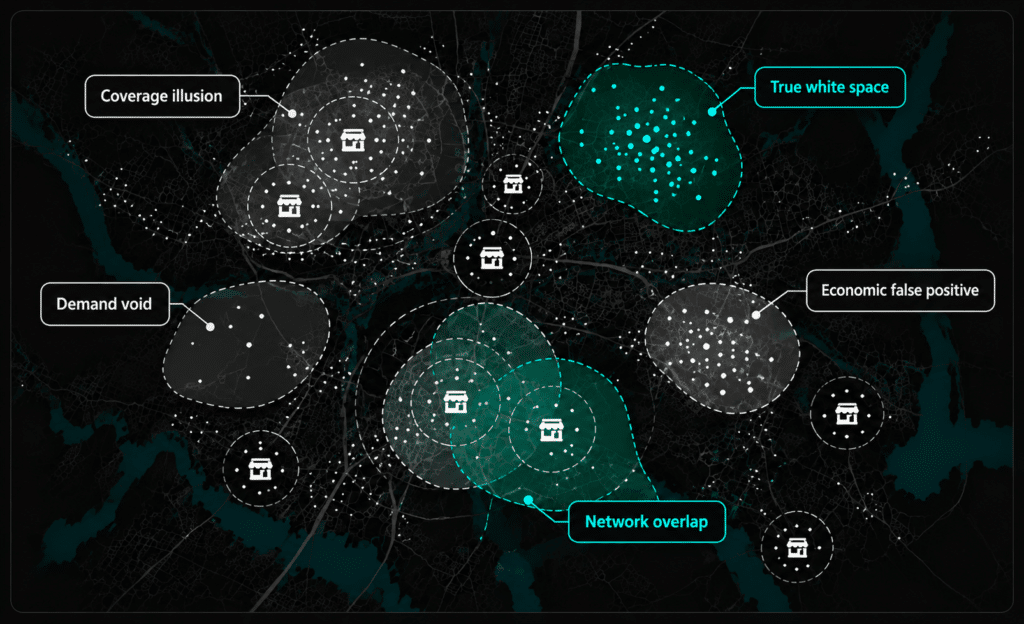
Not every gap on a map means the same thing.
| Market condition | What the map may show | What is actually happening |
| True white space | Few stores | Relevant demand exists and remains underserved |
| Demand void | Few stores | There is not enough demand to support expansion |
| Coverage illusion | No local store | Nearby locations already reach the market |
| Competitive gap | Few direct competitors | Alternatives may already satisfy category demand |
| Network overlap | Space between stores | A new unit would largely serve existing customers |
| Economic false positive | Strong demand | Rent, labor, format, or operating economics do not work |
This distinction matters because traditional gap maps often measure where stores are absent, while expansion teams need to measure where demand is insufficiently served.
That difference turns white space analysis from a mapping exercise into a network-planning problem.
Measure Effective Coverage Before Looking for Gaps
A retailer does not lose coverage the moment a customer crosses a ZIP code or a five-mile radius.
Existing stores can draw visitors across administrative boundaries, highways, suburbs, and neighboring markets. Effective network coverage therefore needs to reflect actual customer behavior.
Useful inputs include:
- observed trade areas
- visitor origins
- drive times
- physical barriers
- customer movement
- catchment overlap
- channel coverage such as delivery or pickup
This is where trade area analysis becomes important. Instead of assuming every store serves a fixed ring, retailers can examine where visitors actually originate and where store influence begins to weaken.
A market may contain no store and still be well covered by nearby locations.
The reverse is also possible. A retailer may technically operate in a market while large pockets of relevant demand remain difficult to reach.
True white space begins outside effective coverage, not simply between store pins.
Prove That the Demand Is Present and Capturable
Once coverage is understood, the next question is whether enough relevant demand remains.
Raw population alone is not enough. A large market can still be a poor fit if category demand, customer profile, accessibility, or the competitive environment is weak.
A stronger analysis combines several layers.
Structural demand can include population, household growth, employment, income, and development. Sources such as the U.S. Census Bureau’s American Community Survey can help establish population and household characteristics, while the Bureau of Labor Statistics provides employment data that can help evaluate local economic activity.
Behavioral demand can include visitation, category activity, visitor origins, repeat behavior, and cross-shopping.
Market context can include competitors, complementary businesses, retail clusters, accessibility, and surrounding place density.
Foot traffic analytics can help distinguish markets that merely contain people from markets where real-world activity supports the expansion hypothesis.
Retailers can also compare candidate markets with successful existing locations using retail location analysis. But this should not become a simple “clone our best stores” exercise. Existing networks reflect past expansion choices, so relying too heavily on historical store profiles can hide new formats, customer segments, or market types.
The test is whether the demand is both present and realistically capturable.
Do Not Confuse White Space With Headroom or Site Selection
Several location-strategy questions can look similar but require different analysis.
White space asks whether valuable demand exists outside effective network coverage.
Market headroom asks whether a market that already contains stores can support additional units.
Retail void analysis asks whether a category, tenant, or format is missing from a trade area.
Site selection begins after the market opportunity has been established and focuses on choosing a specific location.
This separation matters because a strong white-space market can still contain poor individual sites. Likewise, a strong available property does not make a weak market attractive.
White space analysis should therefore sit upstream of property-level site evaluation. It identifies where expansion deserves attention before real estate teams spend time comparing individual parcels or leases.
Test Whether Expansion Creates Incremental Network Growth
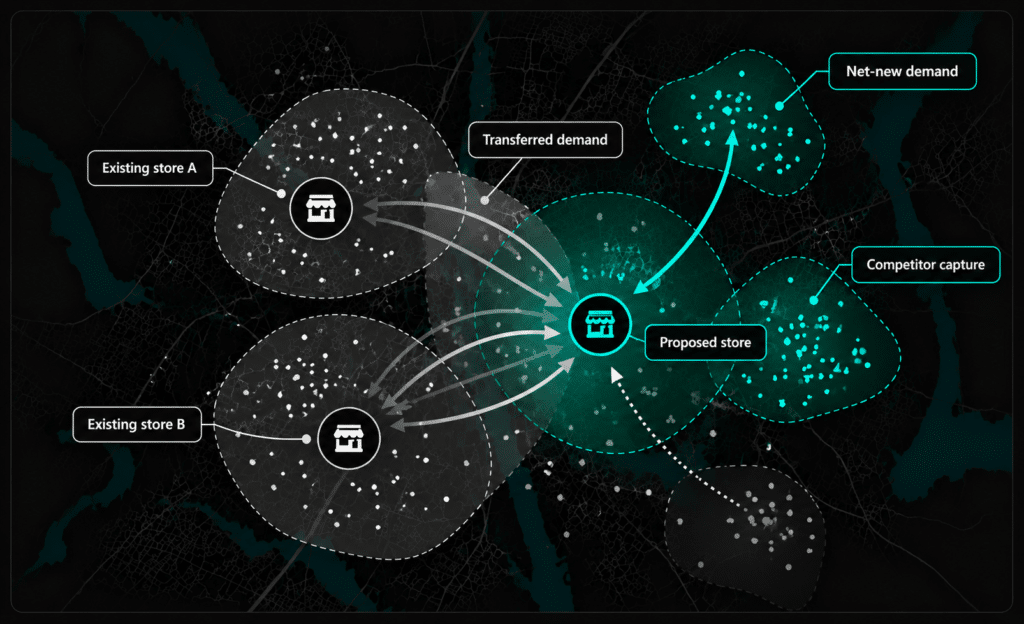
A new location can perform well individually while adding little to the overall network.
Suppose a proposed store attracts significant traffic after opening. If most of those customers previously visited another location in the same chain, the store-level result can look stronger than the network-level result.
That is why white space analysis should test:
- trade-area overlap
- shared visitor origins
- cross-shopping between existing locations
- customer transfer risk
- competitor capture opportunity
- demand currently outside the network
This connects directly to retail store cannibalization.
The important distinction is:
A strong new-store forecast does not automatically mean strong incremental network growth.
Senior expansion teams therefore need to evaluate both the candidate store and the effect of adding it to the existing estate.
Estimate Market Capacity, Not Just Opportunity
Once a market passes the demand, coverage, and incrementality tests, the question changes.
Instead of asking:
“Is there white space here?”
ask:
“How much capacity can this market support?”
A market might support one full-format location, several smaller formats, or no additional units after overlap is considered.
Capacity can depend on:
- total capturable demand
- competitive intensity
- expected trade-area size
- store format
- unit economics
- accessibility
- existing network coverage
- future population and market growth
This is where white space analysis becomes a capital-allocation tool rather than a heatmap.
A high-opportunity market should ultimately produce a view of supportable capacity and rollout priority, not merely a highlighted polygon.
Validate the White-Space Model Before Scaling
A sophisticated map is not proof that the underlying model works.
Retailers should backtest white-space models against known outcomes, including successful openings, weak openings, mature stores, recent expansion markets, and locations affected by competitor openings or closures.
Evaluate several dimensions:
Ranking lift: Do higher-scoring markets consistently outperform lower-scoring ones?
Calibration: Does predicted market capacity resemble the number of stores the market actually supports?
False positives: How often does the model identify apparently attractive gaps that later underperform?
Network lift: Do openings add new demand, or mainly redistribute existing demand?
Stability: Do the relationships hold across regions, store formats, and time periods?
The strongest validation happens on markets the model has not already seen.
This prevents teams from building white-space strategies that explain the current network perfectly but fail when applied to new geographies.
Recalculate White Space as Markets Change
White space is not permanent.
Competitors open and close. Housing expands. Employment shifts. New roads and transit change accessibility. Retail clusters emerge. Customer origins and trade areas move.
White-space analysis should therefore be refreshed as the underlying market changes rather than treated as a static annual map.
The goal is an evolving expansion pipeline where markets can move up or down as demand, coverage, competition, and economics change.
How Factori Supports Retail White Space Analysis
Factori provides real-world data across places, mobility, visits, people, audiences, and market context.
Retail teams can use these signals to evaluate whether an apparent geographic gap contains real activity, understand visitor origins and trade areas, measure surrounding competition and commercial context, and test how a candidate market interacts with the existing network.
The objective is not simply to identify empty areas. It is to add real-world evidence to the decision about whether those areas represent genuine growth opportunities.
Conclusion
An empty market is not automatically retail white space.
True white space exists when relevant demand is present, current network coverage is insufficient, a new location can add incremental demand, and the economics support expansion.
That means the strongest white-space analysis does not ask only where the retailer has no stores. It asks where the network can add capacity without simply shifting existing demand or entering a market that looks better on a map than it performs in reality.
FAQs
What is retail white space analysis?
Retail white space analysis identifies markets where relevant customer demand exists but is not adequately served by a retailer’s current network or competitors, and where additional capacity may be economically viable.
How can retailers tell whether an empty market has real demand?
Retailers can combine demographics with accessibility, category activity, visitation, competitor performance, visitor origins, trade areas, and existing network coverage. The strongest opportunity is demand that is both measurable and realistically capturable.
What is the difference between white space analysis and site selection?
White space analysis identifies which markets or corridors deserve expansion. Site selection comes later and evaluates the specific properties available within those priority markets.