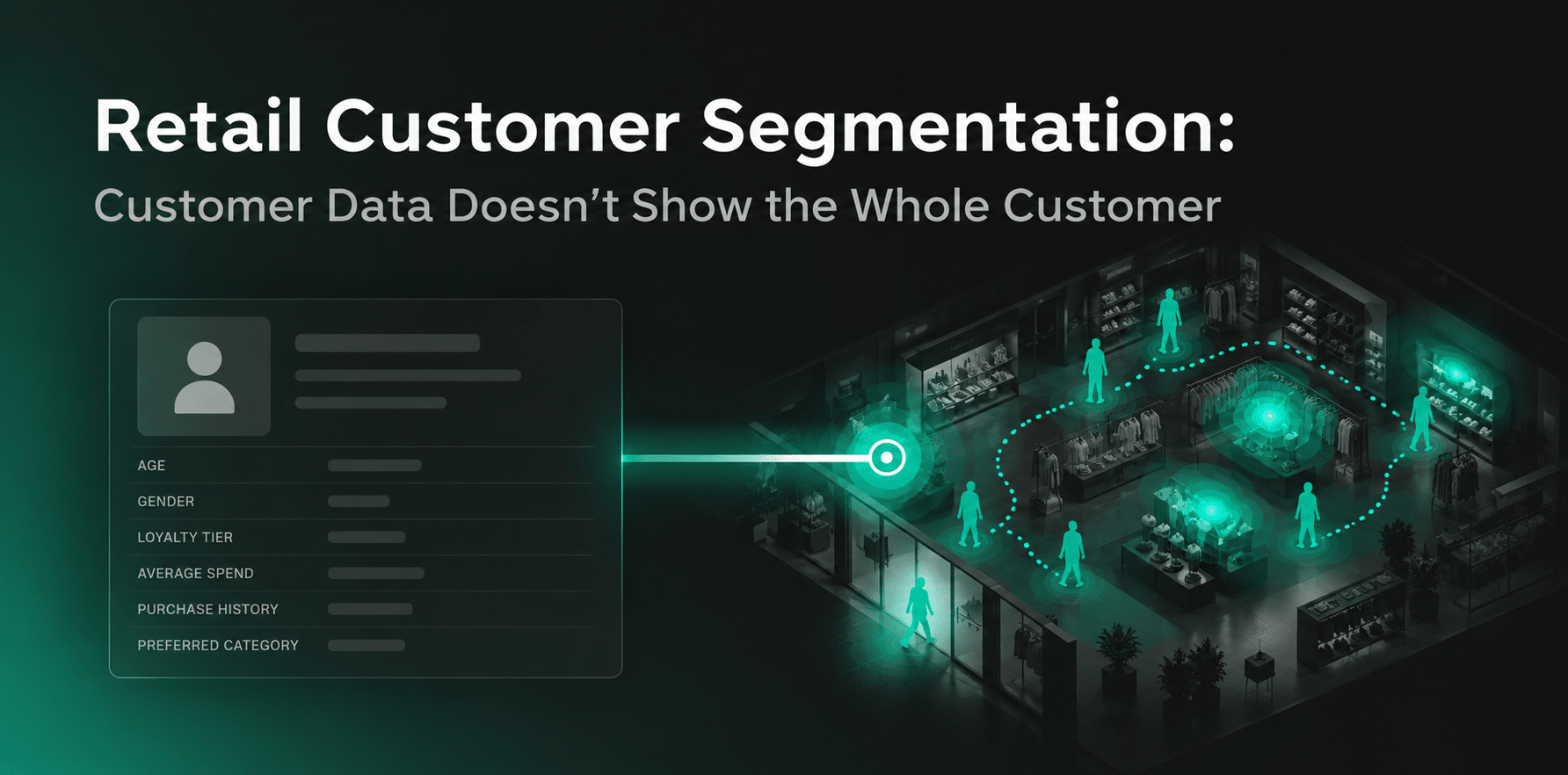
Retailers know a lot about their customers. CRM systems show profiles and loyalty status. Transactions show spend, frequency, and category preferences. Apps and websites show clicks, searches, and engagement.
But those systems mostly describe customers through their relationship with the retailer. They may not show who visits without buying, where customers come from, which other places they visit, or how customer behavior differs across stores and markets.
Retail customer segmentation becomes more useful when it connects known customer data with broader behavioral, geographic, and real-world context.
Key Takeaway
Retailers Often Segment the Customers They Can See
Retail customer segmentation groups customers into meaningful categories based on value, behavior, demographics, geography, preferences, or other characteristics so the retailer can make different decisions for each group.
A common starting point is transaction and loyalty data.
That can produce useful segments such as:
- high-value customers
- loyal shoppers
- new customers
- discount-sensitive customers
- inactive or at-risk customers
These groups matter. But they represent customers the retailer can identify through purchases, CRM records, loyalty programs, or digital interactions.
They may not represent everyone interacting with the physical retail network.
A retailer may also need to understand:
- visitors who did not purchase
- shoppers outside the loyalty program
- customers who regularly visit competing brands
- people traveling into a store from outside the local area
- differences between customers across store trade areas
That is where segmentation needs to move beyond customer records alone.
Not Every Retail Segment Answers the Same Question
Different segmentation methods solve different problems.
| Segmentation approach | Main question | Retail example |
| RFM / value | Who matters most commercially? | Loyal, high-value, at-risk |
| Behavioral | How do they shop? | Category, frequency, channel |
| Demographic | Who are they? | Age, income, household |
| Geographic | Where are they? | Market, trade area, proximity |
| Psychographic | What may matter to them? | Value, convenience, wellness |
| Intent | What might they do next? | Category or purchase propensity |
RFM remains useful because recency, frequency, and monetary value provide a simple view of customer value.
But RFM does not explain everything.
Two customers can have the same spend and purchase frequency while behaving very differently across channels, categories, stores, and promotions.
Retailers should therefore treat RFM as one layer of segmentation rather than the complete customer view.
Separate Who Buys, Who Visits, and Who Lives Nearby
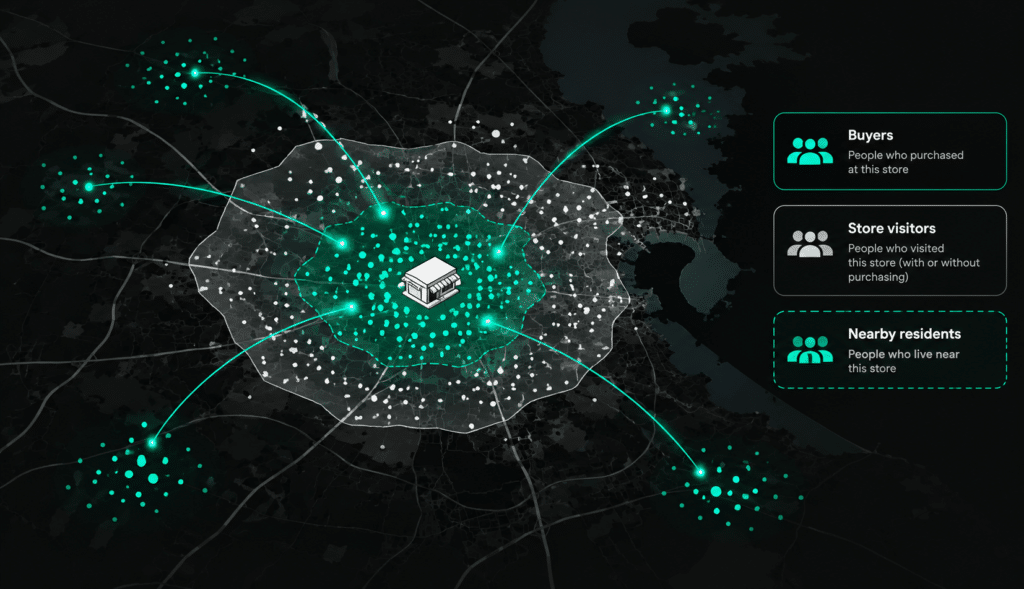
For physical retail, three populations are often treated as if they are the same.
They are not.
Buyers are customers visible through transactions, loyalty systems, or CRM records.
Visitors are people who physically interact with the store, whether or not they buy.
Residents are people who live within the surrounding geography.
A store may sit inside an affluent residential area but attract customers from much farther away. Another may serve commuters, tourists, workers, or visitors who barely appear in the surrounding residential profile.
This is why a trade-area demographic profile is not automatically a customer profile.
Trade area analysis can help retailers understand where actual visitors originate, while foot traffic analytics can show how visitation changes across stores, days, and markets.
The important question is not only:
Who lives nearby?
It is:
Who actually comes, where do they come from, and how does their behavior differ?
Combine Customer Value With Shopping Behavior
Customer value becomes more actionable when it is combined with the way customers shop.
Consider two high-value customers.
Customer A
- shops every month
- prefers physical stores
- buys premium categories
- rarely uses discounts
Customer B
- buys mainly during promotions
- prefers online channels
- frequently shops outlet locations
- shows higher price sensitivity
A simple value segment may classify both as VIP customers.
But treating them identically could weaken the decision.
Retailers can enrich value-based segments with:
- category preference
- store preference
- channel usage
- visit frequency
- promotion response
- cross-shopping
- trip patterns
- brand affinity
That produces segments that are more useful for merchandising, loyalty, pricing, and communication.
Retail Segmentation Should Change More Than Marketing
Customer segmentation is often discussed as a targeting tactic.
Its value is broader.
| Retail decision | What segmentation can change |
| Retention | Who receives win-back investment |
| Merchandising | Which categories or brands fit each group |
| Promotions | Who needs discounts versus other incentives |
| Loyalty | Which benefits improve engagement |
| Store operations | Which groups dominate particular stores |
| Local marketing | Which audiences matter around each location |
| Expansion | Where target customer groups are concentrated |
For example, one group may respond strongly to price promotions, while another values early access or convenience.
A retailer should not automatically send both groups the same offer simply because their historical spend is similar.
The segment becomes useful when it changes the action.
Segment Stores as Well as Customers
Large retail networks rarely have one national customer mix.
Store A may over-index toward commuters and frequent local shoppers.
Store B may attract tourists and occasional visitors.
Store C may operate as a destination location drawing customers from a much wider catchment.
This means customer segmentation can also be analyzed geographically.
Retail location analysis can help connect customer and visitor behavior with the characteristics of individual stores and markets.
Retailers can then ask:
- Does the same customer segment behave differently across markets?
- Which stores attract more premium customers?
- Where are value-oriented customers concentrated?
- Which locations attract destination shoppers rather than local residents?
- Which stores need different assortment or local media strategies?
This turns customer segmentation into a store and market strategy tool rather than only a CRM exercise.
A Customer Segment Must Be Different Enough to Change the Decision
More segments do not automatically produce better segmentation.
A useful retail segment should pass several tests.
Distinctiveness: Does the segment behave differently from others?
Actionability: Can the retailer take a different action?
Scale: Is the group large enough to matter?
Stability: Does the segment remain meaningful over time?
Incremental value: Does using the segment improve the outcome versus a simpler approach?
For example, compare:
Baseline
RFM or simple behavioral segmentation
with
Enriched segmentation
RFM + channel behavior + geography + interests + visitation context
Then measure:
- conversion
- repeat purchase
- retention
- basket value
- category penetration
- visits
- campaign response
- customer lifetime value
The test is straightforward:
Different customer → Different behavior → Different action
If the segment does not change the decision, it may not need to exist.
Avoid Common Retail Customer Segmentation Mistakes
Treating loyalty members as the entire market. Loyalty and CRM systems may represent only part of the people interacting with stores.
Over-segmenting. Twenty customer groups do not help if the business only has four different actions available.
Using static segments. Customers move between new, loyal, at-risk, and inactive states as behavior changes.
Confusing behavior with motivation. Buying premium products does not prove whether the customer values quality, status, durability, or convenience. This is where psychographic segmentation can add another layer when the distinction matters.
Keep Segmentation Dynamic
Retail customer behavior changes constantly.
Customers switch channels, visit different stores, enter new life stages, respond differently to promotions, and move between categories.
Segmentation should therefore include:
- refresh cadence
- membership rules
- segment migration
- minimum segment size
- performance thresholds
- versioning
- retirement rules
A customer who qualified as highly engaged six months ago may no longer belong in that group today.
Segmentation should reflect current behavior rather than preserve an outdated snapshot.
How Factori Supports Retail Customer Segmentation
Factori provides real-world data across People, Audiences, Places, Mobility, and visitation that can add external context to CRM, loyalty, transaction, and digital behavior data.
Retailers can use these signals to examine interests, audience characteristics, brand visitation, geographic context, and how customer groups behave across physical markets.
The goal is not to replace first-party customer data. It is to test whether customer groups differ beyond purchase history and whether those differences improve retail decisions.
Conclusion
Retail customer segmentation should not stop at labels such as loyal, high-value, or at-risk.
Those groups are useful starting points, but retailers also need to understand how customers behave across stores, channels, categories, markets, and the wider physical world.
The strongest customer segments reveal a meaningful difference in behavior and give the retailer a reason to make a different decision.
If the action does not change, the segment may not be adding much value.
FAQs
What is retail customer segmentation?
Retail customer segmentation groups customers based on factors such as value, behavior, demographics, geography, preferences, or intent so retailers can make more relevant decisions for each group.
What data should retailers use for customer segmentation?
Retailers can combine CRM, loyalty, transaction, website, app, demographic, geographic, behavioral, audience, visitation, and intent data depending on the decision they are trying to improve.
How can retailers tell whether a customer segment is useful?
A useful segment should be meaningfully different, large enough to matter, actionable, stable enough for the decision, and able to improve an outcome such as retention, conversion, visits, basket value, or customer lifetime value.