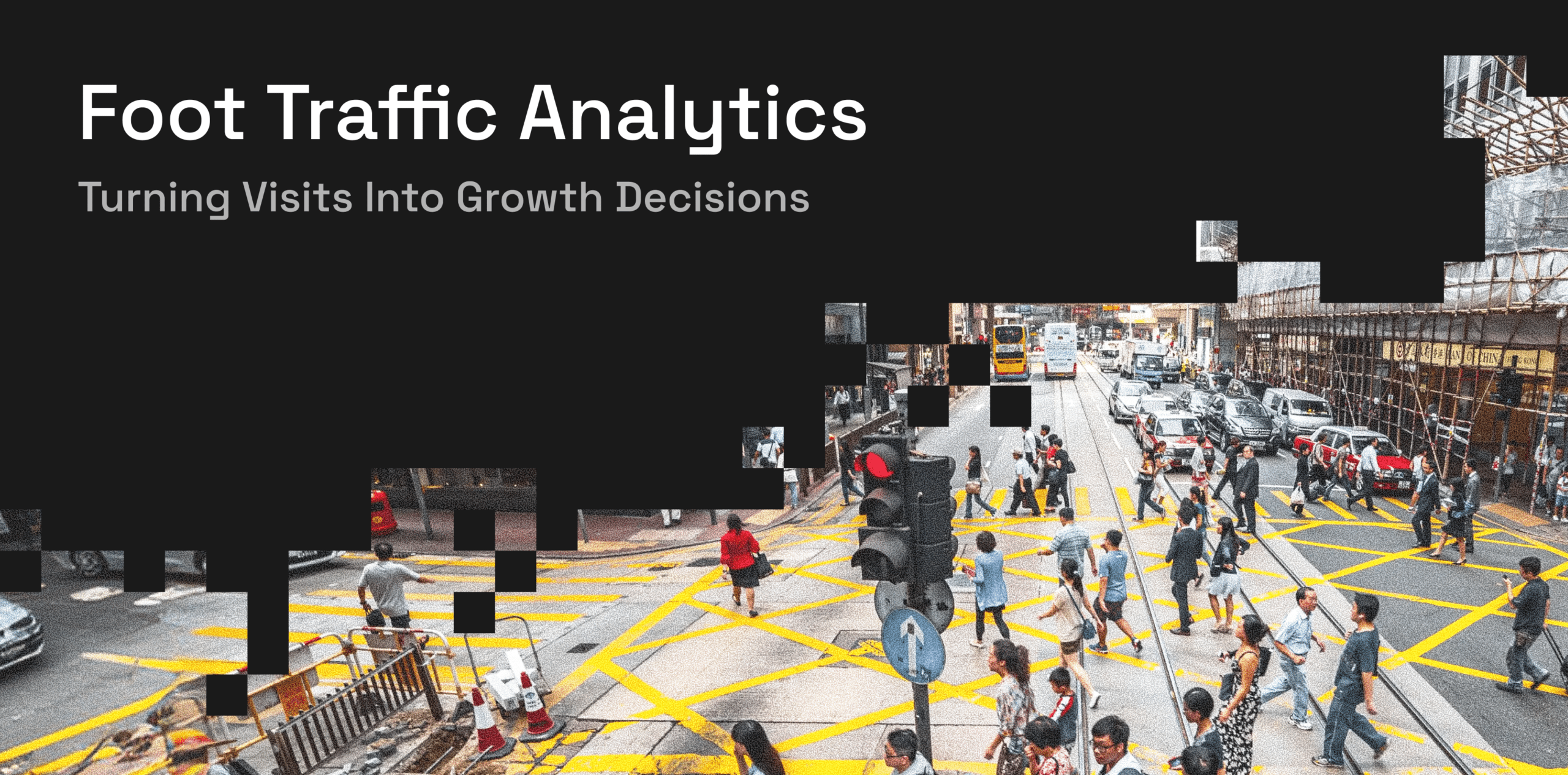
Foot traffic analytics helps businesses understand how people interact with physical locations.
It shows how many visits a site receives, when activity peaks, how often visitors return, and how patterns change over time.
A basic foot traffic count provides one number. Foot traffic data analysis adds context about demand, loyalty, trade areas, competitor overlap, and campaign impact. These foot traffic insights support expansion, marketing, operations, and forecasting.
What Is Foot Traffic Analytics?
Foot traffic analytics is the process of measuring and analyzing visits to physical locations.
It helps businesses understand visitor volume, timing, frequency, dwell time, and movement between places. Footfall analytics, footfall traffic analytics, and footfall data analysis describe similar work.
Foot traffic data and footfall data can help answer:
- Which locations attract the most demand?
- When are stores busiest?
- How often do visitors return?
- Where do visitors come from?
- Which competitors attract the same audience?
- Did a campaign lead to more visits?
A retailer may use retail foot traffic analysis to compare stores. A restaurant group may study repeat visits. A real estate team may use a foot traffic study to identify areas with growing activity.
The goal is not only to measure foot traffic. It is to understand what visitor activity means for performance.
How Is Foot Traffic Measured?
Businesses asking how to measure foot traffic usually combine several data sources.
Mobility Data and Visit Intelligence
Mobility data shows how people move between places.
It can reveal visitor origins, trade areas, visit patterns, and changes across locations. Visit intelligence adds detail about specific stores, restaurants, malls, branches, or venues.
Aggregated consumer foot traffic data can help teams compare locations without identifying individual visitors.
In-Store Sensors and Counters
Cameras, infrared counters, Wi-Fi sensors, and similar tools can record entrances and exits.
They support foot traffic measurement and store-level foot traffic monitoring. However, they usually do not show where visitors came from or which other locations they use.
POS and Customer Data
Point-of-sale data shows what customers buy after entering a location.
When sales are compared with footfall traffic data, businesses can study conversion. Loyalty and CRM data can add context about repeat visits and retention.
How to Get Foot Traffic Data
Businesses exploring how to get foot traffic data or how to find foot traffic data can use mobility providers, visit-intelligence platforms, in-store counters, POS systems, or customer databases.
On-site counters work well for entrance volume. Mobility and visit data are more useful for trade areas, competitor comparisons, and movement patterns. POS data connects visits with sales.
Key Foot Traffic Metrics
Foot traffic statistics should show more than total visits.
| Metric | What It Measures | Why It Matters |
|---|---|---|
| Visit volume | Total visits | Shows overall activity |
| Unique visitors | Distinct visitors | Shows audience reach |
| Visit frequency | Repeat visitation | Indicates loyalty |
| Dwell time | Time spent at a location | Adds engagement context |
| Peak visit times | Busiest periods | Supports staffing and operations |
| Trade area | Visitor origins | Shows market reach |
| Cross-shopping | Other places visitors use | Adds competitive context |
Foot traffic trends become more useful when teams compare several measures over time.
For example, rising visits with falling repeat frequency may mean a location is attracting more one-time traffic but not building loyalty.
How Businesses Use Foot Traffic Analytics
Retail Performance Analysis
Retailers use foot traffic analytics to compare stores and explain performance differences.
One store may be losing visitors. Another may attract strong traffic but convert poorly. A third may have lower traffic but a healthier repeat-visitor base.
Retail foot traffic analysis helps separate market problems from store execution problems.
Site Selection and Expansion
Foot traffic analysis for site selection helps businesses compare candidate locations using observed demand instead of population or visibility alone.
Footfall site analytics can show nearby activity, trade area reach, competitors, and surrounding points of interest.
This reduces the risk of opening in a location that looks attractive on paper but lacks relevant demand.
Trade Area Analysis
Trade area analysis shows where visitors come from.
Fixed-radius maps assume customers travel evenly. Real trade areas are shaped by roads, transport, barriers, competitors, and existing movement patterns.
Marketing Measurement
Foot traffic marketing measurement connects campaign activity with real-world visits.
For campaign tracking, foot traffic metrics can show whether visits increased, which stores responded, and whether the change came from new or returning visitors.
Useful measures include store-visit lift, pre- and post-campaign traffic, and location-level response.
Competitive Benchmarking
Foot traffic intelligence helps businesses compare their locations with competitors.
Teams can study visit volume, growth, loyalty, trade areas, and customer overlap. Ongoing foot traffic monitoring can show whether demand is shifting between brands.
Demand Forecasting and Planning
For demand forecasting, foot traffic can act as an early signal.
Changes in visits may appear before changes in sales. Combined with sales, inventory, customer, and market data, visit trends can support staffing, replenishment, and local demand planning.
Common Challenges in Foot Traffic Data Analysis
Foot traffic data for business decisions must be interpreted carefully.
Looking Only at Total Visits
A high foot traffic count does not always mean strong commercial performance. Repeat visits, dwell time, customer fit, and conversion add needed context.
Comparing Locations Without Context
A city-center store, suburban store, and destination location may have very different patterns. Comparisons should account for location type, trade area, and operating hours.
Treating Foot Traffic as the Only Source
The strongest decisions combine foot traffic data with sales, customer, audience, market, and POI data.
Ignoring Data Quality and Privacy
Coverage, freshness, location accuracy, and measurement methods can affect results. Businesses should also choose providers that use aggregated, privacy-aware practices.
Turning Foot Traffic Data Into Business Outcomes
| Business Goal | How Foot Traffic Analytics Helps |
|---|---|
| Increase sales | Find locations with strong or underused demand |
| Improve marketing ROI | Measure visit changes after campaigns |
| Select new sites | Compare real activity before expansion |
| Improve operations | Align staffing and inventory with visit patterns |
| Forecast demand | Monitor early changes in local activity |
The value of foot traffic analytics comes from connecting visitor activity to a decision.
A foot traffic number is descriptive. Foot traffic data analysis becomes useful when it changes where a business invests, how it operates, or how it measures performance.
How Factori Helps Businesses Use Foot Traffic Analytics
Factori helps businesses understand location performance through Mobility Data, Visit Intelligence, POI Data, and Audience Data.
Organizations can use Factori to evaluate locations, understand trade areas, benchmark competitors, identify demand patterns, and support site selection.
Factori datasets, APIs, and platform workflows can also support marketing measurement, forecasting, market intelligence, and operational planning.
By connecting people, places, and movement data, Factori helps teams turn foot traffic data into clearer business decisions.
Conclusion
Foot traffic analytics helps businesses understand how locations perform, where demand is changing, and how visitor behavior differs across markets.
The goal is not simply measuring footfall traffic. It is understanding what visits mean for sales, loyalty, marketing, operations, and growth.
When foot traffic data is combined with sales, customer, audience, market, and POI data, it becomes a stronger source of location intelligence.
FAQs
What Is Foot Traffic Analytics?
Foot traffic analytics is the process of measuring and analyzing visits to physical locations.
It helps businesses understand visitor activity, demand, location performance, and change over time.
How Do You Measure Foot Traffic?
Businesses measure foot traffic using mobility data, visit intelligence, in-store sensors, counters, POS data, and customer records.
How Can Businesses Find Foot Traffic Data?
Businesses can get foot traffic data from mobility providers, visit-intelligence platforms, in-store sensors, or their own POS and customer systems.
The best source depends on whether the goal is counting entrances, studying trade areas, comparing competitors, or measuring campaigns.
How Does Foot Traffic Analysis Support Site Selection?
Foot traffic analysis for site selection helps businesses evaluate demand, visitor patterns, trade areas, competitors, and nearby points of interest before investing.
Which Industries Use Foot Traffic Analytics?
Retail, restaurants, real estate, banking, hospitality, entertainment, and other location-based industries use foot traffic analytics to improve decisions.