Seasonal campaigns often start with the calendar.
Halloween approaches, so marketers launch costume campaigns, promote candy and décor, build themed audiences, and increase media spend.
But the date alone does not tell you who is actually entering the market.
Seasonal demand starts at different times for different people, places, and categories. Real world audience data can help marketers move beyond a generic “Halloween shopper” and identify audiences based on who they are, where they are, what they engage with, and how their behavior changes as the season develops.
Key Takeaway
- Halloween has expanded into a longer shopping season, with 49% of U.S. consumers beginning purchases in September or earlier in 2026.
- Different seasonal products and activities attract different audiences, so one broad “Halloween shopper” segment may hide meaningful differences.
- Demographic data can become more useful when combined with interests, household characteristics, geography, aggregated visitation, and other relevant audience signals.
- Modeled or inferred financial and lifestyle attributes should be treated as contextual indicators rather than verified individual facts.
- Real-world behavior can provide context about where seasonal activity is developing before a transaction occurs.
- Seasonal audience definitions should evolve as campaigns move from early planning to higher-intent and last-minute periods.
- Addressable reach should be evaluated through privacy-safe and permissioned activation workflows rather than individual-level tracking.
- Resident and visitor audiences can reveal different opportunities for local and destination-based seasonal campaigns.
- Audience Studio can help teams build, inspect, size, and activate privacy-safe seasonal audiences using People Data and aggregated real-world visitation.
Seasonal Campaigns Have a Timing and Audience Problem
Halloween is no longer limited to the final week of October.
According to the National Retail Federation, U.S. consumers are expected to spend $13.5 billion on Halloween in 2026, with 74% planning to celebrate. About 49% say they begin shopping in September or earlier.
That early shopping behavior has changed significantly over time. In 2016, 34% of consumers started before October. By 2026, that figure had risen to 49%.
Participation also takes different forms. In 2026, 61% plan to hand out candy, 50% plan to dress in costume, and 42% plan to decorate their home or yard.
That creates two problems for marketers.
First, not everyone enters the seasonal buying cycle at the same time.
Second, not everyone participates in Halloween the same way.
A household buying costumes for children is different from a young adult planning a party. Someone visiting seasonal attractions may require different messaging from a homeowner buying decorations.
A single seasonal segment can hide those differences.
Build Seasonal Audiences From More Than Demographics
Basic seasonal targeting often starts with age, location, household composition, or other broad characteristics.
Those attributes are useful, but they do not always explain seasonal behavior.
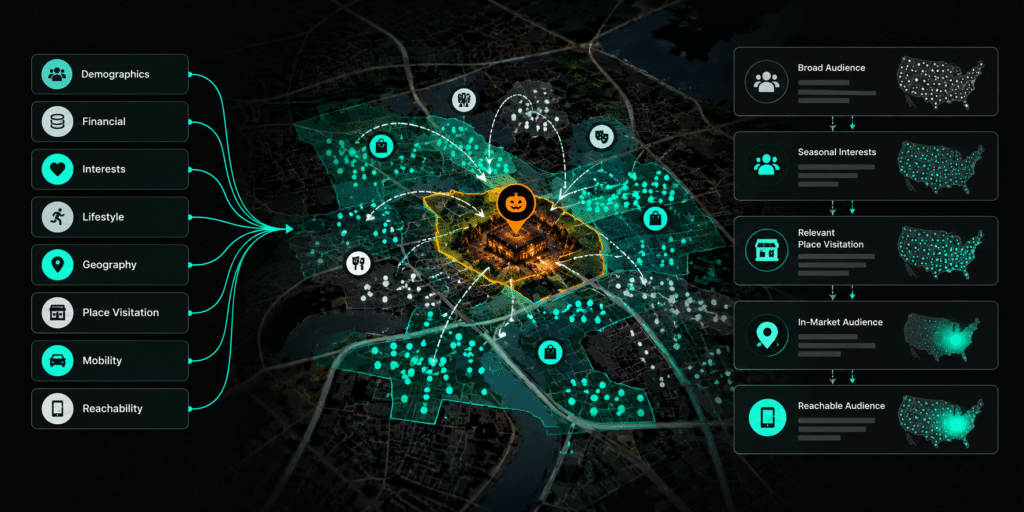
A stronger seasonal audience can combine several types of data.
| Data layer | What it can add to a seasonal campaign |
| Demographics | Age, household, family composition |
| Financial / economic indicators | Modeled or inferred signals such as income bands or spending capacity that can add context where appropriate |
| Interests | Entertainment, beauty, gaming, food, home décor |
| Lifestyle | Activities and broader preferences |
| Geography | Where the audience lives |
| Place visitation | The types of destinations people visit |
| Mobility | How audiences move across markets |
| Reachability | Whether the audience can be activated through available channels |
These attributes should be used carefully. Some financial, lifestyle, and behavioral signals may be modeled or inferred rather than directly observed, so they should be treated as contextual indicators rather than known facts about an individual.
For Halloween, this creates more useful audience definitions.
Instead of: Adults aged 18–34
a marketer might examine: Adults aged 18–34 with entertainment and nightlife interests who frequently visit bars, restaurants, entertainment districts, or seasonal attractions.
A retailer promoting children’s costumes could start with household and family characteristics, then add relevant retail, geographic, or behavioral context.
The goal is not to add every available attribute.
It is to choose signals that make the seasonal audience more relevant to the campaign.
Use Real-World Behavior to Add Seasonal Context
Seasonal intent does not always appear first in transaction data.
Before someone makes a purchase, they may:
- visit costume or party stores
- spend more time in shopping districts
- visit entertainment venues
- attend seasonal attractions
- move through relevant commercial areas
- engage with different retail categories
These behaviors do not prove that someone will buy.
But they can provide additional context about where seasonal activity is developing.
For Halloween, marketers might examine audiences associated with costume and party stores, shopping centers, nightlife districts, family entertainment destinations, or seasonal attractions.
That creates a more useful question than simply asking: Who likes Halloween?
Instead, teams can ask: Which audience groups are showing characteristics or behaviors relevant to the campaign we are running?
This distinction matters because different Halloween categories attract different demand.
NRF expects 96% of Halloween shoppers to buy candy in 2026, while 78% plan to buy decorations and 71% plan to buy costumes. Spending is projected at $4.1 billion for candy, $4.3 billion for decorations, and $4.4 billion for costumes.
A candy campaign, costume campaign, and home décor campaign therefore should not automatically start with the same audience.
Seasonal Audiences Should Change as the Season Progresses
The audience that matters at the beginning of the season may not be the same audience that matters close to Halloween.
Early shoppers may be planning costumes, decorations, parties, or events well ahead of time.
Later shoppers may care more about product availability, convenience, promotions, or last-minute purchases.
In 2026, 23% of early Halloween shoppers say they shop early to spread purchases across their budget, while 21% say attractive prices or promotions encouraged them to buy early.
Price sensitivity also remains important. If shoppers encounter higher-than-expected prices, 31% say they will comparison shop, 26% will look for coupons or sales, and 34% will look for products they can reuse or repurpose later.
That means audience strategy can change as the season progresses.
Early season
Focus on planners and discovery.
Useful signals may include household characteristics, interests, lifestyle, category affinities, and early seasonal engagement.
Mid-season
Shift toward audiences showing stronger category or real-world activity.
This is where teams can refine broad awareness groups using more specific behavioral or geographic signals.
Final weeks
Reachability, proximity, store visitation, product availability, value, and convenience may become more important.
The message can shift from inspiration toward urgency and action.
Separate Audience Size From Addressable Reach
Seasonal campaigns operate within a limited window.
That makes reachability important.
A segment might contain hundreds of thousands of consumers who match the desired demographic, interest, and geographic criteria.
But the practical question is: How many of those people can actually be activated before the seasonal opportunity passes?
Marketers should distinguish between the total audience that matches the criteria and the portion that can be reached through the channels available to the campaign.
Audience building and activation should also follow privacy-safe and permissioned practices. Real-world audience signals should be aggregated and used to define groups, not to expose or identify individual behavior. Reachability should reflect permitted identifiers and approved activation workflows rather than individual-level tracking.
Adding more filters will usually reduce audience size.
For example: Halloween enthusiasts in New York
will produce a broader audience than:
Halloween enthusiasts aged 25–40 in New York with relevant household characteristics, aggregated visitation signals, and permissioned contact reachability.
The second may be more specific, but it could also become too narrow.
Seasonal campaign planning requires a balance between relevance and usable scale.
Compare Residents With Visitors
Geography creates another important distinction.
People who live near a store, attraction, shopping district, or event are not necessarily the same people who actually visit it.
For local seasonal campaigns, marketers can compare two different groups.
Residents are people who live within the target market.
Visitors are people who interacted with a relevant location during a selected period.
Halloween makes this especially useful.
A haunted attraction, seasonal pop-up, shopping center, entertainment district, or theme park may attract visitors from well outside the surrounding residential area.
Targeting only nearby residents could therefore miss part of the actual seasonal audience.
The same logic can apply to Christmas markets, summer attractions, sporting events, festivals, and other seasonal moments.
Validate the Audience Before Activating It
Seasonal timing creates pressure to launch quickly.
But speed should not replace audience validation.
Before activation, review whether the resulting audience actually matches the campaign hypothesis.
Check factors such as:
- age and household composition
- geographic concentration
- interests and lifestyle characteristics
- modeled financial or socioeconomic indicators where relevant
- audience size
- addressable reach
- resident versus visitor mix
Where modeled or inferred attributes are used, teams should validate them as directional audience signals rather than treat them as verified individual facts.
If adding a filter changes the audience dramatically, understand what caused the shift.
A technically valid audience can still be commercially weak.
The objective is not to create the most detailed segment possible. It is to create an audience with enough relevance, scale, and reach to justify different campaign treatment.
Use Audience Studio for Seasonal Audience Building
Factori’s Audience Studio lets teams build U.S. consumer audiences using People Data, audience attributes, geography, and aggregated real-world visitation signals.
Audience building is designed around privacy-safe, permissioned workflows that help marketers work with audience groups and addressable reach without exposing individual movement histories.
Marketers can create audiences using natural-language prompts or structured filters, compare resident and visitor audiences, review audience profiles, and check estimated and addressable reach before activation.
For Halloween, a team could start with a broad campaign idea, refine the audience using relevant demographic, household, lifestyle, or behavioral attributes, then examine whether the resulting audience is large and reachable enough to use.
That process can be repeated for other seasonal campaigns without relying on one static “holiday shopper” segment.
Conclusion
Seasonal marketing is not only about knowing when Halloween, Black Friday, Christmas, or another event occurs.
It is about understanding when different audiences begin responding to that moment and how those audiences differ.
Halloween shows this clearly. Consumers are shopping earlier, participating in different ways, and responding differently to categories, prices, promotions, and experiences.
Real-world audience data can help marketers add more context to those differences by combining demographic, geographic, behavioral, visitation, and reachability signals.
That creates a more useful foundation for seasonal campaigns than treating everyone interested in the same holiday as one audience.
FAQs
What is real-world audience data?
Real-world audience data combines consumer characteristics such as demographics, household information, interests, geography, and aggregated behavioral or visitation signals to help marketers understand and define audience groups.
How can audience data improve Halloween campaigns?
Audience data can help marketers distinguish between different Halloween audiences, identify relevant behavioral or geographic groups, adapt targeting as the season progresses, and evaluate whether the resulting segment is large and reachable enough for activation.
When should marketers start Halloween campaigns?
There is no single start date for every brand. In 2026, 49% of U.S. consumers say they begin Halloween shopping in September or earlier, up from 34% in 2016, which means many seasonal audiences become relevant well before October.
Can seasonal audiences use location and visitation data?
Yes. Aggregated, privacy-safe location and visitation signals can help distinguish people who live within a market from groups of people who actually visit relevant stores, destinations, districts, or attractions. These signals should be used as audience context rather than treated as proof of individual purchase intent.