
EV charging networks cannot choose new locations based on traffic or population alone.
A busy road may have thousands of vehicles but still generate weak charger use if drivers rarely stop nearby. A retail center, hotel, office district, or travel hub with lower traffic may create stronger demand because drivers already spend time there.
POI data adds this destination context. It helps operators understand what surrounds potential EV charging station locations and whether those places support the expected charging behavior.
Key Takeaway
- Traffic volume alone cannot identify the best EV charging station locations.
- POI data adds context about why drivers visit an area and what they can do while charging.
- EV charging site selection should match the charger type with the destination and expected dwell time.
- EV charging stations maps are more useful when charger coverage is analyzed alongside surrounding destinations.
- POI data and mobility data answer different questions and are stronger when used together.
- EV charger utilization data can help operators learn from the performance of existing sites.
- Accurate and fresh POI data matters because businesses, amenities, and EV charge points change over time.
- Commercial demand is only one part of site selection. Grid capacity, property access, parking, permits, and installation costs still need to be evaluated.
What Is POI Data for EV Charging?
POI data is structured information about physical places such as stores, restaurants, offices, hotels, petrol stations, car parks, and transport hubs.
For EV charging site selection, POI data can show:
- Place name and category
- Brand and business type
- Coordinates and address
- Opening hours
- Operating status
- Nearby amenities
- Surrounding businesses
- Destination density
POI data for EV charging helps operators understand what exists around a proposed site and why drivers may stop there.
This matters because charging demand depends on more than vehicle volume. It also depends on where drivers are going, how long they stay, and whether the charger type matches that visit.
Why Traffic Data Alone Is Not Enough
High traffic does not automatically mean high charger utilization.
A road may have heavy traffic but few places where drivers want to stop.
A shopping center may have lower passing traffic but offer restaurants, stores, entertainment, and parking. Drivers already have a reason to stay there.
POI data helps answer:
- What destinations attract visitors?
- Are useful amenities nearby?
- How long might visitors remain?
- When is the area active?
- Are other EV charge points already nearby?
- Is the site easy to combine with an existing trip?
These questions help separate visible traffic from genuine charging demand.
How Does POI Data Support EV Charging Site Selection?
EV charging site selection should start with the charging use case and then evaluate whether the surrounding locations support it.
1. Define the Charging Use Case
Different charging stations for EV drivers need different site characteristics.
Highway fast chargers need easy road access, visibility, and nearby services.
Hotel and office chargers support longer dwell times.
Retail chargers need enough visits and enough time for customers to charge while shopping or using nearby services.
Defining the use case first makes it easier to identify relevant POIs.
2. Find Relevant Destination Categories
Operators can identify candidate locations near:
- Shopping centers
- Supermarkets
- Restaurants and cafés
- Hotels
- Offices
- Tourist attractions
- Car parks
- Service stations
- Transport hubs
- Entertainment venues
Finding EV charging stations should not simply mean finding the busiest commercial areas.
The destination needs to fit the expected charging duration and customer journey.
3. Evaluate the Destination Mix
A location surrounded by several useful destinations may be stronger than a site beside one isolated business.
For example, an area containing a supermarket, gym, restaurants, and other services gives drivers several ways to use their charging time.
This can also make a location useful across different parts of the day.
4. Map Existing EV Charge Points
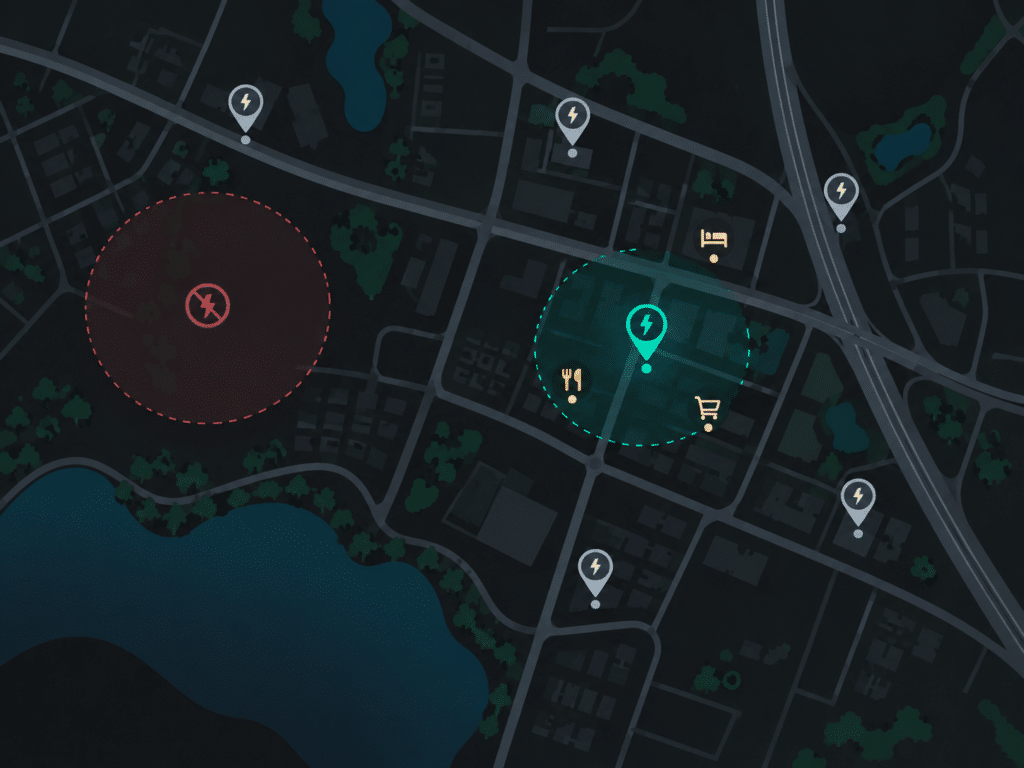
Operators also need to understand existing charging coverage.
An EV charging stations map can show where current infrastructure is concentrated and where gaps remain.
Combining charger locations with POI data can help classify markets as:
- Underserved
- Adequately covered
- Highly competitive
- Concentrated around a small number of destinations
EV charging maps become more useful when they show not only the location of EV charging stations, but also the destinations and activity surrounding them.
5. Rank Candidate Sites
Operators can compare candidate EV charge stations using consistent criteria.
These may include:
- Destination relevance
- POI density
- Nearby amenities
- Accessibility
- Existing chargers
- Expected demand
- Parking availability
This creates a more consistent EV charging site selection process before investing in equipment, permits, leases, and installation.
Which POI Signals Matter Most?
Different POI signals answer different questions about a proposed site.
| POI Signal | What It Helps Evaluate |
|---|---|
| Place category | Whether the destination fits the charging use case |
| Destination density | Whether enough surrounding activity exists |
| Nearby amenities | Whether drivers can use charging time productively |
| Opening hours | When the site is active and accessible |
| Business status | Whether nearby destinations are still operating |
| Existing EV charge points | Whether the market is underserved or crowded |
| Parking-related POIs | Whether practical charger access is likely |
| Brand and venue type | Whether the destination fits the intended user group |
These signals reduce the need to rely only on assumptions.
Where Does POI Data Add the Most Value?
Retail and Shopping Locations
Retail destinations naturally create dwell time.
Customers may already spend time shopping, eating, exercising, or accessing other services.
Operators can compare retail locations using surrounding POIs, visit activity, existing chargers, and dwell patterns.
This can help identify EV charging station locations that fit an existing customer journey.
Hotels and Hospitality
Hotels can support longer charging sessions because guests may remain for several hours or overnight.
Operators can compare hotels using their category, location, nearby amenities, road access, and surrounding destinations.
Highway and Travel Corridors
Fast chargers along major roads need more than spacing between stations.
Drivers need locations where they can safely exit, charge, access food or other services, and return to their route.
POI data can identify fuel stations, convenience stores, restaurants, rest areas, and other useful stopping points.
Urban and Neighborhood Charging
Cities can use POI data to understand where public EV charge points may be needed across residential, commercial, and mixed-use areas.
Comparing existing chargers with workplaces, retail areas, car parks, and transit hubs can reveal gaps in coverage.
POI Data vs. Mobility Data for EV Charging
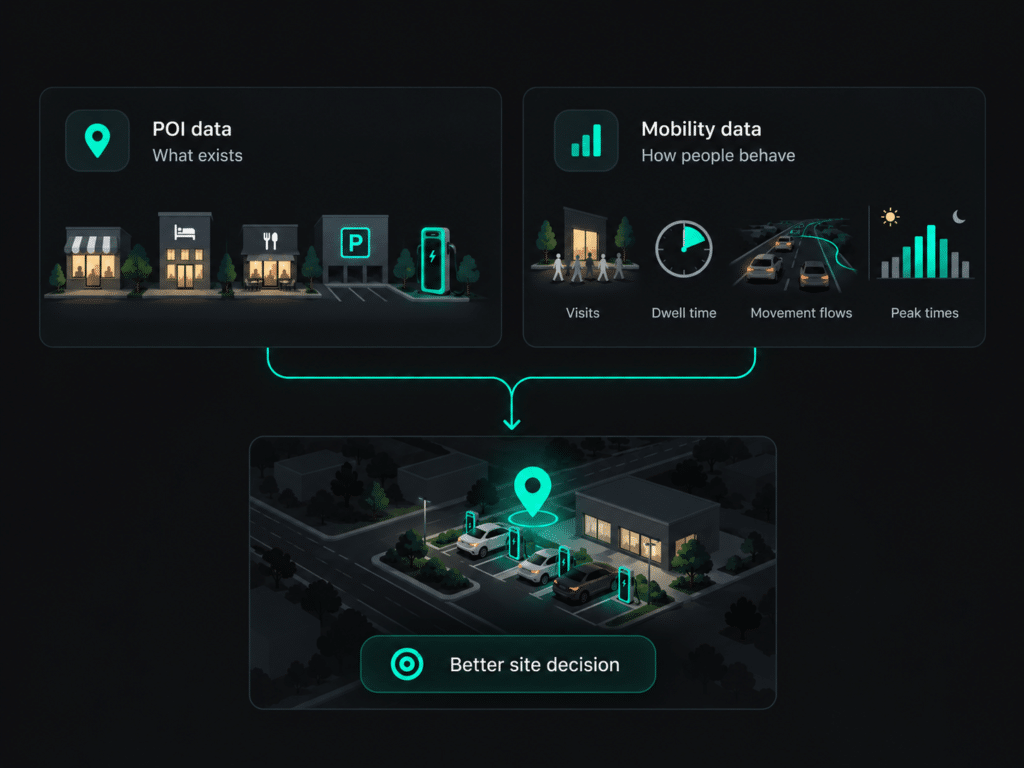
POI data explains what exists around a site.
Mobility data helps explain how people move and interact with those places.
Used together, they can show:
- Visitor volume
- Dwell time
- Peak periods
- Travel behavior
- Movement between destinations
- Weekday and seasonal differences
- Relative popularity of sites
For example, two retail centers may contain similar businesses.
POI data may make them look equally attractive. Mobility and visit data may show that one receives more visitors, has longer dwell times, or attracts people from a wider area.
This is where EV charging analytics becomes more useful.
How Can EV Charger Utilization Data Improve Planning?
POI and mobility data help estimate whether a location has the right conditions for charging demand.
EV charger utilization data adds another layer by showing how existing infrastructure performs.
Operators can compare charger activity with nearby destinations, market characteristics, and competing infrastructure.
This may help answer questions such as:
- Which types of locations produce stronger charger use?
- Which destination combinations perform better?
- Where is existing infrastructure underused?
- Which markets show demand but limited charging coverage?
Historical performance can then inform future site selection.
Who Uses POI Data for EV Charging Networks?
Several groups can use location data for charging expansion.
EV charging networks can compare markets, candidate sites, and surrounding destinations.
Retail and hospitality businesses can evaluate where charging may improve customer convenience.
Cities and planners can study gaps in public charging coverage.
Fleet and logistics companies can evaluate charging opportunities around depots, routes, and operational hubs.
Property owners and developers can assess whether EV infrastructure fits the long-term use of a property.
What Can POI Data Not Tell You?
A strong commercial location is not automatically a feasible charging site.
Operators still need to evaluate:
- Grid capacity
- Power availability
- Parking access
- Property agreements
- Installation costs
- Zoning
- Permits
- Road access
POI data should therefore be used with property, infrastructure, mobility, and market information.
Data quality also matters.
Businesses open, close, relocate, and change operating hours. Incorrect categories or outdated locations can affect EV charging analytics and site rankings.
How Factori Supports EV Charging Site Selection
Factori provides Places, Mobility, Visit, Market, Property, and Business data that can support EV charging networks.
Teams can use these datasets to:
- Map relevant destinations
- Compare nearby amenities
- Analyze aggregated movement patterns
- Study existing EV charge points
- Identify potential charging gaps
- Enrich internal site databases
- Compare candidate locations
Combining these signals helps teams move beyond static EV charging maps and understand the real-world conditions around each proposed site.
Factori data can be accessed through datasets, APIs, its platform, MCP, and other data workflows.
Conclusion
Strong EV charging site selection requires more than traffic counts.
POI data shows what drivers can do around a proposed charging location. Mobility and visit data can add information about how people actually interact with those places.
Together, these signals help operators compare EV charging station locations based on destination fit, accessibility, nearby amenities, competition, and real-world activity.
The goal is not simply to add more EV charge stations.
It is to place infrastructure where drivers are likely to need it, use it, and return to it.
FAQs
What Is POI Data for EV Charging?
POI data for EV charging describes physical places around potential charging sites, including stores, restaurants, hotels, offices, car parks, fuel stations, and transport hubs.
How Can Operators Choose EV Charging Station Locations?
Operators can compare traffic, POIs, destination density, amenities, mobility patterns, existing chargers, parking access, and infrastructure feasibility.
How Can EV Charging Maps Support Site Selection?
EV charging maps show the location of EV charging stations and existing network coverage. Adding POI and mobility information can also reveal destination clusters, competition, and possible coverage gaps.
What Is EV Charger Utilization Data?
EV charger utilization data shows how existing charging infrastructure is being used. Combined with location and destination data, it can help operators understand which site characteristics are linked with stronger or weaker charger activity.
Can POI Data Predict EV Charging Demand?
POI data can help identify locations where demand may be stronger based on destination type, density, amenities, and existing infrastructure.
Forecasting is stronger when POI data is combined with mobility, visit, vehicle, infrastructure, and market information.