
Property data helps businesses understand buildings, land, ownership, transactions, valuations, and the markets around physical assets.
For real estate teams, it supports investment and valuation. Retailers can use it for site selection. Banks can use it for risk and branch planning. Analytics teams can combine it with Places, mobility, and visit data to better understand local demand.
The value of data in real estate increases when property records are connected with what is happening around each location.
Key Takeaway
- Property data describes buildings, land, ownership, transactions, valuations, and other real estate characteristics.
- Commercial property data and residential property data support different types of analysis.
- Real estate data sources include public records, registries, listings, commercial databases, and third-party providers.
- Property data analytics turns static records into insights for investment, risk, site selection, and market planning.
- Property data site selection becomes stronger when property information is combined with Places, mobility, visits, and market context.
- Property data for mortgage and financial-services workflows can support collateral and market analysis.
- A property database should be evaluated on accuracy, freshness, coverage, normalization, and integration, not record count alone.
- Property data online may be accessed through APIs, bulk files, cloud platforms, or a property data app.
- The best real estate data provider is the one whose coverage, methodology, and access model fit the business use case.
What Is Property Data?
Property data is structured information about land, buildings, and real estate assets.
It can explain:
- What a property is
- Where it is located
- How it is used
- Who owns it
- How its value has changed
- What surrounds it
Real estate property data may include address, building type, parcel boundaries, ownership, transactions, rental values, zoning, and valuations.
Commercial property data focuses on assets such as offices, retail properties, and other commercial buildings. Residential property data focuses on homes and residential assets.
Real property data can also include broader market and location context when connected with other datasets.
What Types of Property Data Are Available?
A property database can contain several types of information.
| Type | What It Shows | Common Use |
|---|---|---|
| Property attributes | Size, age, type, structure, parcel details | Valuation and planning |
| Transaction data | Sale price, date, ownership transfer | Market and pricing analysis |
| Listing data | Active listings, rent, asking prices | Competitive research |
| Property owner data | Ownership records | Due diligence and prospecting |
| Valuation data | Estimated value and price changes | Investment and lending |
| Location data | Nearby places, access, neighborhood context | Site selection |
| Mobility and visit data | Footfall and local activity | Demand and retail analysis |
Property databases become more useful when these records can be linked consistently across markets and systems.
How to Get Real Estate Data
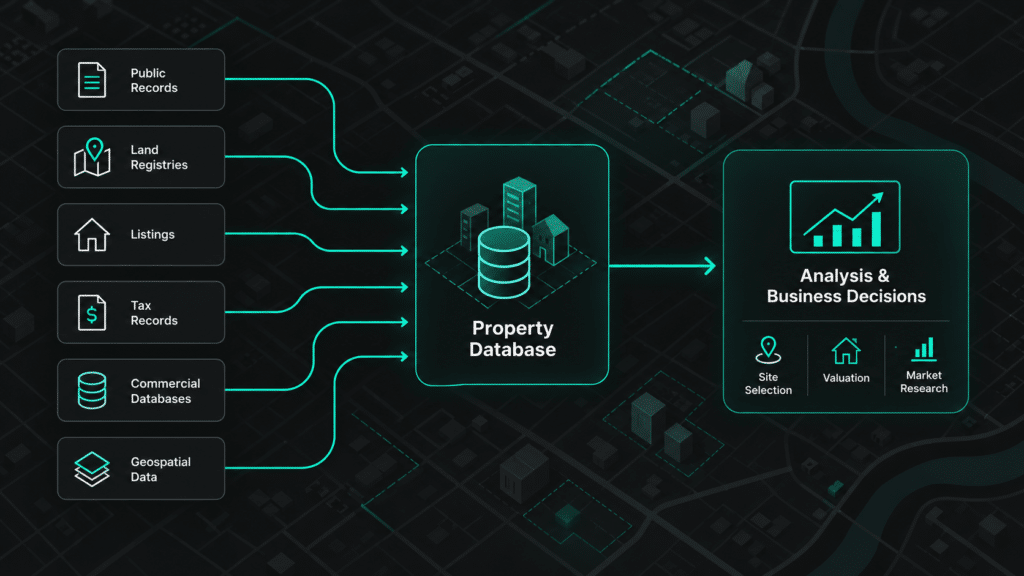
Businesses can get data for real estate from several types of real estate data sources.
These may include:
- Public records
- Land registries
- Property listings
- Tax records
- Surveys
- Commercial databases
- Geospatial sources
- Third-party property data providers
No single real estate data source always contains everything a business needs.
Teams often combine several sources to improve coverage and fill missing attributes.
A property data search may begin with a single address, parcel, owner, or market. For larger analysis, teams usually need a structured property database rather than searching one record at a time.
How Can Businesses Access Property Data?
Property data online can be delivered in different ways depending on the workflow.
A real estate data provider may offer:
- APIs
- Bulk datasets
- Cloud delivery
- Data warehouses
- A property data app
- A location intelligence platform
A real property data search may work well through a business interface when teams need to inspect individual assets.
Data and engineering teams may prefer APIs or bulk access for larger property data analysis projects.
The right access model depends on whether teams are researching individual properties, enriching a database, building an application, or running analytics at scale.
What Is Property Data Analytics?
Property data analytics is the process of turning property records into insights for investment, planning, risk, market analysis, and location decisions.
Property data and analytics can help businesses compare:
- Assets
- Neighborhoods
- Property values
- Ownership changes
- Market activity
- Nearby businesses
- Local demand
- Location performance
For example, a commercial building record may show size, ownership, use, transaction history, and estimated value.
Add Mobility Data and the analysis can also consider how active the surrounding area is.
This turns static property records into broader location intelligence.
Property Data Use Cases
Property data use cases extend beyond traditional real estate teams.
Property Data Site Selection
Retailers can use property data to compare potential store locations.
Teams can evaluate property characteristics together with nearby businesses, mobility patterns, visits, competition, and trade areas.
This gives businesses a stronger view of a site than property records alone.
Real Estate Investment
Real estate teams can use property data research to compare assets, study price trends, evaluate rental potential, and identify investment opportunities.
Adding location and mobility context can help show whether the surrounding market is active.
Financial Services and Mortgage Analysis
Banks, lenders, and financial institutions can use property information for collateral analysis, market research, branch planning, and geographic risk.
Property data for mortgage workflows may include asset characteristics, ownership, transaction, and valuation information.
Marketing and Audience Analysis
Property and location information can help marketers understand the areas where audiences live, work, shop, or spend time.
This can support audience targeting, media planning, enrichment, and campaign measurement.
Market and Urban Planning
Property data research can help planning teams understand where development is occurring, how markets are changing, and where activity is concentrated.
This can support territory planning, infrastructure decisions, and market expansion.
Property Data vs. Places Data vs. Mobility Data
These datasets answer different questions.
| Data Type | Main Question | Example |
|---|---|---|
| Property data | What is the asset? | Building, parcel, ownership, value |
| Places data | What operates there? | Store, bank, hotel, restaurant |
| Mobility data | How do people interact with the area? | Visits, footfall, movement |
Places Data adds information about the businesses and venues around a property.
Mobility data adds information about real-world movement and activity.
The strongest analysis often combines all three.
A team can understand the asset, the surrounding commercial environment, and the behavior that may shape demand.
How Is Property Data Used for Assessment and Research?
A property data assessment checks whether the available information is reliable enough for the decision being made.
Businesses should review:
- Accuracy: Are addresses, coordinates, and attributes correct?
- Freshness: Are listings, transactions, and ownership records current?
- Coverage: Does the dataset cover the markets and property types required?
- Normalization: Are records standardized?
- Linkability: Can property records connect with other datasets?
- Explainability: Are attributes and sources clearly defined?
- Privacy: Is the information handled responsibly?
The data real estate teams rely on should be accurate, current, and easy to integrate.
For teams buying property data USA-wide or across multiple markets, coverage should also be checked at the local level rather than assumed from a headline coverage figure.
How Do You Choose a Property Data Provider?
The right property data provider depends on the use case.
When comparing property data providers or real estate data services, check:
- Geographic coverage
- Property-type coverage
- Accuracy
- Update frequency
- Attribute completeness
- Historical data
- Integration options
- Documentation
- Data licensing
- Ability to connect with other datasets
A large property database is not automatically a better one.
The right provider is the one whose data supports the decision your team needs to make.
How Factori Supports Property Data Analysis
Factori helps businesses combine Property Data with real-world location intelligence.
Teams can connect property records with Places, Mobility, visit intelligence, People, Audience, Market, and other datasets.
This can support:
- Site selection
- Trade area analysis
- Retail expansion
- Property data analysis
- Market intelligence
- Audience targeting
- Demand forecasting
- Financial services strategy
Factori provides access through datasets, its platform, APIs, and MCP, helping teams bring property and location signals into existing analytics workflows.
Conclusion
Property data provides a structured view of real estate assets and the markets around them.
On its own, it can explain ownership, transactions, valuations, physical attributes, and listings.
Combined with Places, mobility, visit, and audience information, it becomes a stronger tool for understanding demand, risk, competition, and location performance.
For businesses using data for real estate decisions, the goal is not simply to collect more records. It is to connect reliable property information with the context needed to make better decisions.
FAQs
What Is Property Data?
Property data is structured information about land, buildings, parcels, ownership, transactions, valuations, listings, and other real estate characteristics.
How Do I Get Real Estate Data?
Real estate data can come from public records, land registries, listings, tax records, commercial databases, geospatial sources, and third-party property data providers.
What Is the Difference Between Property Data and Real Estate Data?
Real estate data is a broad category that can include transactions, listings, market trends, leases, investments, and property records.
Property data usually focuses more directly on individual buildings, parcels, ownership, and asset attributes.
What Is a Property Data Search?
A property data search retrieves information about a specific asset, address, parcel, owner, or market from a property database or data platform.
What Is Property Data Used For?
Common property data use cases include site selection, investment analysis, mortgage and lending workflows, market research, valuation, risk analysis, audience planning, and forecasting.
What Should I Look for in a Real Estate Data Provider?
Evaluate coverage, freshness, accuracy, completeness, historical availability, integration, documentation, licensing, and whether the dataset can connect with other business and location data.