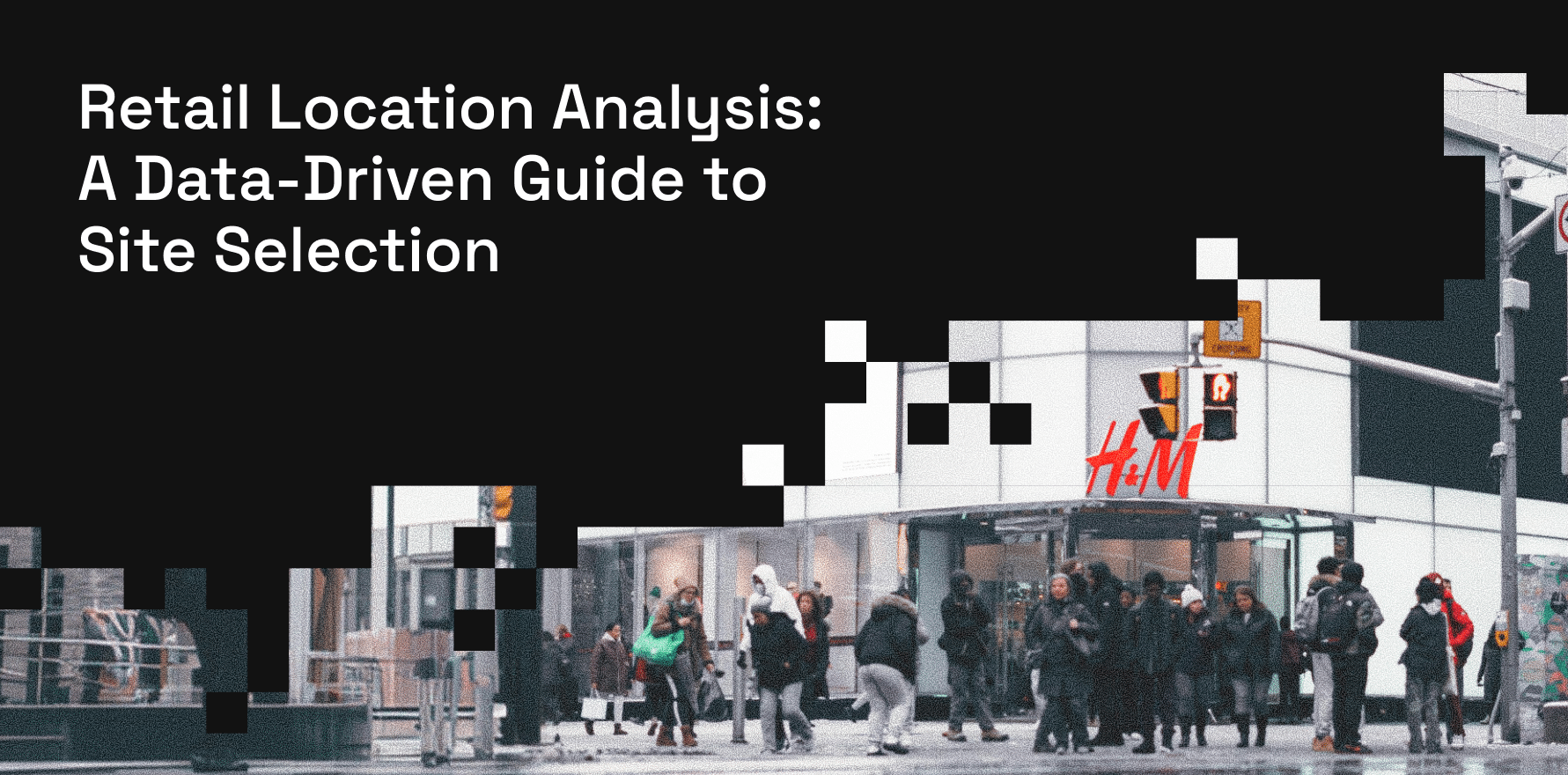

A site selection strategy is a structured process for identifying, evaluating, and choosing locations for expansion, optimization, or investment.
The location a business chooses can directly affect demand, accessibility, costs, and long-term performance.
But many site selection decisions still rely heavily on demographics, past performance, or broad market reports. These inputs are useful, but they do not always show how people actually move through and interact with a location.
A stronger strategy combines traditional market data with real-world signals such as mobility, footfall, customer behavior, trade areas, and surrounding places.
The following seven steps create a more consistent way to evaluate potential locations.
Key Takeaway
- A site selection strategy provides a repeatable process for evaluating potential locations.
- The process should begin with clear business and location objectives.
- Demographic data explains who lives around a site, but does not fully explain real customer demand.
- Mobility and footfall data show how people actually move through and interact with locations.
- Real trade areas are shaped by customer movement, accessibility, competition, and destination strength.
- POI data helps explain the competitors, businesses, and demand drivers surrounding a location.
- Candidate locations should be compared using the same scoring criteria.
- Forecasting helps test whether shortlisted sites can support expected demand and performance.
- Combining demographic, behavioral, movement, and location data reduces reliance on assumptions.
- A structured, data-driven process makes site selection easier to repeat across markets.
Why Does a Structured Site Selection Strategy Matter?
Location decisions can have a long-term impact on revenue, operations, and growth.
A strong site may attract consistent demand and improve market coverage. A poor site can reduce visibility, weaken footfall, and increase expansion risk.
The problem is that locations are often evaluated using incomplete information.
Population and income may suggest strong demand. But they do not show whether the target audience actually visits the area.
A structured site selection strategy helps businesses:
- Compare locations using the same criteria
- Reduce subjective decisions
- Identify risks earlier
- Better understand real customer demand
- Make the process easier to repeat across markets
Step 1: Define Business Goals and Location Objectives
Start by defining what the new location needs to achieve.
Not every location serves the same purpose.
A business may want to:
- Enter a new market
- Expand an existing network
- Improve market coverage
- Reach a new customer segment
- Reduce gaps between existing locations
Each objective changes how potential sites should be evaluated.
For example, a market-entry location may prioritize audience reach and demand. A network-optimization decision may focus more on coverage and overlap with existing locations.
Defining the objective first keeps the rest of the site selection process focused.
Step 2: Identify Target Customers and Demand Drivers
A strong site selection strategy starts with understanding the customer.
Basic demographics can help show who lives around a location. This may include age, income, household characteristics, and population.
For U.S. analysis, the U.S. Census Bureau American Community Survey provides demographic, economic, housing, income, and commuting data.
But knowing who lives nearby is only one part of demand.
Businesses also need to understand:
- Who actually visits the area
- Where customers spend time
- How often they visit
- What influences their trips
- Whether the audience fits the business
Relying only on demographic data can therefore overstate potential.
Combining audience characteristics with behavioral signals provides a stronger view of actual demand.
Step 3: Analyze Real-World Movement and Footfall
The next step is understanding how people move through the area.
Footfall and mobility patterns can show:
- How active a location is
- When activity peaks
- How frequently people visit
- How activity changes by day or week
- Where visitors come from
This is important because high population does not always mean high customer activity.
Mobility data helps businesses observe actual movement instead of assuming that nearby residents will become customers.
For U.S. markets, Census commuting datasets can also provide additional context on where people live and work.
This makes movement an important layer in understanding location potential.
Explore how Factori’s retail site selection solution helps businesses evaluate locations using real-world movement and footfall data.
Step 4: Define Trade Areas and Customer Catchments
A trade area is the geographic area from which a location draws its customers.
Traditional analysis often uses fixed-radius circles.
For example, a retailer may assume that customers within three or five miles belong to the site’s trade area.
Real customer behavior is rarely that simple.
Trade areas can be affected by:
- Roads
- Public transport
- Competitors
- Shopping destinations
- Work locations
- Travel habits
- Brand strength
A stronger approach uses actual movement patterns to understand where customers are likely to come from.
This helps businesses define more realistic catchment areas and understand whether a new site may overlap with existing locations.
Step 5: Evaluate Competition and Surrounding Places
No site operates in isolation.
Nearby businesses can either support or compete with a location.
Businesses should evaluate:
- Direct competitors
- Complementary retailers
- Shopping centers
- Restaurants
- Offices
- Entertainment venues
- Other demand-generating places
POI Data provides this surrounding context.
For example, a site near offices, restaurants, and complementary retailers may benefit from regular activity.
A site surrounded by several direct competitors may face more pressure on available demand.
Understanding the surrounding environment helps businesses judge whether a location benefits from its context or competes against it.
Step 6: Compare and Score Potential Locations
Once candidate sites have been identified, they should be evaluated using the same criteria.
A simple scoring framework might include:
| Factor | What to Evaluate |
|---|---|
| Demand | Is there enough customer demand? |
| Audience fit | Are the right customers present? |
| Footfall | Is activity strong and consistent? |
| Trade area | Where will customers come from? |
| Competition | How crowded is the market? |
| Accessibility | Can customers reach the site easily? |
| Surrounding places | Does the area support demand? |
| Commercial fit | Does the site support the business objective? |
Different factors can be weighted depending on the goal.
For example, accessibility may matter more for one format, while destination strength or audience fit may matter more for another.
Using the same scoring framework across locations makes comparisons more consistent.
Step 7: Forecast Performance and Validate the Decision
Before committing to a site, businesses should test whether the location can support expected performance.
This may include forecasting:
- Footfall
- Customer demand
- Revenue potential
- Operational viability
Historical performance can provide a starting point.
Real-world data adds context about current movement, visits, competition, and audience behavior.
The goal is not to treat the forecast as certainty.
It is to test whether the assumptions behind the location decision are supported by the available evidence.
See how demand forecasting can help validate location performance projections before committing to a site.
Read About: Site Selection Analysis: A Data-Driven Guide to Choosing High-Performing Locations
Traditional vs. Data-Driven Site Selection Strategy
Traditional site selection is useful for understanding the basic characteristics of a market.
A data-driven approach adds behavioral and location context.
| Aspect | Traditional Site Selection | Data-Driven Site Selection |
|---|---|---|
| Main inputs | Demographics and historical data | Demographics plus real-world data |
| Demand | Estimated from market characteristics | Informed by observed activity |
| Trade areas | Often fixed-radius | Based on customer movement |
| Customer understanding | Who lives nearby | Who visits and how they behave |
| Competition | Basic competitor counts | Competitors plus surrounding place context |
| Decision process | More assumption-based | Structured comparison using multiple signals |
A data-driven strategy gives businesses a clearer way to compare locations based on how markets actually behave.
How Data Improves Site Selection Outcomes
Different datasets answer different parts of the site selection question.
Better Demand Estimation
Mobility Data and visit data can show actual footfall, visit frequency, and activity patterns.
This adds context beyond projected demand.
Stronger Customer Understanding
People and consumer data help businesses understand whether the audience around a location matches their target customer.
More Accurate Trade Areas
Mobility data can help map catchment areas using real movement patterns instead of fixed circles.
Better Competitive Context
POI Data shows nearby businesses, competitors, co-tenants, and other destinations.
This helps explain the commercial environment around a site.
Lower Expansion Risk
Combining mobility, visit, audience, and POI data helps businesses test assumptions before opening a location.
Faster Location Comparison
Structured datasets make it easier to evaluate multiple sites using the same criteria.
Explore the full Factori product suite to see how different datasets can support site selection. Read more.
When these signals are connected, site selection becomes more measurable and repeatable.
Conclusion
Site selection is no longer only about finding available space in a promising market.
It is a strategy decision that requires a clear understanding of demand, customer movement, trade areas, competition, and market context.
A structured seven-step process gives businesses a more consistent way to compare locations.
Adding real-world data helps test assumptions and understand how potential sites actually function.
The result is a site selection strategy that is easier to repeat, easier to scale, and better connected to business goals.
FAQs
What Is a Site Selection Strategy?
A site selection strategy is a structured process for identifying and evaluating locations based on business goals, customer demand, market conditions, accessibility, and location performance.
What Factors Matter Most in Site Selection?
Important factors include customer demand, audience fit, footfall, accessibility, competition, trade areas, nearby places, and commercial viability.
How Is a Trade Area Defined?
A trade area is the geographic area from which a location attracts customers.
Real-world movement patterns can help define trade areas more accurately than fixed-radius assumptions.
What Data Is Used in Site Selection?
Common inputs include mobility data, visit and footfall data, demographics, audience data, POI data, competition, and trade area information.
How Do Businesses Compare Potential Locations?
Businesses can use a scoring framework that evaluates every location against the same factors, such as demand, audience fit, footfall, accessibility, competition, and trade area strength.