
Business site selection plays a major role in how confidently a company can expand and improve long-term location performance.
Choosing the right site is not just about finding available space or picking a market that looks attractive. A stronger process starts with a clear business goal, defines practical criteria, learns from existing locations, studies real trade areas, evaluates competition, compares sites consistently, and validates the final decision over time.
Key Takeaway
- Strong business site selection starts with a clear objective, because the best location depends on what the business is trying to achieve.
- Site selection works best when every candidate is compared using consistent criteria such as demand, accessibility, competition, cost, and operating fit.
- Existing location performance, real trade areas, movement patterns, and local demand drivers can provide a stronger basis for expansion decisions than fixed-radius assumptions alone.
- A good site is not defined only by market demand. Competitive pressure, access, visibility, parking, layout, and other site-level factors also affect long-term performance.
- Site selection should continue after launch through validation and feedback, so teams can improve scoring models, refine criteria, and make future expansion decisions with greater confidence.
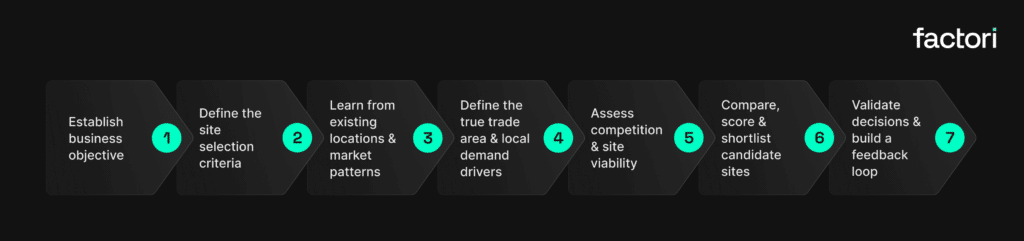
1. Establish the Business Objective
Every site decision should start with one question: what is the business trying to achieve?
One location may be intended to drive revenue in a high-demand market. Another may be needed to improve customer coverage, reduce service gaps, support logistics, or strengthen brand presence.
Without a clear objective, teams can focus too heavily on surface-level factors such as foot traffic, rent, or visibility.
The objective also shapes the rest of the process.
A business focused on expansion may prioritize untapped demand and competitive whitespace. A business focused on efficiency may care more about access, delivery times, workforce availability, or network coverage.
The best site is not always the most attractive one. It is the site that best supports the business goal.
2. Define the Site Selection Criteria
Once the objective is clear, the next step is to turn it into measurable criteria.
This creates a consistent way to compare locations and reduces the risk of relying on instinct alone.
Common criteria may include:
- Accessibility
- Visibility
- Local demand
- Property cost
- Workforce availability
- Competitive density
- Ease of customer access
The exact criteria depend on the business model.
A retailer may focus on demand, visit potential, parking, surrounding activity, and nearby businesses. A bank may care more about branch coverage gaps, customer convenience, and local market potential.
What matters most is consistency. The same criteria should be applied across candidate sites so teams can compare them fairly.
3. Learn From Existing Locations and Market Patterns
A strong site selection process should not start from zero.
Existing locations already contain useful clues about what tends to work and what does not.
By studying current site performance, businesses can identify patterns in customer behavior, nearby businesses, competition, location context, and market conditions.
These patterns can help create a benchmark for future locations.
They can also reveal look-alike markets. If a high-performing location has a clear set of characteristics, teams can search for other areas with similar conditions.
This step also helps businesses avoid repeating mistakes.
A site may have looked strong based on demographics or market size but still underperformed because of weak access, poor surrounding demand, or too much competition.
Using real performance data makes future decisions more grounded.

4. Define the True Trade Area and Local Demand Drivers
One of the biggest site selection mistakes is assuming that demand comes from a fixed radius around a location.
In reality, trade areas depend on how people move, where they come from, how easy the site is to reach, and what local factors shape demand.
Two nearby sites can serve very different customer groups.
That is why teams need to understand how the surrounding market actually works.
Important demand drivers may include commuter flows, residential density, nearby workplaces, retail clusters, road access, local routines, and major destinations.
A better view of the trade area helps businesses estimate whether a site can support steady demand instead of relying only on nearby population.
5. Assess Competition and Site Viability
A strong market does not automatically mean a strong site.
Businesses also need to understand competitive pressure and practical site conditions.
Competition should not be measured only by counting nearby businesses. Teams should also consider how strong those competitors are, how close they are, which audiences they attract, and whether the market is already crowded.
In some cases, nearby businesses can help by making an area more attractive as a destination. In other cases, they may reduce the amount of demand a new site can capture.
Site viability matters too.
Access, visibility, parking, delivery constraints, property layout, and operating fit can all affect performance after launch.
A location may sit in a strong trade area but still fail if the site itself creates too much friction.
6. Compare, Score, and Shortlist Candidate Sites
Once the market, trade area, competition, and site conditions are understood, businesses need a structured way to compare options.
A scoring model helps turn a large amount of location information into a clearer decision framework.
Teams can rank sites against weighted criteria linked to the original business objective.
This may include demand potential, accessibility, competition, cost, operating fit, and local market strength.
The goal is not to reduce the entire decision to one number.
The goal is to make trade-offs easier to see and compare.
A structured shortlist also makes it easier for stakeholders to understand why certain sites deserve deeper review.
7. Validate Decisions and Build a Feedback Loop
Site selection should not end when a location is approved.
After launch, businesses should compare expected performance with actual results.
This helps teams understand which assumptions were correct and which signals were most useful.
For example, if a site was chosen because of strong demand, the business should check whether visits, sales, or customer activity developed as expected.
Over time, this creates a feedback loop.
Teams can refine their criteria, improve scoring models, and learn which market signals are most closely linked to performance.
This turns site selection from a one-time exercise into a repeatable process that becomes stronger with every expansion cycle.
How Factori Supports Better Site Selection
Factori helps businesses improve site selection by turning external location signals into structured, decision-ready inputs.
Instead of relying only on static market indicators, teams can use Factori to understand how places perform, how people move through an area, where demand exists, and how the surrounding location affects commercial potential.
Factori can help teams:
- Analyze movement and visit patterns
- Understand trade areas based on real behavior
- Assess nearby places and competitive density
- Compare candidate sites with consistent criteria
- Learn from existing location performance
By combining external data with a structured evaluation process, businesses can reduce location risk and make expansion decisions with greater confidence.
Conclusion
Smarter site selection is not about choosing the location that looks best at first glance.
It is about connecting business goals with real market evidence.
Companies make stronger decisions when they define clear objectives, use consistent criteria, learn from existing locations, understand trade areas, assess competition, compare sites carefully, and validate results after launch.
A disciplined process also creates value beyond one opening.
It helps businesses improve how they evaluate markets, allocate investment, and plan future expansion. In a competitive environment, the goal is not simply to open more locations. It is to open the right ones.
FAQs
1. What Is Business Site Selection?
Business site selection is the process of evaluating and choosing the best location for a new site based on market demand, accessibility, competition, operating fit, and long-term potential.
2. Why Is Site Selection Important for Business Growth?
Site selection affects revenue potential, customer access, operating efficiency, and long-term profitability.
A poor location can limit performance. A strong one can support growth and reduce expansion risk.
3. What Factors Should Businesses Consider in Site Selection?
Common factors include business objectives, trade area demand, accessibility, local competition, surrounding businesses, property costs, workforce availability, and operating fit.
4. What Is a Trade Area in Site Selection?
A trade area is the geographic area from which a location draws its customers.
In practice, it is shaped by movement, travel patterns, accessibility, and local demand rather than just a fixed radius.
5. How Can Data Improve Business Site Selection?
Data helps businesses compare locations using market patterns, customer movement, competition, and real-world demand.
This makes site selection more measurable, more consistent, and less dependent on assumptions.