Out-of-home advertising is becoming more flexible and data-driven.
Instead of relying only on fixed placements, advertisers can now use automation and real-world signals to decide when and where campaigns should run.
Programmatic OOH advertising brings these capabilities together. Movement patterns, location context, audience data, weather, traffic, and local activity can help improve targeting, timing, and measurement.
Key Takeaway
- Programmatic OOH automates the buying and delivery of digital out-of-home advertising.
- Campaigns can respond to factors such as location, time, weather, traffic, and local activity.
- Real-world data adds context about audience presence, movement, and the environment around each screen.
- Programmatic OOH can improve campaign flexibility, media efficiency, targeting, and measurement.
- Data quality, fragmented inventory, and inconsistent measurement remain important challenges.
- Mobility, Places, and audience data can help advertisers make better campaign decisions.
- Programmatic OOH measurement can evaluate both pre-campaign location suitability and post-campaign real-world outcomes.
- The strongest campaigns combine automation with reliable real-world data.
What Is Programmatic OOH Advertising?
Programmatic OOH advertising is the automated buying and delivery of out-of-home advertising using software platforms.
Instead of manually booking a fixed location for a set period, advertisers can define rules around location, timing, budget, and other conditions.
Campaigns then run across digital out-of-home advertising screens such as:
- Digital billboards
- Transit displays
- Retail screens
- Other public-facing digital screens
Programmatic OOH combines the physical reach of traditional OOH with the automation used in digital media buying.
How Does Programmatic OOH Advertising Work?
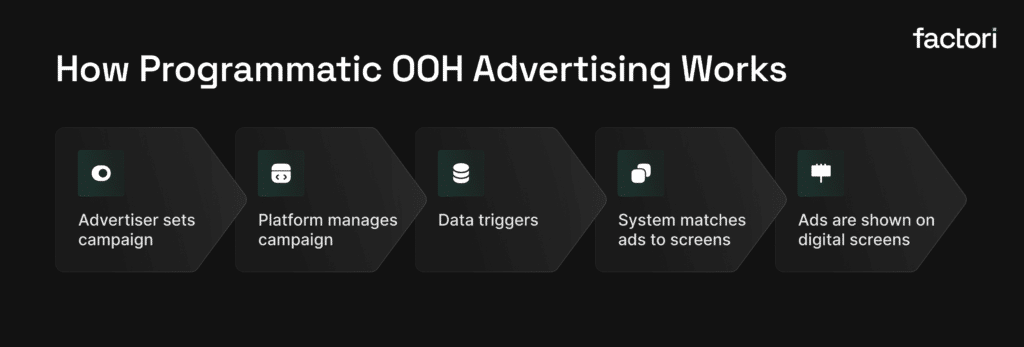
Advertisers first define campaign conditions such as location, timing, audience, and budget.
Programmatic platforms then match those requirements with available digital OOH inventory.
Ads can be delivered when predefined conditions are met.
For example, a campaign may run:
- During certain hours
- In selected locations
- During specific weather conditions
- When local activity is higher
This gives advertisers more control than a fixed OOH campaign.
OOH vs. DOOH vs. Programmatic OOH
| Aspect | OOH (Out-of-Home) | DOOH (Digital OOH) | Programmatic OOH |
| Format | Static billboards, posters | Digital screens | Digital screens |
| Buying Method | Manual, fixed booking | Manual or scheduled | Automated via platforms |
| Flexibility | Low | Medium | High |
| Creative Changes | Not possible after print | Rotational creatives | Dynamic, trigger-based |
| Targeting | Location-based | Location + scheduling | Data and trigger-based |
| Optimization | Post-campaign | Limited | Real-time or in-flight |
| Measurement | Estimated impressions | Improved estimates | Data-driven measurement |
The three terms describe different parts of out-of-home advertising.
OOH refers to advertising in physical public spaces.
DOOH refers to OOH advertising shown on digital screens.
Programmatic OOH refers to the automated buying and delivery of advertising on those digital screens.
Programmatic OOH therefore changes how DOOH inventory is purchased, scheduled, and optimized.
Why Is Programmatic OOH Growing?
Programmatic OOH is growing as more out-of-home inventory becomes digital.
Digital screens allow advertisers to move beyond fixed schedules and adjust campaigns based on timing, location, and real-world conditions.
Advertisers are also asking for better measurement.
Estimated impressions can show potential exposure. They do not always explain whether a campaign influenced real-world behavior.
Programmatic OOH makes it easier to connect campaign exposure with other performance signals.
It also fits more naturally into omnichannel media planning because teams can manage physical and digital campaigns through more connected workflows.
Benefits of Programmatic OOH Advertising
Programmatic OOH gives advertisers more flexibility than traditional fixed placements.
More Flexible Campaign Execution
Campaigns can adjust based on timing and real-world conditions instead of running in the same way throughout the entire booking period.
More Relevant Targeting
Advertisers can use location, timing, audience, and contextual signals to make campaign delivery more relevant.
Better Media Efficiency
Budgets can be focused on locations and moments that are more relevant to the campaign objective.
Better Measurement
Campaigns can be evaluated using real-world outcomes in addition to estimated impressions.
Stronger Omnichannel Planning
Programmatic OOH can work alongside other digital media channels as part of a broader campaign strategy.
What Are the Challenges of Programmatic OOH?
Programmatic OOH improves flexibility, but several challenges remain.
Data Quality
Targeting and measurement depend on the quality of the underlying data.
Poor location, audience, or movement data can reduce campaign accuracy.
Inventory Fragmentation
Digital OOH inventory may be spread across different media owners and platforms.
This can make campaign planning and access more complex.
Measurement Consistency
Different platforms may use different measurement methods.
That can make it harder to compare performance across campaigns, markets, or media partners.
These challenges make consistent real-world data important for both planning and measurement.
How Does Real-World Data Improve Programmatic OOH?
Programmatic OOH becomes more useful when campaigns are informed by what is happening around each screen.
Advertisers can use real-world data to understand:
- How people move through an area
- When activity is highest
- What places surround a screen
- Which audiences are present
- How weather, traffic, or events may affect activity
This allows campaigns to respond to real-world context instead of relying only on screen location.
For example, the same screen may have very different value during weekday commuting hours and quiet weekend periods.
Real-world data helps advertisers identify those differences.
What Data Can Support Programmatic OOH?
Several data layers can contribute to campaign planning.
Mobility data can show aggregated movement and activity patterns.
Places and POI data can explain what surrounds a screen, such as stores, restaurants, offices, transit hubs, or entertainment locations.
Audience data can add broader context about the types of audiences relevant to different markets.
Used together, these signals can help move programmatic OOH from simple location-based buying toward context-aware campaign delivery.
What Can Be Measured Before and After a Campaign?
Programmatic OOH can support measurement before and after campaign activation.
Before the Campaign
Advertisers can evaluate potential locations using signals such as:
- Audience presence
- Movement patterns
- Location context
- Peak activity periods
This helps teams choose locations that better match the campaign objective.
After the Campaign
Advertisers can study whether exposure is followed by changes in real-world behavior.
Measurement may include:
- Footfall changes
- Visit patterns
- Location-level performance
- Market-level differences
| Measurement Stage | What Is Evaluated | Why It Matters |
| Before Campaign | Audience movement and density | Helps identify high-traffic locations |
| Location relevance | Ensures alignment with campaign goals | |
| Reach estimation | Provides a realistic view of potential exposure | |
| After Campaign | Footfall changes | Indicates whether campaigns influenced visits |
| Visit attribution | Connects ad exposure to real-world actions | |
| Location-level performance | Shows which areas performed better | |
| Cross-market insights | Helps compare performance across regions |
This provides another way to evaluate campaign performance beyond estimated impressions.
How Factori Supports Programmatic OOH
Factori provides real-world datasets that can support programmatic OOH planning, targeting, and measurement.
These include:
Mobility | Places | People | Audiences | Identity | Retail | Market | Economic | Events | Property | Business | Geo
Teams can use these datasets to add real-world context to media planning and analytics workflows.
Data can be accessed through APIs, raw datasets, applications, MCPs, and agentic workflows.
Talk to an Expert or Get Started.
Conclusion
Programmatic OOH is changing how out-of-home advertising is planned, bought, and measured.
Automation gives advertisers more control over when and where campaigns run.
Real-world data adds the context needed to understand audience movement, surrounding locations, and changing conditions.
Together, these capabilities make OOH easier to connect with broader media strategies and real-world campaign outcomes.
FAQs
What Is Programmatic OOH Advertising?
Programmatic OOH advertising is the automated buying and delivery of out-of-home ads through software platforms.
It allows advertisers to control when and where ads appear using predefined rules and data signals.
How Is Programmatic OOH Different From DOOH?
DOOH describes advertising shown on digital out-of-home screens.
Programmatic OOH describes the automated process used to buy, schedule, and deliver advertising on those screens.
What Data Is Used in Programmatic OOH?
Programmatic OOH can use mobility, location, audience, weather, traffic, event, and other contextual signals to inform campaign delivery.
How Is Programmatic OOH Performance Measured?
Performance can be evaluated using exposure data together with real-world signals such as footfall, visit patterns, and location-level performance.
Is Programmatic OOH Privacy-Safe?
Programmatic OOH can use aggregated and anonymized signals to understand broader audience and movement patterns rather than identify individuals.