Whether you’re finding the closest ATM, booking a restaurant for dinner, or analyzing the best area to open a retail outlet, the common thread is data, more specifically, Points of Interest (POI) data.
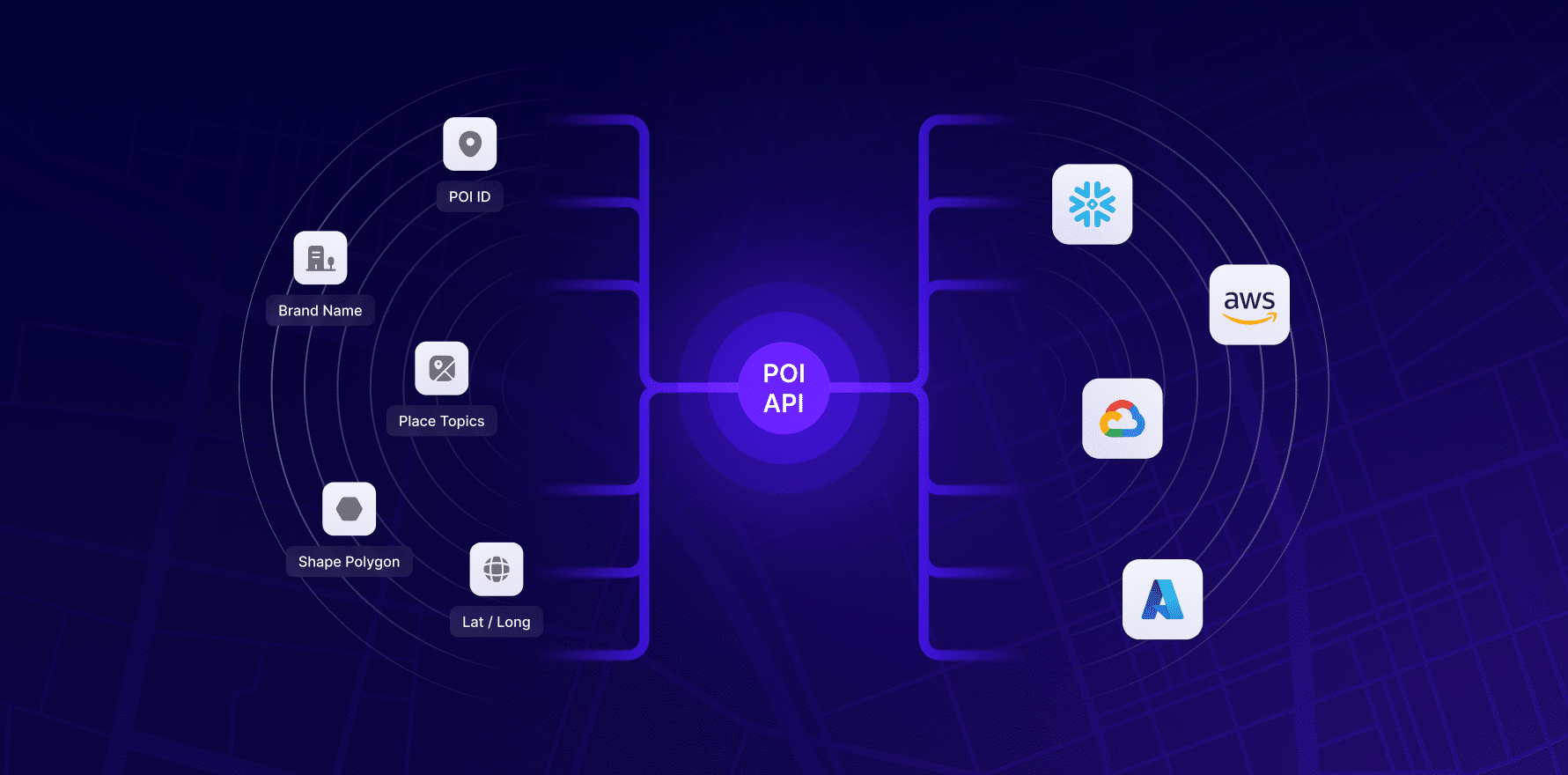
A Points of Interest (POI) API allows developers and businesses to access structured data about real-world locations such as restaurants, stores, and landmarks and use it to power applications like mapping, site selection, and location intelligence.
What is a POI API?
A POI API is a software interface that delivers structured data about physical locations. These places could include:
- Restaurants and cafes
- Landmarks and tourist attractions
- Hospitals, pharmacies, and healthcare centers
- Gas stations and EV charging points
- Shopping malls and retail outlets
- Public facilities like ATMs, schools, or libraries
And hundreds of other categories.
Instead of relying on outdated manual lists or static databases, a POI API continuously pulls in and updates information so businesses and apps always have the most accurate data.
In short, it’s the digital bridge that keeps location-aware applications relevant, real-time, and user-friendly.
Why Are POI APIs Important?
The importance of POI APIs goes far beyond powering “near me” searches. They shape customer experience, business strategy, and even entire industries. Let’s break it down:
1. Delivering Real-Time Accuracy
Nothing frustrates a user more than being directed to a restaurant that has closed down or a gas station that no longer exists. POI APIs solve this by providing real-time, verified data, reducing errors and ensuring smooth user journeys.
2. Enhancing Customer Experience
Imagine opening a travel app that instantly suggests nearby attractions, dining spots, or hidden gems – tailored to your preferences. This kind of contextual experience builds trust and keeps users engaged.
3. Driving Personalization
POI APIs can be combined with user data to offer personalized recommendations. For example, a fitness app might recommend nearby running trails, while a food delivery app highlights trending restaurants in your neighborhood.
4. Supporting Business Intelligence
For businesses, POI data is gold. Retailers use it to identify high-traffic areas for new stores. Real estate developers analyze surrounding amenities to price properties. City planners leverage POIs to improve public transport and urban design.
Explore Factori’s foot traffic data to understand how people move through high-traffic areas and inform smarter retail and site decisions.
5. Fueling Innovation Across Industries
POI APIs power much more than maps. They integrate with AI, IoT, and machine learning systems to enable predictive modeling, smart logistics, autonomous vehicles, and even AR/VR experiences.
Read About: Point of Interest

Common Use Cases of POI APIs
The flexibility of POI APIs makes them valuable across diverse industries. Here are some examples that highlight just how impactful they are:
Travel & Tourism
- Travel apps can use POI APIs to build smart itineraries, suggesting must-visit spots near a traveler’s hotel.
- Tour operators can highlight hidden local experiences like cultural attractions, hiking trails, or food markets.
- Airlines and booking platforms can integrate POI data to enhance pre-trip planning.
Retail & Real Estate
- Retailers analyze foot traffic and nearby competitors to decide where to open new outlets.
- Real estate apps show potential buyers neighborhood insights – like nearby schools, gyms, and parks – influencing purchase decisions.
- Franchise businesses use POI APIs for territory planning and growth strategy.
Logistics & Mobility
- Delivery companies rely on POIs for optimized routing, ensuring drivers know the best drop-off points.
- Ride-hailing apps use POI APIs to show pickup and drop-off hotspots like airports, stadiums, or malls.
- EV manufacturers and mobility services map out charging stations to support eco-friendly adoption.
Marketing & Advertising
- Brands run hyperlocal campaigns targeting users around specific POIs (e.g., coffee shops, stadiums, shopping malls).
- Retailers push geo-targeted offers when customers are near their stores.
- Event organizers use POI data to drive awareness and footfall at concerts, exhibitions, or trade shows.
See how Factori’s audience targeting solutions help brands run hyperlocal campaigns around specific points of interest.
Smart Cities & Urban Planning
- Governments use POI APIs to map essential services like hospitals, fire stations, and schools.
- City planners optimize public transport routes and identify areas for infrastructure upgrades.
- Sustainability initiatives rely on POI data to expand green zones, parks, and EV infrastructure.
About Factori
Factori is a partner-powered real-world data platform offering 13 standardized, enterprise-ready datasets including:
Mobility | Places | People | Audiences | Identity | Retail | Market | Economic | Events | Property | Business I Geo
Each dataset is governed, privacy-safe, and designed to join cleanly with your existing data stack, whether you’re working in SQL, a data warehouse, a BI tool, or an ML pipeline. No black boxes, no mystery sources, just real-world signals about how people move, shop, work, and live, delivered the way your team works: via API, raw data, app, MCPs, or agentic workflows. Explore datasets suitable for your use case and available for your market.
Talk to an Expert Get Started
Conclusion
A Points of Interest API isn’t just about mapping locations – it’s about enabling smarter decisions, creating personalized experiences, and bridging the digital and physical worlds. From travel apps that help tourists explore new cities to logistics companies optimizing delivery routes, POI APIs are a silent but powerful driver of innovation.
As industries become increasingly reliant on location intelligence, POI APIs will only grow in importance. Businesses that embrace them today will be better positioned to serve users with precision, personalization, and efficiency tomorrow.
So, whether you’re building a consumer app, planning a retail expansion, or designing a smart city, remember this: the Points of Interest API is the backbone of modern location-aware experiences.
FAQs
What is a Points of Interest (POI) API?
A Points of Interest (POI) API provides structured data about real-world locations such as businesses, landmarks, and public places, making it easy to search, filter, and analyze location information.
How does a POI API work?
A POI API takes location-based inputs like coordinates, radius, or category filters and returns structured information about nearby places, including names, categories, and attributes.
What data does a POI API provide?
A POI API typically provides place names, geographic coordinates, categories, and other attributes such as amenities, operating hours, or ratings.
What are POI APIs used for?
POI APIs are used for location-based search, site selection, mapping, logistics planning, market analysis, and personalized recommendations.
Which industries use POI APIs?
POI APIs are commonly used in travel, retail, real estate, logistics, mobility, and urban planning.