

Digital advertising is easy to measure when a customer clicks, fills out a form, or buys online.
The picture becomes less clear when advertising drives someone to a store, restaurant, bank branch, dealership, or another physical location.
Offline attribution helps close this gap. It connects campaign exposure with real-world actions so marketers can understand whether advertising influenced physical visits and whether those visits were incremental.
Key Takeaway
- Offline attribution connects advertising exposure with real-world actions such as store or branch visits.
- Digital attribution can miss campaigns that influence offline behavior without generating clicks.
- Mobility data provides the real-world visit signals used in many offline attribution models.
- Attributed visits and incremental visits are not the same.
- Control groups help estimate how many visits would have happened without the campaign.
- Visit lift is often a stronger KPI than raw matched visits for campaigns designed to drive foot traffic.
- Accurate location data, suitable attribution windows, and clear methodology are essential.
- Privacy-aware, aggregated measurement should remain central to offline attribution.
What Is Offline Attribution?
Offline attribution is the process of measuring how advertising or marketing influences actions that happen outside digital channels.
These actions may include a store visit, restaurant visit, branch visit, dealership visit, appointment, or other physical conversion.
The goal is to answer a simple question:
Did the campaign lead to a real-world outcome that would not have happened otherwise?
Offline attribution is especially useful for businesses where physical visits are an important part of the customer journey.
The IAB has long recognized online-to-offline attribution as a way to connect digital advertising activity with outcomes such as in-store visits and purchases. IAB Digital Attribution Primer
Digital Attribution vs. Offline Attribution
Digital and offline attribution measure different parts of the customer journey.
| Measurement Type | What It Measures | Example |
|---|---|---|
| Digital attribution | Online actions after campaign exposure | Click, form fill, online purchase |
| Offline attribution | Physical actions after campaign exposure | Store or branch visit |
| Footfall attribution | Campaign influence on location visits | Increase in store traffic |
| Sales attribution | Campaign influence on purchases | Revenue linked to media activity |
A campaign may generate few clicks but still influence many physical visits.
If marketers measure only digital actions, they may undervalue campaigns that affect offline behavior.
Why Digital Attribution Models Can Miss Offline Impact
Digital attribution models are built around actions that happen online.
A customer may see an ad, remember the brand, and visit a physical location several days later without clicking anything.
That journey may look like this:
Ad exposure → Brand consideration → Physical visit → Purchase
A click-based model may record only the first impression. It may not connect that impression with the later store visit.
This can create several problems.
Marketers may undervalue channels that drive physical behavior, move budget toward channels that are easier to track, or optimize campaigns using incomplete performance data.
Offline attribution adds the missing real-world layer.
How Does Offline Attribution Work?
Offline attribution usually combines campaign exposure data with location and visit data.
A typical process has four stages.
1. Identify Campaign Exposure
The first step is understanding which audience was exposed to the campaign.
Exposure may come from:
- Mobile advertising
- Display
- Social media
- Connected TV
- OOH and DOOH
- Video
- Programmatic advertising
The exposure data creates the starting point for measurement.
2. Measure Real-World Visits
Next, marketers use mobility data and accurate location information to measure aggregated visits to relevant physical locations.
These may include stores, restaurants, dealerships, bank branches, hotels, or venues.
The location itself must be mapped accurately. Poor location boundaries can count people passing nearby or visiting another business.
3. Compare Exposed and Unexposed Audiences
A visit after campaign exposure does not automatically mean the campaign caused it.
Some customers would have visited anyway.
A stronger offline attribution approach compares the exposed audience with a similar control or unexposed group.
This helps estimate the baseline level of visits that may have happened without advertising.
4. Measure Incremental Lift
The final step is comparing visit rates.
A simple model looks like this:
Ad Exposure → Validated Visit → Control Comparison → Incremental Visit Lift
If the exposed audience visits at a higher rate than the control group, that difference can provide evidence of campaign lift.
This is more useful than simply counting visits that happened after exposure.
Attribution vs. Incrementality
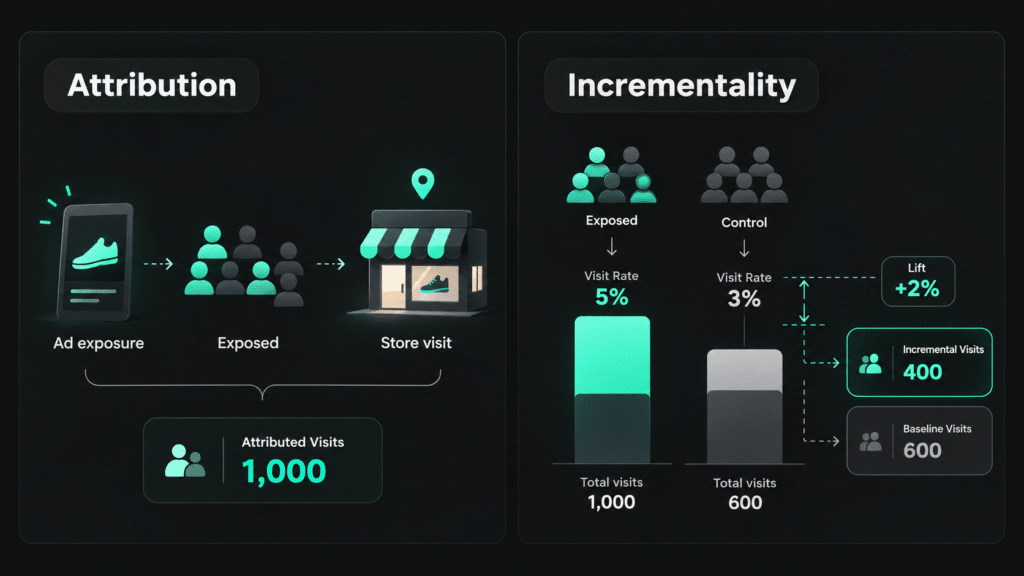
Attribution and incrementality are related, but they answer different questions.
Attribution asks: Did someone exposed to the campaign later visit?
Incrementality asks: Did the campaign cause additional visits that probably would not have happened otherwise?
This difference matters.
Imagine 1,000 people exposed to an ad later visit a retailer.
That number may sound impressive. But if almost the same number of comparable unexposed customers would have visited anyway, the campaign may have created very little incremental impact.
Visit lift provides a stronger view of performance.
The OOH industry also uses foot traffic attribution to evaluate how campaign exposure affects physical visitation. OAAA overview of OOH attribution
Key Offline Attribution Metrics
Offline attribution should focus on business outcomes rather than matched visits alone.
| Metric | What It Shows |
|---|---|
| Visit rate | Percentage of the measured audience that visited |
| Exposed visit rate | Visit rate among the exposed audience |
| Control visit rate | Baseline visit rate without exposure |
| Visit lift | Difference between exposed and control visit rates |
| Incremental visits | Additional visits linked to the campaign |
| Cost per incremental visit | Spend required to generate an incremental visit |
| Time to visit | Time between exposure and physical visit |
| Store-level lift | Performance differences across locations |
| Market-level lift | Performance differences across geographic markets |
The exact metric should match the campaign objective.
If the campaign is designed to drive store traffic, incremental visits may be more useful than clicks or impressions.
The Role of Mobility Data in Offline Attribution
Mobility data helps connect media activity with aggregated physical visit patterns.
Instead of measuring only online interactions, marketers can study whether audiences exposed to advertising later showed higher visitation to relevant locations.
Mobility data can help answer:
- Did store visits increase?
- Which markets responded most strongly?
- Which locations experienced greater lift?
- How quickly did visits happen after exposure?
- Did different audiences respond differently?
The quality of the result depends on the quality of the mobility data.
Coverage, location accuracy, visit methodology, attribution windows, and control-group design all affect the final measurement.
Offline Attribution for OOH and DOOH
Offline attribution is especially useful for OOH and DOOH campaigns.
These channels often influence people without generating an immediate click.
Advertisers can combine media exposure information with mobility and visit data to study whether audiences exposed to an OOH campaign later visited a relevant location.
OAAA guidance describes foot traffic attribution as a way to measure a campaign’s influence on physical visitation. OAAA DOOH measurement guidance
This gives OOH advertisers another way to evaluate performance beyond estimated reach or impressions.
Offline Attribution Use Cases
Retail
Retailers can measure whether campaigns increased visits across stores, markets, or formats.
This can support local media planning, promotions, new-store campaigns, and budget allocation.
Factori’s Retail Data can add further context to retail performance analysis.
Restaurants and QSR
Restaurants and quick-service brands can compare visit activity before and after campaigns.
This can help evaluate local promotions, store launches, seasonal campaigns, and regional media.
Banking and Financial Services
Banks can measure whether advertising is followed by changes in branch activity.
Results can be compared across cities, branch networks, or campaign markets.
Automotive
Automotive brands can study whether campaigns drive dealership or showroom visits.
This provides another measurement point between digital engagement and a vehicle purchase.
Travel and Hospitality
Hotels, destinations, attractions, and other travel businesses can measure whether campaigns influence visits to physical locations.
This can help compare campaign response across markets and destinations.
What Makes Offline Attribution Reliable?
Good offline attribution depends on more than matching an advertisement with a location signal.
Businesses should evaluate several factors.
| Factor | What to Check |
|---|---|
| Location accuracy | Are stores and physical boundaries mapped correctly? |
| Mobility coverage | Is there enough data to measure meaningful patterns? |
| Visit definition | What qualifies as a real visit? |
| Control group | Is the unexposed group comparable to the exposed audience? |
| Attribution window | How long after exposure can a visit count? |
| Sample size | Is there enough data for a reliable comparison? |
| Reporting | Are observed and modeled results clearly separated? |
| Privacy | Are results aggregated and handled responsibly? |
Transparency matters.
Measurement providers should explain how visits are validated, how control groups are created, and how incremental lift is calculated.
For broader advertising measurement, IAB’s current Campaign Data Standards aim to improve consistency and comparability across campaign systems and channels. IAB Campaign Data Standards
How to Choose an Offline Attribution Approach
Start with the business outcome.
If the campaign aims to increase store visits, measurement should be designed around visits rather than clicks.
A useful evaluation checklist includes:
- Does the approach measure incremental lift?
- Does it use an exposed and control group?
- Are physical locations mapped accurately?
- Is the attribution window clearly defined?
- Can results be compared by campaign, market, and location?
- Is the mobility data aggregated and privacy-aware?
- Can the results support actual budget decisions?
Avoid choosing a measurement solution only because it can match large numbers of exposed devices with visits.
The important question is whether the methodology can separate normal behavior from campaign-driven behavior.
Privacy and Responsible Offline Attribution
Offline attribution involves location and advertising data, so privacy should be built into the measurement process.
Analysis should focus on aggregated patterns rather than identifying or monitoring individuals.
Strong practices can include:
- Permission-aware data sourcing
- Aggregation
- Anonymization or pseudonymization where appropriate
- Minimum reporting thresholds
- Sensitive-place filtering
- Secure data processing
- Clear retention policies
Organizations should also assess privacy risk across the entire measurement workflow.
The NIST Privacy Framework provides a broader framework for identifying and managing privacy risks in products, systems, and data practices. NIST Privacy Framework
How Factori Supports Offline Attribution
Factori helps businesses connect digital campaign activity with aggregated real-world visit behavior.
Factori’s Mobility and location intelligence data can support:
- Store-visit measurement
- Footfall attribution
- Campaign lift analysis
- Market-level comparisons
- Location-level performance
- Audience analysis
- OOH and DOOH measurement
Teams can compare visit patterns across stores, markets, and audiences to understand where campaigns create stronger real-world response.
This helps marketers move beyond digital proxies and evaluate advertising using physical outcomes that matter to the business.
Factori provides data through datasets, APIs, and platform workflows so marketing, analytics, and data science teams can connect offline attribution with their existing measurement systems.
Conclusion
Offline attribution helps businesses measure advertising outcomes that happen in the physical world.
It connects campaign exposure with store, branch, dealership, restaurant, or other real-world visits.
The strongest approaches go beyond counting attributed visits. They compare exposed and control groups to understand incremental lift.
For businesses built around physical locations, this provides a clearer view of which campaigns, audiences, markets, and channels are actually driving real-world results.
FAQs
What Is Offline Attribution in Marketing?
Offline attribution measures whether advertising or marketing activity influences real-world actions such as store visits, branch visits, dealership visits, or other physical conversions.
How Does Offline Attribution Work?
Offline attribution connects campaign exposure data with aggregated real-world visit signals.
Exposed audiences can then be compared with control groups to estimate whether the campaign created incremental visits.
What Is the Difference Between Offline Attribution and Digital Attribution?
Digital attribution focuses mainly on online actions such as clicks, form submissions, and ecommerce conversions.
Offline attribution measures outcomes that happen in physical locations.
What Role Does Mobility Data Play in Offline Attribution?
Mobility data provides aggregated information about visits and movement around physical locations.
It helps marketers study whether campaign exposure is followed by changes in real-world visitation.
What Is Visit Lift?
Visit lift is the increase in visitation among an exposed audience compared with a control or baseline group.
It helps estimate whether a campaign generated additional visits.
Which Industries Use Offline Attribution?
Offline attribution is useful for retail, restaurants, financial services, automotive, travel, hospitality, entertainment, and other industries where campaigns are expected to influence physical visits.