Mobility data gives advertisers a view of how audiences interact with the physical world.
It can show where people spend time, which places attract visits, when activity peaks, and how movement changes across markets.
Using mobility data in advertising helps marketers add this real-world context to campaign planning and measurement. It can improve audience targeting, OOH placement, campaign timing, local media planning, and footfall attribution.
At Factori, mobility data is available as a dataset that helps advertising and analytics teams understand aggregated real-world movement patterns.
Key Takeaway
- Mobility data in advertising adds real-world context to digital campaign data.
- Advertisers can use it for audience targeting, campaign timing, OOH planning, and market prioritization.
- Mobility data can help connect advertising exposure with offline store or venue visits.
- Incremental visits provide a stronger measure of impact than total attributed visits.
- Mobility, Places, and audience data work best when analyzed together.
- Privacy-aware, aggregated analysis should remain central to mobility-based advertising.
What Is Mobility Data in Advertising?
Mobility data in advertising is the use of aggregated movement and visit data to improve advertising decisions.
It helps marketers understand how audiences interact with places before, during, and after campaigns.
This adds another layer to traditional digital metrics such as clicks, impressions, reach, and conversions.
Advertisers can use mobility data to understand:
- Where relevant audiences are active
- Which locations attract more visits
- When activity is highest
- Which markets have stronger audience presence
- How customers move between competing locations
- Whether campaigns are followed by changes in store visits
The goal is not to identify or track individuals.
The value comes from analyzing aggregated patterns across audiences, places, and markets.
Why Use Mobility Data in Advertising?
Digital advertising data explains what happens online.
Mobility data helps explain what happens in the physical world.
A customer may see an ad online, research a product, visit a store, compare competing locations, and buy later through another channel.
Digital analytics may capture only part of that journey.
Mobility data can add context around physical visits and movement between places.
This makes it useful for data driven advertising where offline behavior matters.
1. Improve Audience Targeting
Traditional audience targeting may rely on demographics, interests, browsing behavior, or purchase history.
Mobility data adds real-world behavioral context.
For example, advertisers may identify aggregated audiences that frequently visit:
- Fitness centers
- Shopping districts
- Premium grocery stores
- Automotive dealerships
- Entertainment venues
- Business districts
These patterns can help marketers understand which audience groups may be more relevant to a campaign.
Mobility insights become even stronger when combined with audience targeting data.
Explore Factori’s pre-built audience segments for campaign activation.
2. Improve Campaign Timing
Audience behavior changes throughout the day and week.
A quick-service restaurant may see strong activity during weekday lunch hours. A retailer may receive more visitors on weekend afternoons.
Mobility data can reveal these patterns.
Advertisers can then adjust campaign timing around moments when relevant audiences are more active.
This makes the campaign more closely aligned with real-world behavior.
3. Improve OOH and DOOH Planning
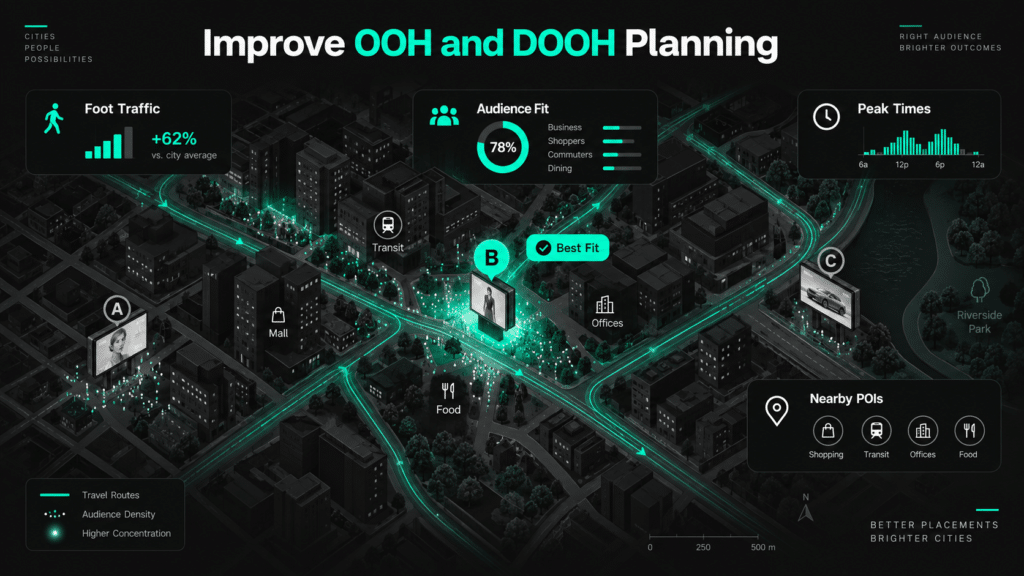
Mobility data in advertising is especially useful for OOH and DOOH planning.
A busy road does not automatically make a billboard valuable.
Advertisers also need to understand who moves through the area, when activity happens, and which destinations surround the placement.
Mobility data can add signals such as:
- Foot traffic
- Travel routes
- Peak activity times
- Nearby POIs
- Audience concentration
- Origin and destination areas
This helps teams compare OOH locations using real-world movement rather than traffic volume alone.
For broader OOH industry research, advertisers can also use resources from the Out of Home Advertising Association of America.
Factori’s marketing planning capabilities can add audience and location context to media decisions.
4. Add Audience Context to Location Activity
Mobility data shows where activity happens.
Audience data helps explain which broad customer groups are associated with that activity.
For example, two shopping centers may generate similar foot traffic.
One may attract more weekday professionals. The other may have stronger weekend family activity.
Those differences can affect:
- Campaign messaging
- Media timing
- Creative strategy
- Market-level budgets
- Audience selection
Combining mobility and audience data gives advertisers a more complete view than either dataset alone.
5. Measure Store Visits After Campaigns
One of the biggest uses of mobility data in advertising is offline measurement.
Clicks and impressions show digital engagement. They do not always show whether a campaign influenced store or venue visits.
Advertisers can study visit patterns before, during, and after campaigns.
Useful comparisons may include:
- Pre- and post-campaign visits
- Exposed and control audiences
- Test and control markets
- Store-level visit changes
- New and repeat visits
- Differences between audience groups
The strongest analysis focuses on incremental visits.
An attributed visit happened after campaign exposure. An incremental visit is estimated to have happened because of the campaign.
Learn more about footfall attribution and how it connects advertising exposure with real-world store visits.
6. Connect Digital Campaigns With Offline Behavior
Customer journeys often move between digital and physical channels.
A person may see an ad, visit a website, go to a store, compare products, and complete the purchase later.
Mobility data can add information about the physical part of this journey.
This helps advertisers evaluate campaigns using outcomes beyond clicks.
For location-based businesses, this provides a stronger link between digital advertising and offline behavior.
7. Understand Competitive Visitation
Geographic proximity does not always show which brands compete for the same audience.
Mobility data can reveal cross-visitation between locations.
A retailer may find that customers frequently visit a competitor several miles away but rarely visit a closer competitor.
This changes how the business may think about:
- Competitive targeting
- Market positioning
- Local media
- Conquest campaigns
- Audience overlap
The focus shifts from which competitor is closest to which competitor shares the same audience.
8. Personalize Advertising by Market
Customer behavior can vary significantly by location.
A campaign that performs well in a city center may not work the same way in a suburban market.
Advertisers can use mobility patterns to compare:
- Visit frequency
- Peak periods
- Travel distance
- Nearby destinations
- Competitive activity
- Trade areas
Trade area analysis can add more context by showing where visitors come from and how customer catchments differ between locations.
This allows marketers to adapt campaigns by market without depending on individual-level tracking.
9. Support Journey-Based Media Planning
Historical mobility patterns can show common movement between places.
A coffee brand may see strong morning movement along commuter routes.
A retailer may find that customers often visit a nearby shopping district before reaching one of its stores.
These patterns can help teams decide where and when advertising should appear.
Mobility data does not need to predict where one person will go next.
Its value comes from identifying repeatable patterns across larger audiences.
Mobility Data in Advertising: Main Use Cases
| Use Case | Mobility Insight | Advertising Application |
|---|---|---|
| Audience targeting | Places and categories visited | Build more relevant audience groups |
| Campaign timing | Visits by hour and day | Choose stronger campaign periods |
| OOH and DOOH | Movement around media locations | Compare placements |
| Local campaigns | Differences between markets | Adapt creative and media spend |
| Competitive analysis | Cross-visitation | Identify real-world audience overlap |
| Footfall attribution | Visits after campaign exposure | Measure offline impact |
| Market planning | Audience activity by location | Prioritize markets |
These use cases show how mobility data can connect advertising decisions with real-world behavior.
Privacy and Responsible Use
Privacy should remain central when using mobility data in advertising.
The analysis should focus on aggregated audience and movement patterns rather than identifying individual people.
Responsible practices can include:
- Permissioned collection
- Aggregation
- Anonymization
- Minimum audience thresholds
- Sensitive-place filtering
- Secure processing
- Clear retention policies
Advertisers should also understand the privacy requirements that apply in the markets where they operate.
The European Commission provides official information about EU data protection rules.
The California Attorney General provides information about CCPA.
Advertising teams can also review the IAB Digital Advertising Policy Resource Center.
For broader privacy risk management, the NIST Privacy Framework provides additional guidance.
Factori’s guide to consumer data privacy also covers privacy considerations for data-driven marketing.
Emerging Trends in Mobility Data in Advertising
Faster Campaign Optimization
More frequently updated mobility data can help marketers understand changes in traffic, local activity, weather-related behavior, and events.
This can support faster campaign adjustments.
Cross-Channel Measurement
Advertising teams are combining mobility data with audience, campaign, transaction, and digital engagement data.
This creates a wider view of campaign performance.
Privacy-Preserving Analytics
Aggregation, data minimization, sensitive-location controls, and secure analytical environments are becoming more important.
These approaches help teams use real-world data while reducing privacy risk.
Spatial AI
AI can help advertisers analyze large mobility datasets, identify geographic patterns, compare markets, and surface changes in audience movement.
However, AI outputs are only as reliable as the underlying data.
Accurate places, movement, and audience data remain essential.
How Factori Supports Mobility Data in Advertising
Factori helps advertising, marketing, and analytics teams work with aggregated movement, visit, Places, and audience data.
Teams can use Factori to support:
- Audience planning
- OOH and DOOH strategy
- Market comparison
- Campaign timing
- Competitive analysis
- Footfall attribution
- Offline measurement
Factori provides data through datasets, APIs, and its platform, helping teams connect real-world signals with existing advertising and analytics workflows.
Conclusion
Mobility data in advertising helps marketers connect campaign decisions with real-world behavior.
It can show where audiences are active, when locations receive visits, how people move between places, and whether campaigns are followed by changes in foot traffic.
This makes mobility data useful for audience targeting, OOH planning, campaign timing, competitive analysis, market planning, and offline measurement.
Its strongest value comes when mobility data is combined with accurate Places data, audience intelligence, strong attribution methods, and privacy-aware practices.
FAQs
What Is Mobility Data in Advertising?
Mobility data in advertising is aggregated movement and visit information used to improve campaign planning, targeting, OOH placement, market analysis, and offline measurement.
How Does Mobility Data Help Advertisers?
Mobility data helps advertisers understand where audiences spend time, when activity happens, which places they visit, and how real-world behavior differs between markets.
How Is Mobility Data Used in OOH Advertising?
Advertisers can use movement, foot traffic, audience concentration, nearby POIs, and time-of-day patterns to compare billboard and DOOH locations.
Can Mobility Data Measure Store Visits After Advertising?
Yes. Mobility data can support footfall attribution by comparing visit patterns after campaign exposure.
For stronger measurement, advertisers should use baselines, control groups, and incremental lift.
Is Mobility Data in Advertising Privacy-Safe?
It can be when strong privacy controls are used.
Analysis should focus on aggregated audience patterns, responsible sourcing, sensitive-place filtering, and minimum thresholds rather than individual tracking.