MCP, or Model Context Protocol, helps AI agents connect with external data, tools, APIs, and business systems through a structured connection layer. Instead of building separate custom integrations for every dataset or workflow, MCP gives AI applications a more consistent way to access approved systems and retrieve trusted context.
For enterprises, MCP makes AI agents more useful by helping them work with current, governed data instead of relying only on static model knowledge. When connected with external data, MCP can support workflows across analysis, planning, forecasting, targeting, and decision-making.
Key Takeaway
- MCP gives AI agents a standardized way to connect with external tools, APIs, datasets, and business systems instead of relying on separate custom integrations.
- The main value of MCP is better context. It helps AI agents work with current, trusted, and governed data rather than only static model knowledge.
- MCP does not replace APIs or RAG. It provides a structured layer that helps AI agents discover and use those systems more consistently.
- External data such as mobility, places, visits, audiences, and market signals can make AI workflows more useful for forecasting, targeting, market analysis, and location-based decisions.
- Factori MCP brings real-world data into AI workflows while supporting structured, privacy-aware access for use cases across marketing, retail, financial services, analytics, and strategy.
What Is MCP?
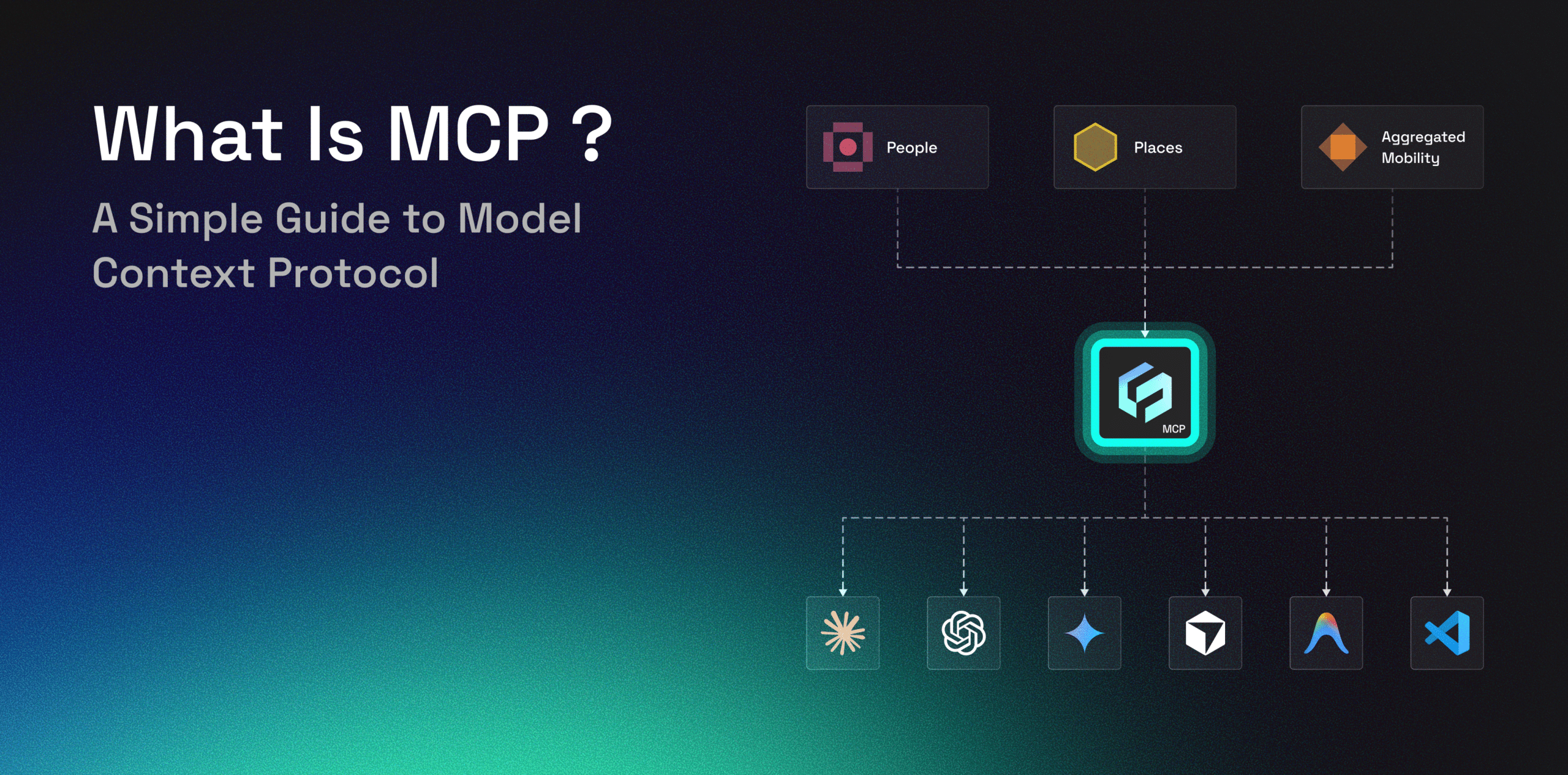
MCP stands for Model Context Protocol. It is a standard that helps AI applications connect with external systems in a structured way.
Without MCP, teams may need to build separate custom integrations between every AI tool and every data source. This can become difficult to manage as businesses use more AI agents, APIs, datasets, and enterprise applications.
MCP creates a common connection layer. It helps AI agents access tools, data, and context from approved systems without requiring every integration to be built from scratch.
In simple terms, MCP helps AI agents move from isolated answers to connected workflows.
Why MCP Matters for AI Agents
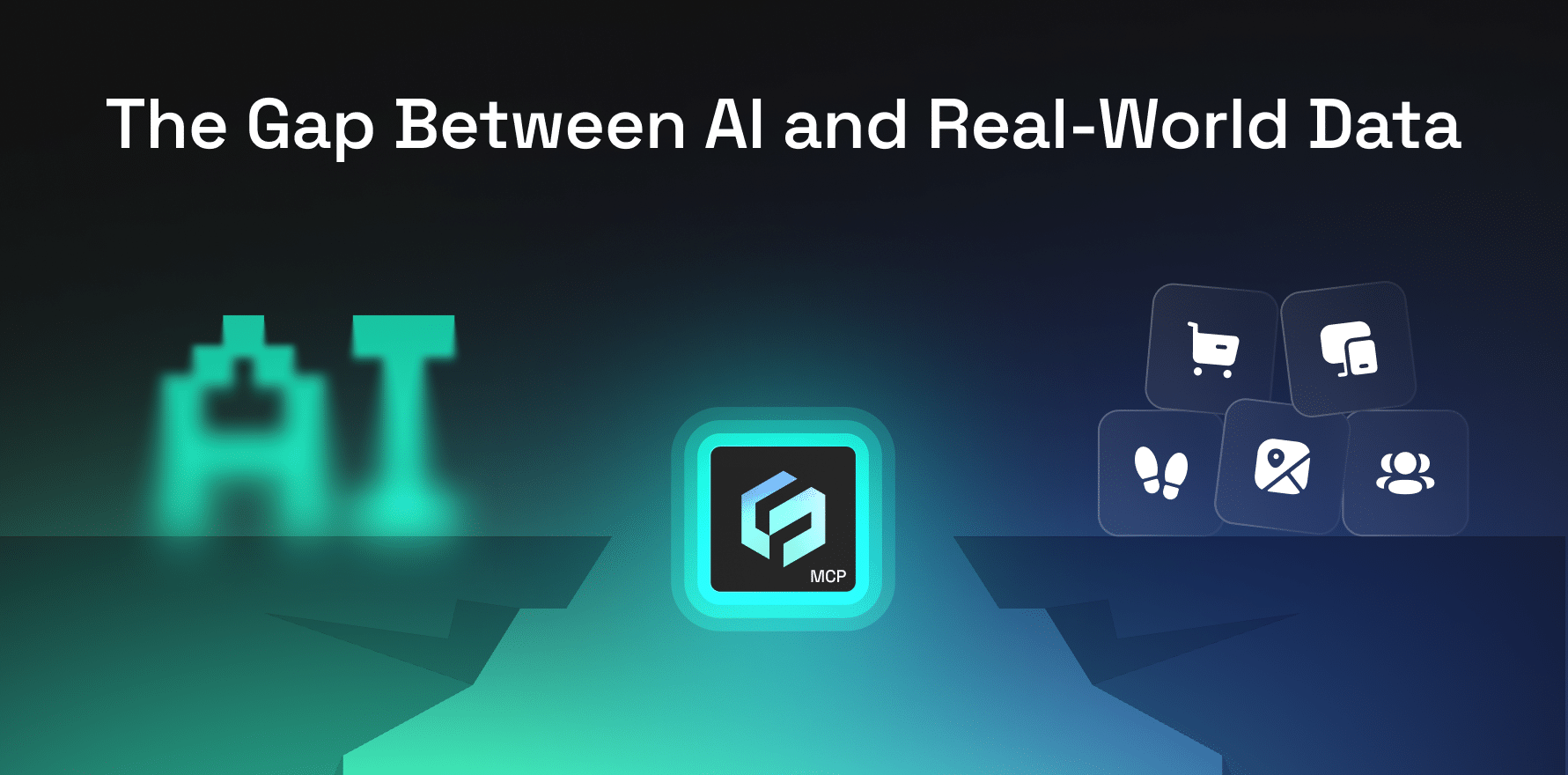
AI agents become more useful when they can work with relevant business context. A model may understand general concepts, but it may not know what is happening inside a company’s systems, markets, locations, customers, or operations.
Many businesses store valuable data across different systems, including:
- Databases
- APIs
- Analytics tools
- Internal knowledge systems
- Customer platforms
- External data sources
If an AI agent cannot access those systems, its answers may be limited. MCP helps by giving AI agents a more consistent way to connect with approved tools and datasets. This can reduce integration complexity and make AI workflows more useful for business use cases.
For example, instead of asking an AI agent a broad question and receiving a generic answer, a team could use MCP-enabled workflows to bring in trusted data before the answer is generated. This makes the response more grounded, timely, and relevant.
How MCP Works
MCP works by creating a structured connection between an AI application and an external system.
The main components are:
| Component | What it means |
| MCP Host | The AI application or agent environment where the user interacts |
| MCP Client | The connector that sends requests from the AI application |
| MCP Server | The system that exposes data, tools, or actions to the AI agent |
The basic workflow is simple:
- A user asks an AI agent a question or gives it a task.
- The AI agent identifies that external data or a tool is needed.
- The MCP client sends a structured request to the MCP server.
- The MCP server retrieves the relevant data or performs the allowed action.
- The AI agent uses the result to generate a more useful response.
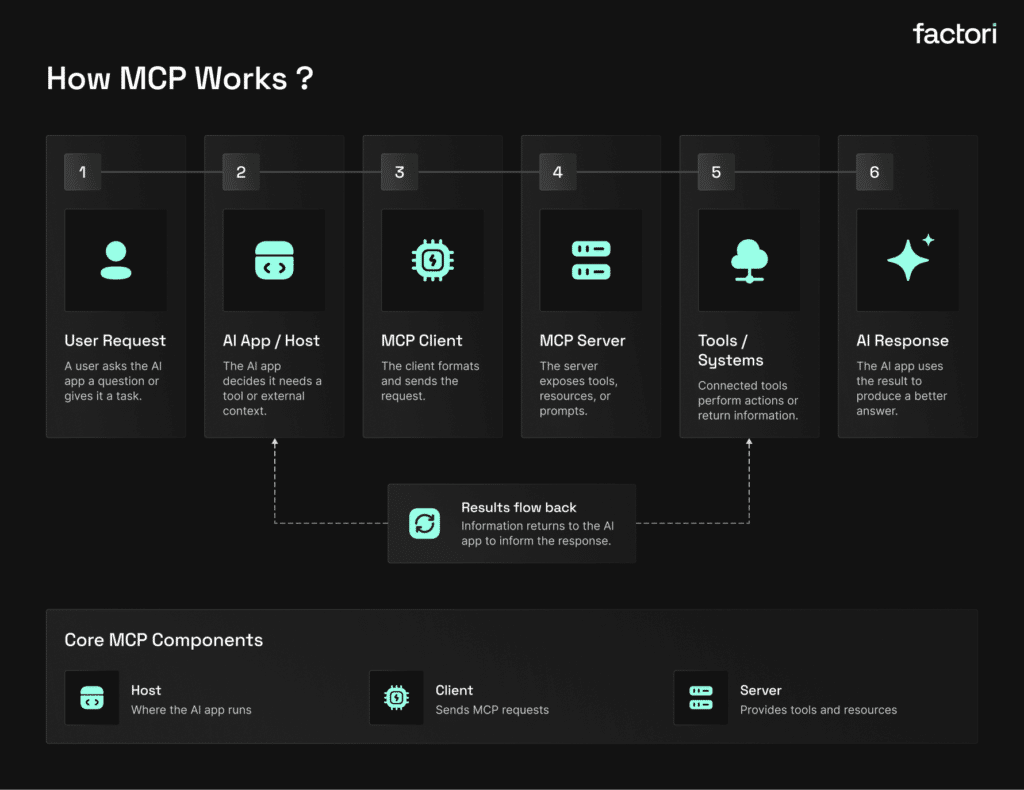
This structure makes MCP valuable for enterprise AI because it gives agents a repeatable way to access external context.
Benefits of MCP
MCP helps businesses connect AI agents with approved tools, systems, and datasets in a more consistent way. This reduces integration effort and makes AI workflows more useful for business decisions.
| Benefit | Why it matters |
| Faster integration | Reduces the need to build separate custom connections for every AI workflow |
| Better data access | Helps AI agents retrieve trusted context from approved data sources |
| More scalable workflows | Makes it easier to connect multiple tools, APIs, and datasets across use cases |
| Improved decision support | Gives AI agents more relevant information before generating answers |
| Stronger governance | Supports clearer controls around what agents can access and use |
| Better use of external data | Makes real-world datasets easier to bring into AI-assisted workflows |
For enterprises, MCP can help move AI from isolated chat-based answers to connected workflows that support analysis, planning, forecasting, targeting, and business decision-making.
MCP vs APIs vs RAG
MCP is often discussed alongside APIs and RAG, but they are not the same.
| Method | What it does | Best for |
| API | Lets software systems exchange data or trigger actions | Direct integrations between systems |
| RAG | Retrieves relevant content to improve AI responses | Knowledge search and document grounding |
| MCP | Standardizes how AI agents connect to tools and data | Agentic workflows and trusted data access |
MCP does not replace APIs or RAG. It can work with both.
An API may expose data or functionality. RAG may help retrieve useful information from documents or knowledge bases. MCP helps AI agents discover and use tools, APIs, and external data sources in a more standardized way.
MCP and External Data
External data is one of the most important opportunities for MCP.
Many enterprise AI workflows need more than internal documents or static knowledge. Teams often need real-world context to understand markets, locations, audiences, demand, and customer behavior.
Examples of external data include:
- Places data
- Mobility data
- Visit patterns
- Audience attributes
- Market activity
- Local demand signals
This data can help AI agents answer more practical business questions. For example, a retail team may want to compare location performance across trade areas. A marketing team may want to understand audience movement before planning a campaign. A financial services team may want to evaluate market activity around branches or service areas.
MCP makes easier for AI agents to query this type of data and use it inside structured workflows. Instead of manually exporting files or switching between disconnected tools, teams can bring trusted external context closer to the AI workflow.
How Factori MCP Supports AI-Ready Data Access
Factori MCP helps AI agents access Factori’s real-world datasets through a structured, AI-ready connection layer. This can make it easier for teams to query data about people, places, movement, visits, audiences, and markets inside AI workflows instead of relying only on manual extraction or disconnected files.
By bringing Factori’s external data closer to AI agents, teams can support use cases such as data enrichment, audience targeting, media planning, market intelligence, retail optimization, predictive analytics, and financial services strategy.
Factori MCP helps turn real-world signals into faster, more useful business context while supporting governed and privacy-aware data access.
Security, Governance, and Responsible Use
MCP can make AI agents more powerful, so governance matters.
If an AI agent can access tools and data, businesses need clear controls around what the agent can retrieve, use, or execute. This is especially important when working with external data, location intelligence, and audience insights.
Important considerations include:
- Permissioned access to approved systems
- Auditability of agent activity
- Clear limits on what agents can access or execute
- Protection against tool misuse
- Privacy-safe data handling
- Aggregated and responsible use of location intelligence
For location and audience data, businesses should avoid individual tracking, sensitive-place misuse, or any workflow that creates privacy risk. Data should be used in aggregated, privacy-aware, and responsible ways.
MCP can support more structured access, but the value depends on how carefully it is implemented.
Conclusion
MCP helps AI agents connect to trusted external data, tools, and systems through a more standardized approach. This matters because enterprise AI needs more than general model knowledge. It needs current, relevant, and governed business context.
For businesses, the value of MCP is not only technical. It can help make AI workflows more useful, connected, and decision-ready.
Factori MCP brings this value to real-world data access. By helping AI agents work with data about people, places, movement, visits, audiences, and markets, Factori MCP can support faster analysis across marketing, planning, forecasting, retail, financial services, and strategy workflows.
FAQs
1. Why is MCP becoming important for enterprise AI?
MCP is becoming important because enterprises want AI agents that can work with trusted data, tools, and systems instead of relying only on static model knowledge. It helps make AI workflows more connected, useful, and easier to scale.
2. What types of teams can benefit from MCP?
MCP can benefit data teams, analytics teams, AI teams, product teams, marketing teams, and business strategy teams. Any team that wants AI agents to work with structured tools or trusted business data can benefit from MCP-enabled workflows.
3. Can MCP support real-time or frequently updated data?
MCP can support access to current or frequently updated data when the connected data source or API provides it. The freshness depends on the system, dataset, or tool exposed through the MCP server.
4. What should businesses consider before using MCP?
Businesses should consider data permissions, security, governance, privacy, auditability, and whether the connected tools are reliable enough for production AI workflows. MCP should be implemented with clear controls around what AI agents can access or execute.
5. How can MCP improve decision-making?
MCP can improve decision-making by helping AI agents use relevant external context before generating answers or recommendations. This can make outputs more grounded, timely, and useful for planning, analysis, forecasting, targeting, and operational workflows.