Customer data helps businesses understand their customers, improve segmentation, personalize engagement, and make better decisions.
It can include identity, demographic, transaction, behavioral, preference, and location-based information. Together, these signals help teams understand how customers interact across channels and markets.
The value of customer data depends on its accuracy, organization, and responsible use. When it is enriched with signals such as mobility, place activity, visits, and audience intelligence, it can support marketing, analytics, media planning, predictive modeling, retail strategy, and customer acquisition.
Key Takeaway
- Customer data helps businesses understand customers, prospects, and accounts across identity, demographic, transactional, behavioral, preference, engagement, and location-based signals.
- Its value comes from supporting practical decisions such as segmentation, personalization, targeting, campaign measurement, forecasting, retail planning, and customer acquisition.
- First-party customer data becomes more useful when enriched with external context such as mobility, visits, POI, audience, identity, and market data.
- The biggest customer data challenges are often accuracy, duplication, outdated records, disconnected systems, missing real-world context, and privacy management.
- The strongest customer data strategies focus on data that is accurate, current, privacy-aware, and directly connected to a clear business use case.
What Is Customer Data?
Customer data is information a business collects, stores, or uses to understand its customers, prospects, or accounts.
It can include basic details such as name, email address, phone number, and customer ID. It can also include purchase history, preferences, online behavior, location patterns, and engagement activity.
Businesses use customer data across marketing, sales, customer service, analytics, product, and operations.
For example, a retailer may use customer data to identify frequent shoppers, personalize offers, measure campaign performance, and understand which markets have stronger growth potential.
In simple terms, customer data helps businesses decide who to reach, what to offer, where to invest, and how to improve customer relationships.

Why Customer Data Matters
Without reliable customer data, teams may depend on broad market averages, outdated reports, or incomplete views of their audience.
Customer data provides direct information about customer needs, preferences, purchases, and behavior.
It can help businesses:
- Build more accurate audience segments
- Improve marketing targeting
- Personalize messages and offers
- Identify high-value customers
- Improve retention and customer lifetime value
- Support forecasting and market planning
Customer data is also an important input for analytics and predictive models.
When enriched with external signals such as mobility, visit patterns, POI data, and consumer attributes, it can provide a broader view of how customers behave across both digital and physical environments.
Main Types of Customer Data
Customer data comes in several forms. Each type answers a different question about the customer.
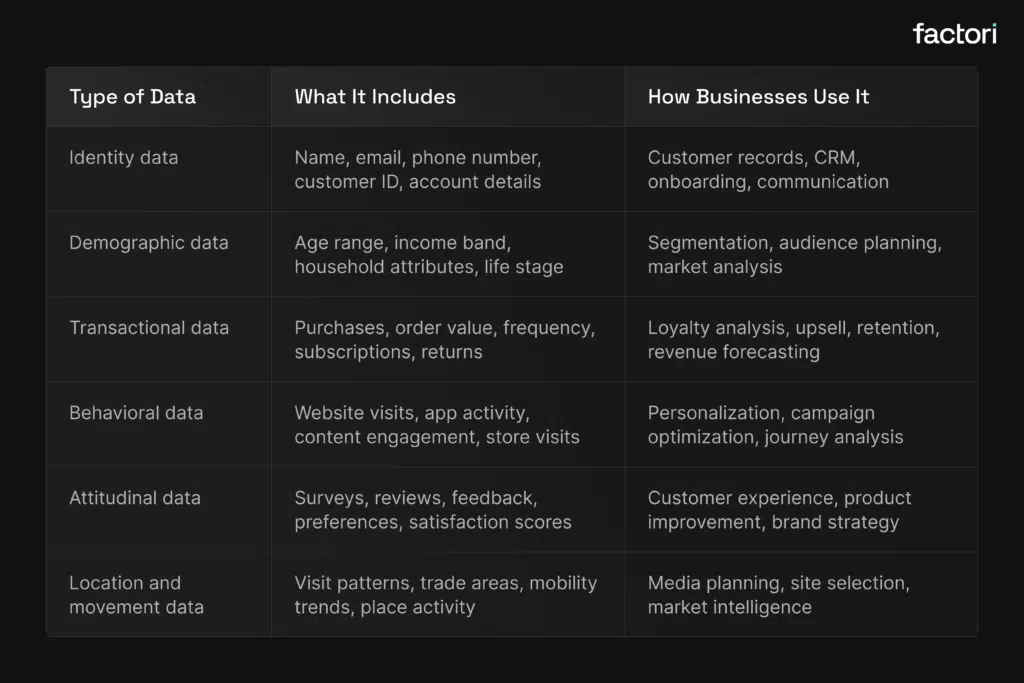
The strongest customer strategies often combine several data types.
For example, transaction data can show what a customer bought. Behavioral data can show how they engaged before the purchase. Location intelligence can then show how activity differs across stores, markets, or trade areas.
Explore how retail site selection combines customer data with mobility and POI signals to evaluate locations and trade areas.
Customer Data Use Cases
Customer data supports decisions across marketing, analytics, retail, financial services, travel, gaming, and customer experience.
Audience Segmentation
Customer data helps businesses group customers based on shared attributes, behaviors, preferences, purchases, or location activity.
A brand may create segments for frequent buyers, high-value customers, lapsed customers, category shoppers, or customers in particular markets.
These segments can improve targeting, messaging, campaign planning, and product strategy.
External audience and movement data can add more context. Teams may be able to understand where customer groups spend time, which places they visit, and which behaviors indicate demand or intent.
Data Enrichment
Data enrichment adds external attributes or signals to existing customer records.
A company may already have first-party data from purchases, loyalty programs, CRM systems, or website activity. That information can be enriched with mobility, visit, POI, people, consumer, audience, identity, web stream, or cross-device data.
This can help businesses build a more complete view of customers and improve segmentation, analytics, and activation.
Identity data can also support privacy-aware record matching and cross-device linkage across approved customer touchpoints.
The goal is not to collect more data simply because it is available. The goal is to make existing customer information more useful for business decisions.
Personalization
Customer data helps businesses tailor messages, offers, recommendations, and experiences.
An ecommerce company may personalize product recommendations using browsing and purchase history. A retailer may adapt offers based on shopping frequency, category interest, and local market behavior.
A travel brand may use preferences and behavioral signals to improve the timing and relevance of destination recommendations.
Useful personalization depends on having accurate data and a clear understanding of customer needs.
Media Planning and Measurement
Marketing teams use customer data to decide who to reach, where to invest, and how to measure results.
Customer and audience data can help identify high-value segments, prioritize markets, plan campaigns, and measure outcomes.
Movement and visit data can also provide real-world context. For example, marketers may study whether store visits or activity around specific locations changed after a campaign.
This can be useful for retail, travel, hospitality, quick-service restaurants, and out-of-home advertising.
Predictive Analytics
Customer data is an important input for predictive models.
Businesses may use it for churn prediction, customer lifetime value, demand forecasting, propensity scoring, and next-best-action models.
Historical customer data shows what happened in the past. Real-world signals can add context about what is happening now across locations, audiences, and markets.
Combining both can help models better reflect changing customer behavior.
Retail and Site Strategy
Retailers use customer data to understand trade areas, store performance, customer movement, local demand, and competition.
This information can support site selection, expansion planning, merchandising, catchment analysis, and market optimization.
For example, a retailer evaluating a new store can combine customer information with mobility and POI data.
This can help the retailer understand nearby demand, visitor patterns, competitor presence, and how people move through the area.
Financial Services Strategy
Banks, lenders, and other financial services companies can use customer data for segmentation, market analysis, branch planning, ATM network strategy, and customer acquisition.
For example, customer data can help teams understand service demand across markets and evaluate branch catchments.
It can also support more relevant outreach for financial products when used responsibly and with appropriate privacy controls.
Common Customer Data Challenges
Most businesses already collect customer data. The bigger challenge is making that data accurate, connected, current, and useful.
Customer information may be spread across CRM, analytics, sales, marketing, and customer-service systems. The same customer may appear more than once, while some records may contain missing or outdated information.
Internal data can also lack real-world context.
A business may understand what a customer did on its website but know much less about market-level movement, place activity, or competitive conditions.
Privacy and consent also need to be managed carefully. Businesses need clear rules for how customer information is collected, enriched, connected, and activated.
Solving these challenges requires more than a place to store data. It requires strong governance, reliable enrichment sources, consistent records, and workflows that connect customer information to real decisions.
How to Make Customer Data More Useful
More customer data does not automatically lead to better decisions.
Businesses should focus on whether the information is accurate, relevant, current, and connected to a specific use case.
Before adding new data, teams should ask whether it helps answer an important question.
Does it improve customer segmentation? Does it make a forecast stronger? Does it help identify a better market? Can it improve campaign measurement or customer retention?
The strongest customer data strategies connect internal information with the external context needed to explain customer behavior.
How Factori Helps Businesses Use Customer Data
Factori helps businesses enrich customer information with real-world signals about people, places, movement, visits, audiences, and markets.
Teams can combine their first-party customer records with Factori datasets to add context around customer behavior and market activity.
This can support audience segmentation, targeting, media planning, campaign measurement, retail strategy, market intelligence, and predictive analytics.
Factori’s datasets, APIs, and platform workflows are designed to make external data easier to connect with existing business systems while supporting privacy-aware use.
About Factori
Factori is a partner-powered real-world data platform offering standardized, enterprise-ready datasets across mobility, places, people, audiences, identity, retail, market, economic, events, property, business, and geo data.
Each dataset is designed to support privacy-aware use and integration with existing data workflows.
Teams can access Factori data through APIs, raw data, applications, MCP, and agentic workflows.
Conclusion
Customer data is an important asset for understanding and serving customers.
It helps teams improve segmentation, personalize engagement, plan campaigns, measure results, and forecast demand.
Its value increases when the data is accurate, connected, privacy-safe, and enriched with real-world context.
By combining internal customer records with signals such as mobility, places, visits, and audience intelligence, businesses can make decisions that better reflect how customers behave across digital and physical environments.
FAQs
What Is Customer Data?
Customer data is information a business collects or uses to understand customers, prospects, or accounts.
It can include identity, demographic, behavioral, transactional, preference, engagement, and location-based information.
What Are the Main Types of Customer Data?
The main types include identity data, demographic data, transactional data, behavioral data, attitudinal data, and location or movement-based data.
Each type provides a different view of the customer.
Why Is Customer Data Important?
Customer data helps businesses understand customer needs, improve segmentation, personalize campaigns, increase retention, forecast demand, and make stronger marketing, sales, product, and customer experience decisions.
What Is Customer Data Enrichment?
Customer data enrichment is the process of adding external attributes or signals to existing customer records.
It can help businesses create a more complete and useful customer view for analytics, targeting, and decision-making.
How Can Customer Data Improve Marketing?
Customer data helps marketers build better audiences, personalize messages, improve targeting, select stronger markets, and measure campaign performance across digital and real-world channels.