
A target audience can look ideal in a campaign brief and still fall apart when media buying begins. Add more criteria, narrow the geography, apply channel constraints, and a segment that started with hundreds of thousands of people can quickly become too small to support the campaign.
Audience planning should surface that problem before budget is committed. The goal is not only to define who the campaign should reach, but to determine whether enough of that audience can actually be reached in the right markets and through the right channels.
Key Takeaway
- Target audience size and addressable reach are not the same thing.
- Every additional targeting criterion can improve relevance while reducing usable scale.
- Geographic concentration can matter more than national audience size.
- Audience sizing should influence channel selection, market prioritization, and budget allocation.
- A strong audience plan proves that the segment is commercially usable before media is purchased.
What Is Audience Planning?
Audience planning is the process of defining, sizing, and evaluating the consumer groups a campaign should prioritize before media is selected or purchased.
It connects the audience definition with reach, geography, channel availability, and campaign objectives. Rather than building a segment and assuming it can be activated, audience planning tests whether that segment has enough usable scale to support the media strategy.
The Gap Between a Target Audience and an Addressable Audience
A target audience describes the people a marketer wants to reach.
An addressable audience is the portion of that group that can realistically be reached through the available media and activation environment.
Those numbers can be very different.
A campaign may identify 600,000 consumers who match its selected audience criteria. But geography, channel availability, matching, exclusions, and activation constraints can reduce the number that is actually reachable.
This is why the quality of the underlying audience data matters. A large theoretical audience has limited value if the available signals cannot support meaningful segmentation or downstream activation.
| Audience layer | What it represents |
|---|---|
| Potential audience | Everyone who broadly fits the market or category |
| Target audience | People who match the campaign criteria |
| Addressable audience | The portion that can realistically be reached |
Media planning should be based much closer to the third number than the first.
Why Audience Size Can Collapse Before Activation
Audience size rarely disappears because of one major decision. It usually shrinks through a series of reasonable choices.
A campaign may start with consumers in Phoenix, then narrow to selected parts of the market, relevant category or lifestyle context, people associated with certain places, and additional campaign exclusions.
Each criterion may make strategic sense. Together, they can reduce the audience far more than expected.
The same can happen later when the campaign adds market restrictions, platform requirements, exclusions, or channel-specific addressability.
This is why planning teams should not treat a more detailed audience definition as automatically better. The question is whether each additional restriction improves expected campaign relevance enough to justify the reach being lost.
Size the Audience While You Are Building It
Audience sizing works best as an iterative process rather than a final check.
A practical workflow looks like:
Audience hypothesis → Criteria → Estimated size → Refinement → Addressable reach
Start with the business objective and build only the characteristics that matter to that decision.
For example:
“Reach consumers in Phoenix who fit a premium home-furnishing audience and show relevant category or real-world place affinity.”
The initial audience might combine geography, category context, available lifestyle signals, resident or visitor status, and relevant visitation patterns.
At that stage, planners should already be looking at the resulting audience size.
People Data can add broader consumer context to the planning process, while geographic and real-world signals can help make the audience more relevant to the campaign.
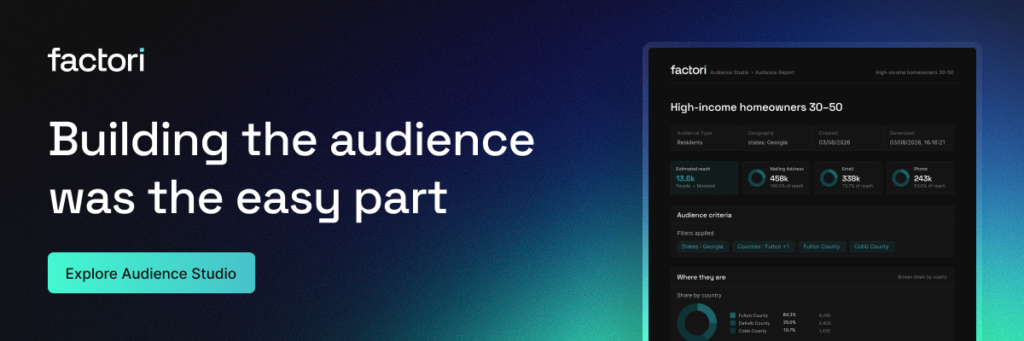
Factori Audience Studio supports this type of iterative planning by allowing teams to build an audience using plain language or structured criteria, review its size, and refine the definition before moving downstream.
The useful workflow is:
Define → Size → Refine → Size Again
The objective is not maximum precision. It is usable precision.
When More Precision Starts Hurting Reach
Consider a campaign testing three definitions.
| Audience | Approximate profile | Planning implication |
|---|---|---|
| Broad | Consumers across Phoenix | High scale, limited differentiation |
| Focused | Consumers in priority areas with relevant category or lifestyle context | Stronger relevance with usable reach |
| Hyper-specific | Focused audience plus several narrow visitation or behavioral conditions | Strong fit in theory, but limited scale |
The third audience may look closest to the campaign hypothesis. That does not mean it should automatically receive the media budget.
If a new criterion cuts the addressable audience significantly while adding little decision value, it may be better removed.
This is where audience segmentation analysis becomes useful. A segment should not be considered better simply because it is smaller or more detailed. The differences should be meaningful enough to justify a different targeting or media decision.
This is one reason audience planning should happen before channel budgets are fixed. It gives marketers room to adjust the definition instead of forcing an undersized segment into an already-approved media plan.
Market Concentration Can Matter More Than National Reach
A national audience count can hide where the real opportunity exists.
Suppose 400,000 consumers match the campaign criteria. If 180,000 of them are concentrated in six metropolitan areas, those markets may deserve a different media strategy from the rest of the country.
That concentration could support local OOH or DOOH, market-specific digital campaigns, retail activations, or heavier media investment in selected regions.
If the same 400,000 consumers are spread evenly across the country, a highly localized strategy may make less sense.
This is why audience planning should include geographic distribution, not only total reach.
Audience Studio provides a map view alongside audience sizing, which can help teams see whether the audience is concentrated in the markets that matter before media allocation begins.
The planning question changes from:
“How many people match?”
to:
“Where are enough matching people concentrated to justify spend?”
Audience Planning Should Change the Media Plan
Once the audience has been sized and mapped, it should influence channel selection.
A geographically concentrated audience may support OOH, DOOH, local sponsorships, regional media, or market-level activation.
A dispersed but highly addressable audience may be better suited to broader programmatic or digital channels.
A segment tied closely to known customers or prospects may make CRM or first-party activation more important.
Different audience targeting strategies require different combinations of audience data, geography, channels, and activation methods. The audience definition should therefore help determine the media plan, not be retrofitted after channels have already been chosen.
If the media mix is fixed first, planners may end up forcing the audience into channels that do not match its scale or distribution.
A Practical Audience-Sizing Scenario
Consider a premium furniture retailer preparing a launch campaign in Phoenix.
The first audience definition might be:
Consumers across Phoenix
That provides scale but limited targeting value.
The planning team could then narrow the audience to selected parts of the market and add relevant category or lifestyle context.
A second layer could incorporate visitors associated with furniture, home-improvement, interior-design, or related retail locations.
The audience now has stronger campaign relevance, but its addressable size may also fall.
At that point, the decision is not whether the most filtered audience is technically more specific. It is whether each additional condition improves the media decision enough to justify losing reachable consumers.
The team may decide to keep one focused core audience and a broader expansion audience rather than forcing every desirable characteristic into a single segment.
That is audience planning doing its job before media spend begins.
What to Do When the Audience Is Too Small
An undersized audience does not automatically mean the campaign idea is wrong.
First, look at the criteria. Some conditions may be desirable but not essential. Removing one or two can restore scale without materially changing the audience hypothesis.
Geography can also be reconsidered. A campaign may expand from selected ZIP codes to a broader metro, or prioritize several high-density markets rather than insisting on one small area.
Channel strategy is another lever. An audience that is too small for one activation environment may still be viable through a different media mix.
Teams can also separate audiences into tiers. A narrow core audience can receive higher-priority investment while a broader secondary audience provides additional reach.
What to Do When the Audience Is Too Broad
Too much scale creates the opposite problem.
A very broad segment may be easy to activate but waste budget on consumers with weak relevance to the campaign.
In that case, planners should add criteria connected directly to the business objective. For a retail campaign, relevant geography, category affinity, or visitation to related types of places may add more value than stacking generic filters.
The goal is not to narrow for the sake of narrowing.
It is to identify the few signals that materially improve the likelihood that the audience fits the campaign.
Addressable Reach Is a Planning Estimate, Not a Guarantee
Even a strong pre-campaign estimate should not be treated as a guaranteed outcome.
Actual reach can change because of inventory availability, channel delivery, matching, frequency, competition, bid dynamics, and other campaign conditions.
Identity and matching can also affect how much of a target audience becomes usable downstream. An identity graph can help connect identifiers and audience signals across systems, but addressability still depends on the activation environment and the available match paths.
That is why audience planning should connect to post-campaign measurement.
After activation, teams should compare the planning assumptions with what actually happened. Did the campaign reach the expected share of the audience? Were some markets easier to reach than others? Did the tighter audience outperform the broader alternative?
Those answers improve the next audience plan.
The process becomes:
Define → Size → Buy → Measure → Refine
Conclusion
Audience planning should answer a simple question before media is purchased:
Is this audience actually usable?
A strong audience is not merely well defined. It needs enough addressable scale, the right geographic distribution, and a realistic path into the channels the campaign plans to use.
By sizing and refining the audience before budget is committed, media teams can avoid two expensive mistakes: buying too broadly and building an audience so narrow that there is hardly anyone left to reach.
FAQs
What is the difference between audience planning and media planning?
Audience planning determines which consumers should be prioritized and whether enough of them can be reached. Media planning decides which channels, formats, markets, schedules, and budgets should be used to reach them.
What is addressable reach?
Addressable reach is the portion of a defined target audience that can realistically be reached through available media, identity, matching, or activation methods.
How large should an addressable audience be?
There is no universal minimum. The required size depends on the campaign objective, budget, geography, channel, frequency requirements, and expected cost of reaching the audience.
Why can addressable reach be smaller than the target audience?
Geographic restrictions, channel availability, matching, identity coverage, exclusions, and activation requirements can all reduce the portion of a target audience that can actually be reached.
Should audience planning happen before channel selection?
Ideally, yes. Understanding audience scale and geographic concentration first can help determine which channels and markets are practical rather than forcing the audience into a predetermined media plan.