
Choosing the right location is one of the most important decisions for any business with physical sites. A store, branch, restaurant, gym, or service location may look strong because of rent, visibility, traffic counts, nearby businesses, or population density. But these inputs do not always show whether people actually visit the area or whether the location fits the business.
Mobility data helps businesses make site selection more evidence-based. It shows how people move, where they visit, when activity is strongest, and how a potential site compares with nearby locations. When combined with other business and market data, mobility data can help teams reduce guesswork and choose locations with stronger performance potential.
Why Traditional Site Selection Inputs Are Not Enough
Traditional site selection inputs are still useful. Businesses need to understand population density, income levels, rent, road visibility, traffic counts, nearby businesses, and property availability before choosing a location.
But these inputs are incomplete on their own. They show what an area looks like on paper, not how people actually behave there.
For example, a busy road may have high vehicle traffic, but that does not mean people are stopping nearby. A dense neighborhood may have a large population, but it may not attract the right type of movement for a specific business. A low-rent site may reduce operating costs, but it may also have weak foot traffic or poor customer access.
Nearby businesses can also be misleading. Some may attract useful traffic, while others may pull demand away. A location may look strong in a static analysis but still underperform if people visit at the wrong time of day, choose nearby competitors, or do not spend enough time in the area.
This is where mobility data adds value. It helps businesses understand the movement patterns behind the location.
How Mobility Data Improves Site Selection
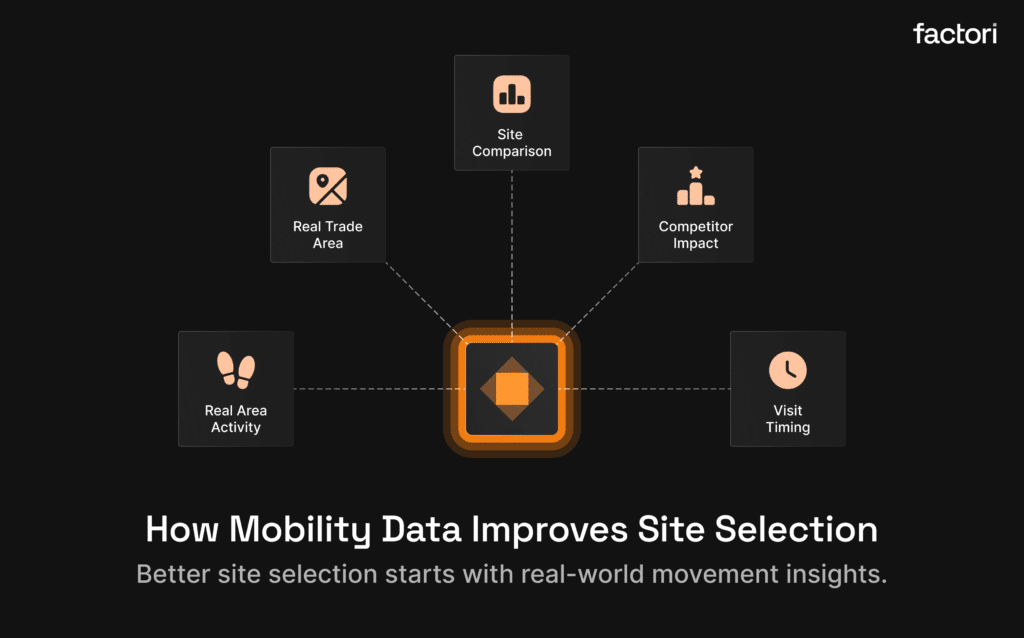
Mobility data gives businesses a clearer view of how people interact with an area. Instead of relying only on static inputs, teams can understand real activity, visitor behavior, trade areas, and nearby demand.
Shows Real Area Activity
Mobility data helps businesses understand whether an area has steady movement, weak activity, seasonal demand, weekday traffic, or weekend traffic.
This matters because not all activity is equal. A location may be busy only during tourist season. Another may be active during weekdays but quiet on weekends. Some areas may have strong morning traffic but weak evening demand.
By studying real area activity, businesses can avoid assuming that a visible property, dense neighborhood, or busy road will automatically lead to strong location performance.
Helps Identify the Real Trade Area
A trade area should not only be based on a fixed radius or drive-time map. Those methods can be useful, but they do not always show where visitors actually come from.
Mobility data can help identify the real trade area around a location. It can show whether visitors come from nearby residential areas, office districts, commuter routes, tourist zones, or destination hubs.
This helps businesses understand the true demand base around a site. A grocery store may depend on repeat local visitors. A restaurant may need office workers, hotel guests, or entertainment traffic. A fitness center may need a strong residential or workplace catchment.
When businesses understand the real trade area, they can make better decisions about whether a location fits their customer base.
Reveals When People Visit
Timing matters in site selection. A location that looks active overall may still be wrong for a business if activity happens at the wrong time.
Mobility data can show peak days, peak hours, weekday patterns, weekend behavior, and seasonal changes. This helps businesses match location activity with their operating model.
For example:
- Coffee shops need strong morning activity.
- Restaurants need lunch, dinner, or weekend movement.
- Grocery stores need repeat local visits.
- Fitness centers need early morning and evening movement.
- Banks need weekday daytime accessibility.
Without this view, a business may choose a location that has traffic, but not the right traffic at the right time.
Helps Compare Potential Sites
Mobility data helps teams compare shortlisted locations using the same signals. This makes the site selection process more consistent.
Two sites may look similar based on rent, visibility, and nearby demographics. But mobility data may show that one location has stronger repeat visits, better visitor origin patterns, more stable demand, or stronger nearby activity.
This makes it easier to rank potential sites based on actual movement instead of relying only on assumptions or local market opinions.
Shows Competitor and Nearby Location Impact
Nearby locations can support or weaken a site. Mobility data helps businesses understand whether nearby businesses bring useful traffic, create competition, or pull visitors away.
For example, restaurants may benefit from office buildings, hotels, entertainment venues, and shopping areas. Retail stores may benefit from malls, high streets, and complementary brands. Bank branches may need movement from residential areas, business districts, and commuter corridors.
Mobility data can also show how competitor locations perform in terms of visits, repeat activity, and trade area reach. This helps businesses understand whether a market is attractive, crowded, underserved, or at risk of cannibalization.

Key Mobility Data Signals for Site Selection
The most useful mobility data signals depend on the business type, location format, and market. But several signals are commonly used in site selection.
| Signal | Why It Matters |
| Foot traffic volume | Shows how active the area is |
| Visit frequency | Shows whether people return often |
| Peak days and hours | Shows when demand is strongest |
| Visitor origin | Shows where visitors come from |
| Dwell time | Shows how long people stay in the area |
| Repeat visits | Shows routine behavior |
| Competitor visits | Helps compare nearby alternatives |
| Seasonality | Shows whether activity is stable or temporary |
| Trade area overlap | Helps avoid cannibalization between locations |
These signals help businesses understand not just whether a location is busy, but whether it is busy in the right way.
How Mobility Data Works With Other Site Selection Data
Mobility data should not be used alone. It becomes more useful when combined with other business and market signals.
| Dataset | Role in Site Selection |
| Places data | Shows nearby businesses and competitors |
| Retail sales data | Shows category demand and spending patterns |
| Demographic data | Shows who lives or works nearby |
| Economic data | Shows local income, employment, and market strength |
| Property data | Shows rent, size, frontage, and availability |
| Internal sales data | Helps compare against existing store performance |
For example, mobility data may show that an area has strong movement. Retail sales data can help show whether that movement connects to category demand. Places data can show which nearby businesses may support or compete with the location. Demographic and economic data can help explain whether the local market fits the target customer.
Together, these datasets give businesses a stronger view of location potential.
Common Mistakes to Avoid
Mobility data can improve site selection, but it should not be used in isolation. Teams need to connect movement patterns with customer fit, business type, nearby demand, and market context.
Common mistakes include:
- Choosing a site only because foot traffic is high: High movement does not always mean the right audience or visit intent.
- Using fixed-radius trade areas: A simple radius may not reflect how people actually travel to the area.
- Ignoring time patterns: Weekday, weekend, morning, evening, and seasonal activity can all affect site potential.
- Assuming road traffic means store visits: People may pass through an area without stopping.
- Ignoring competitors: Nearby competitors may already capture most of the relevant demand.
- Using mobility data alone: It should be combined with sales, places, demographic, economic, property, and internal data.
The goal is to use mobility data to test assumptions and reduce the risk of choosing a location that looks good on paper but does not perform in the real world.
How Factori Helps With Mobility Data for Site Selection
Factori helps businesses use mobility, places, retail sales, people, consumer, market, economic, and geo data to make better location decisions.
For site selection, Factori can help teams compare movement around potential sites, understand visitor origins and trade areas, analyze nearby competitors and businesses, identify high-demand markets, and connect mobility patterns with retail sales and category demand.
Through Factori’s datasets, platform, APIs, and MCP, teams can bring site selection data into existing planning, analytics, and forecasting workflows. This helps businesses move from static location research to more informed decisions based on real-world movement and market context.
About Factori
Factori is a partner-powered real-world data platform offering 13 standardized, enterprise-ready datasets including:
Mobility | Places | People | Audiences | Identity | Retail | Market | Economic | Events | Property | Business I Geo
Each dataset is governed, privacy-safe, and designed to join cleanly with your existing data stack, whether you’re working in SQL, a data warehouse, a BI tool, or an ML pipeline. No black boxes, no mystery sources, just real-world signals about how people move, shop, work, and live, delivered the way your team works: via API, raw data, app, MCPs, or agentic workflows. Explore datasets suitable for your use case and available for your market.
Talk to an Expert Get Started
Conclusion
Mobility data helps businesses make better site selection decisions by showing how people actually move around potential locations. It helps teams look beyond static inputs such as demographics, rent, visibility, and traffic counts.
By understanding area activity, visitor origins, visit timing, competitor impact, and trade area behavior, businesses can choose locations with stronger demand potential. The strongest site selection decisions come from combining mobility data with places, retail sales, demographic, economic, property, and internal business data.
FAQs
How is mobility data used in site selection?
Mobility data is used to evaluate foot traffic, visitor origins, trade areas, peak visit times, competitor activity, and movement patterns around potential locations.
Why is mobility data important for site selection?
Mobility data helps businesses understand whether people actually visit an area, when activity is strongest, and whether a location fits the target customer.
Can mobility data reduce site selection risk?
Yes. Mobility data can help identify weak activity, poor customer fit, seasonal dependency, competitor pressure, and trade area limitations before a business commits to a location.
What data should be combined with mobility data?
Mobility data should be combined with places data, retail sales data, demographic data, economic data, property data, and internal sales data.
Which businesses use mobility data for site selection?
Retailers, restaurants, grocery stores, banks, fitness centers, fuel stations, healthcare providers, hospitality brands, and commercial real estate teams can use mobility data for site selection.