
Behavioral data helps businesses understand what people do across digital and physical environments.
It can show how customers browse websites, use apps, make purchases, visit stores, move through areas, engage with content, and respond to brands.
For businesses, this matters because actions often reveal intent and demand more clearly than static profiles. When behavioral data is combined with location, audience, mobility, and market signals, it can support targeting, personalization, forecasting, site selection, campaign measurement, and customer analysis.
Key Takeaway
- Behavioral data shows what people actually do across digital and physical environments, including clicks, purchases, visits, movement, and engagement.
- It can support targeting, personalization, forecasting, site selection, campaign measurement, and market analysis.
- Combining behavioral data with location, mobility, audience, and market signals gives businesses a more complete view of demand and customer intent.
- The most useful behavioral data strategies start with a clear business question and connect multiple signals to a specific decision.
- Behavioral data should be used responsibly, with privacy-safe, permissioned, and aggregated approaches where appropriate.
What Is Behavioral Data?
Behavioral data is information about what people, customers, or audiences do.
It focuses on actions and interactions rather than only describing who someone is.
This data can come from websites, apps, purchase systems, physical locations, media channels, and customer touchpoints.
Examples include:
- Website clicks
- App sessions
- Product purchases
- Store visits
- Search activity
- Repeat visits
- Content engagement
In simple terms, behavioral data helps businesses move from assumptions to observed actions.
Types of Behavioral Data
Behavioral data can come from several sources. The most useful type depends on the business goal.
Digital Behavioral Data
Digital behavioral data shows how people interact with websites, apps, and online content.
It can include page views, clicks, searches, app sessions, form submissions, cart activity, and content engagement.
Businesses use this data to improve digital experiences, understand user intent, personalize journeys, and plan campaigns.
For example, an ecommerce company may study browsing and cart behavior to understand which products customers are interested in before they buy.
Purchase and Transaction Behavior
Purchase behavior shows what people buy, how often they buy, and how spending changes over time.
It can include products purchased, purchase frequency, basket size, repeat purchases, category preferences, and subscription activity.
Businesses can use this data for demand planning, retention, loyalty, merchandising, and customer value analysis.
For example, a retailer may use purchase trends to identify growing categories or understand which customers are more likely to return.
Location and Visit Behavior
Location and visit behavior shows how people interact with physical places.
This may include store visits, footfall, dwell time, visit frequency, trade area behavior, peak activity periods, and visits to competing locations.
It is especially useful for retailers, restaurants, banks, hospitality businesses, real estate teams, and media planners.
It can help answer questions such as:
- Which locations attract more repeat visits?
- When is activity highest?
- Are people actually visiting an area?
- How does one store compare with nearby competitors?
Mobility and Movement Behavior
Mobility behavior focuses on how people move between places over time.
This can include movement flows, commuting patterns, travel behavior, origin-destination trends, and visitor inflow or outflow.
Businesses use mobility behavior for demand forecasting, catchment analysis, media planning, travel strategy, and market intelligence.
For example, a travel brand may study movement patterns to understand where visitors come from and when demand is likely to increase.
Audience and Engagement Behavior
Audience behavior shows how groups engage with brands, content, places, and channels.
This may include media engagement, brand affinity signals, interest patterns, channel interactions, and segment-level activity.
Businesses can use these signals for targeting, segmentation, campaign measurement, and data enrichment.
For example, marketers can build audience groups based on real-world interests and visit patterns instead of relying only on broad demographic assumptions.

Why Behavioral Data Matters for Businesses
Behavioral data shows what people actually do.
This makes it useful for businesses that want to understand demand, customer intent, and changing behavior instead of relying only on surveys or static profiles.
Behavioral data can help teams understand where activity is growing, which audiences are engaging, which locations are performing well, and how behavior changes over time.
It can also support:
- Better targeting
- More relevant personalization
- Stronger forecasting
- Location optimization
- Campaign measurement
- Market opportunity analysis
The strongest use of behavioral data starts with a clear business question.
A retailer may want to know where to open a new store. A marketer may want to know which audiences are most likely to visit a location. A data science team may want to improve a demand forecast with real-world signals.
Common Business Use Cases of Behavioral Data
Data Enrichment
Behavioral data can enrich CRM, customer, first-party, and audience data.
It adds context around interests, movement, visits, purchases, and engagement.
This helps businesses understand not only who a customer is, but also how that customer behaves across channels and real-world environments.
Audience Targeting and Segmentation
Businesses can use behavioral data to build more relevant audience segments.
Instead of grouping people only by broad profile attributes, teams can use website activity, purchase behavior, store visits, category interest, media engagement, location behavior, and movement patterns.
This helps marketers reach audiences based on what they do.
Media Planning and Measurement
Behavioral data can support both campaign planning and measurement.
Before a campaign runs, marketers can study where target audiences spend time, which areas have strong activity, and which places are relevant to the campaign.
After the campaign, teams can look for changes in visits, engagement, demand, or audience response.
Visual suggestion: Show campaign exposure → audience behavior → visit or engagement change.
Retail and Site Selection
Retailers can use visit and mobility behavior to compare locations, study trade areas, benchmark competitors, and identify expansion opportunities.
Behavioral data can also help separate actual destination activity from simple pass-through traffic.
This is useful for store expansion, restaurant planning, branch network optimization, and local market analysis.
Predictive Analytics and Forecasting
Behavioral signals can improve predictive models by adding real-world context.
Businesses may use them to forecast footfall, demand, sales, churn, inventory needs, market performance, or campaign impact.
For example, a demand model may become stronger when historical sales are combined with visit trends, mobility patterns, events, weather, and audience behavior.
Market Intelligence
Behavioral data helps businesses compare markets based on activity, movement, interest, and demand.
A company may compare two cities not only by population or income, but also by footfall, visit behavior, audience interest, and movement trends.
This can support growth strategy, territory planning, competitive analysis, and market prioritization.
How Behavioral Data Becomes Business Intelligence
A single click, visit, purchase, or movement signal may not mean much by itself.
The value appears when businesses analyze many signals together and connect them to a business decision.
For example, a retailer may notice that visits are rising in a specific trade area. When that is combined with audience behavior, movement patterns, and nearby place data, the business can decide whether to increase local marketing, assess a new store site, or adjust its demand forecast.
This is where behavioral data moves beyond reporting.
It helps teams understand what happened, why it may have happened, and what they should do next.
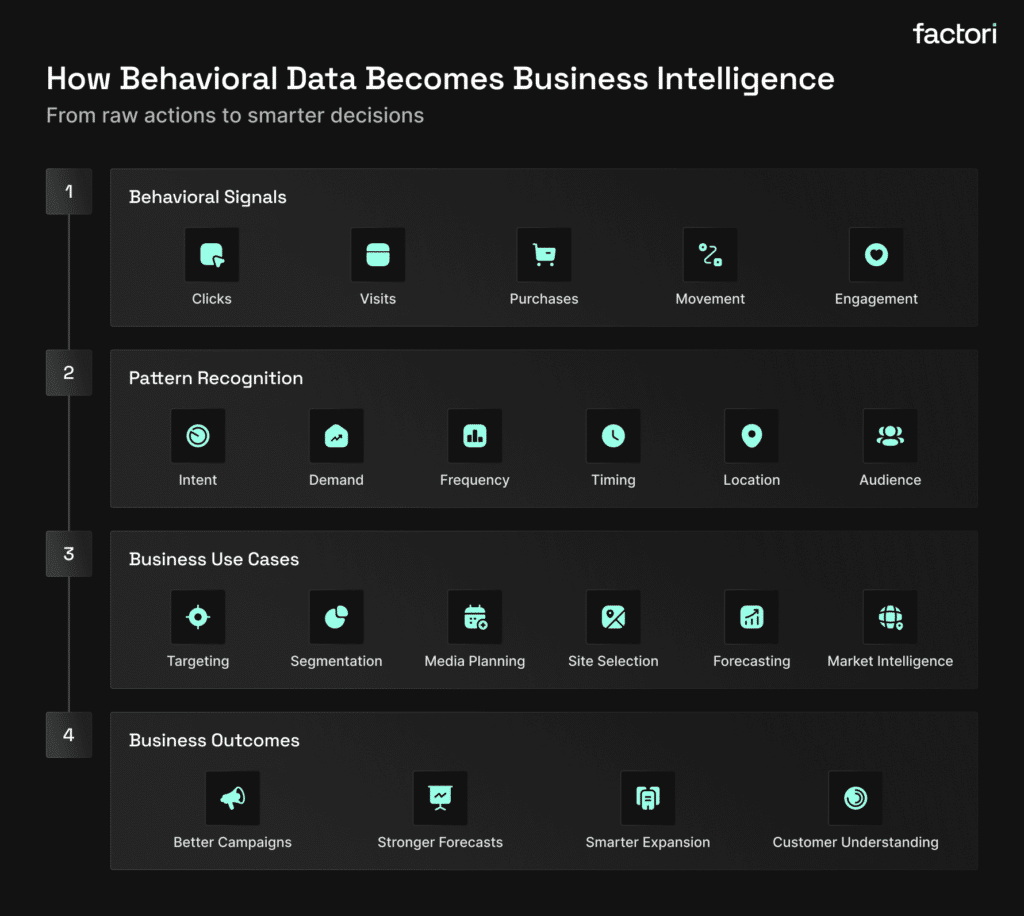
In simple terms, behavioral data shows what happened. Behavioral analytics helps explain what it means.
How Factori Helps Businesses Use Behavioral Data
Factori helps businesses turn behavioral data into practical intelligence for marketing, analytics, retail, financial services, travel, and data science teams.
Through Factori’s datasets, platform, APIs, and MCP, teams can access and integrate mobility data, visit and location intelligence, POI and places data, people data, consumer data, audience data, identity and cross-device data, web stream data, and high-fidelity data.
These signals help businesses understand how people move, which places they visit, how audiences behave, and where demand is changing.
They can support data enrichment, audience targeting, media planning, campaign measurement, retail optimization, market intelligence, and predictive analytics.
By connecting behavioral data with real-world location intelligence, Factori helps teams move from raw signals to clearer decisions and stronger forecasts.
Conclusion
Behavioral data helps businesses understand actions, movement, engagement, and demand across digital and physical environments.
It can support better decisions across marketing, analytics, retail, forecasting, site selection, and growth.
When connected with location, audience, mobility, and market signals, behavioral data becomes even more useful. It helps businesses understand customers more clearly, plan with better context, and act with greater confidence.
FAQs
What Is an Example of Behavioral Data?
Examples include website clicks, app usage, store visits, product purchases, search activity, footfall patterns, content engagement, and repeat visits.
How Is Behavioral Data Different From Demographic Data?
Demographic data describes characteristics such as age range, income group, household type, or location.
Behavioral data shows actions, such as where people visit, what they buy, how they engage, and how often they take certain actions.
Why Do Businesses Use Behavioral Data?
Businesses use behavioral data for targeting, personalization, forecasting, customer understanding, site selection, campaign measurement, product decisions, and market planning.
Is Location Data a Type of Behavioral Data?
Location data can support behavioral analysis when it shows visits, movement, footfall, dwell patterns, or other real-world activity over time.
How Should Behavioral Data Be Used Responsibly?
Behavioral data should be used in a privacy-safe and permissioned way.
Where appropriate, businesses should rely on aggregated signals and focus on patterns and business insights rather than individual surveillance.