Digital out of home advertising has become a key part of modern media planning as brands look for ways to reach people beyond phones, laptops, and in-app spaces. As people move through cities, stores, transit hubs, and other public places, this channel helps brands stay visible in the physical world.
Its role has also evolved. Brands now expect better targeting, clearer measurement, and stronger links between ad exposure and real-world results. This shift has made digital out-of-home advertising a more flexible, measurable, and data-driven channel.
What Is Digital Out of Home Advertising?
Digital out-of-home advertising refers to ads displayed on digital screens in physical locations such as billboards, malls, airports, and transit systems. Unlike traditional out-of-home advertising, which uses static formats, DOOH uses digital displays to show dynamic and changeable content.
These screens are placed in high-traffic environments where people are already moving, commuting, or spending time, allowing brands to reach audiences outside of personal devices.
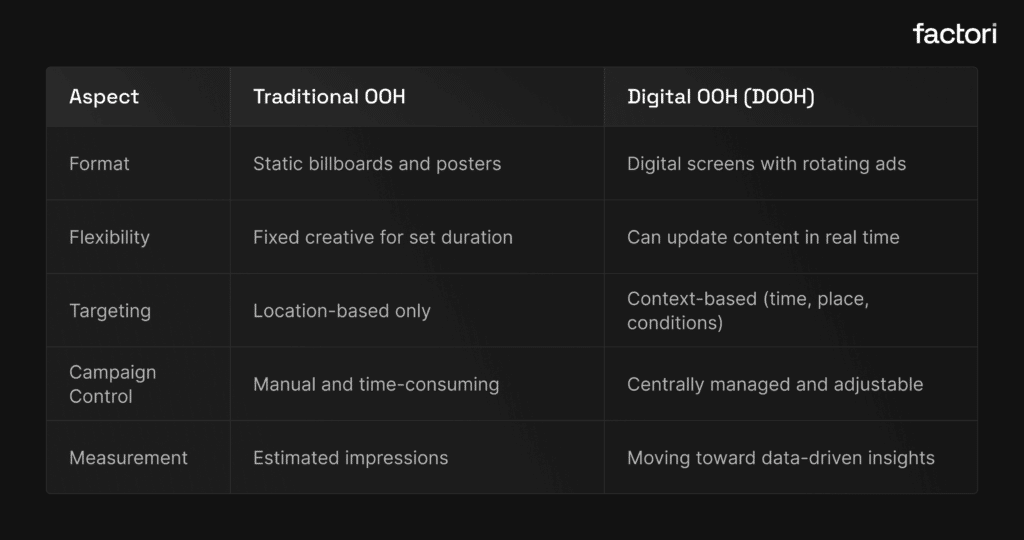
DOOH vs Traditional OOH Advertising
Digital out-of-home advertising builds on traditional out of home advertising formats but adds flexibility and control through digital screens. While both aim to reach people in physical environments, the way campaigns are delivered, updated, and measured is different.
Types and Benefits of Digital Out-of-Home Advertising
Digital out-of-home advertising appears across a range of screen formats placed in high-traffic physical locations. This gives brands multiple ways to stay visible as people move through daily environments such as roads, transit systems, shopping areas, and public venues.
Types of DOOH Advertising
- Billboards: Large digital screens on highways, major roads, and city centers
- Place-based screens: Displays in malls, retail stores, airports, gyms, and office buildings
- Transit media: Screens in buses, metros, taxis, and transit stations
Benefits of DOOH Advertising
Digital out-of-home advertising offers a mix of scale and flexibility, making it more adaptable than traditional outdoor formats while still delivering strong physical-world visibility.
- High visibility in busy environments
DOOH ads appear in spaces where people are already moving, waiting, commuting, or shopping, which helps brands stay visible in moments of real-world attention. - Strong reach beyond digital channels
It extends campaign reach outside mobile phones, desktops, and social platforms, helping brands maintain presence across both digital and physical touchpoints. - More flexibility than static OOH
Creative can be updated more easily without replacing printed materials, making campaigns faster to manage and adjust. - Better contextual relevance
Messaging can be aligned with time, place, and surrounding environment, which makes ads feel more timely and relevant. - Dynamic and timely creative updates
Different creatives can run at different times or in different locations, allowing campaigns to stay fresh and more responsive.
These advantages make DOOH a more practical option for brands looking to balance reach, relevance, and flexibility in their advertising strategy.
Real-World Data and Measurement in DOOH Advertising
Digital out-of-home advertising becomes more effective when it is supported by real-world data. Instead of relying only on screen locations and estimated impressions, brands can use data about how people move, where they spend time, and how different places perform. This helps improve both planning and measurement.
Before a campaign starts, real-world data helps identify where ads should run. By understanding movement patterns, foot traffic, and the type of audience visiting specific locations, brands can choose placements that are more likely to deliver results. This reduces guesswork and ensures campaigns are aligned with actual demand and audience behavior.
After a campaign runs, the data can be used to measure impact more clearly. Instead of only looking at estimated reach, businesses can analyze what changed.
This approach allows brands to move from estimated visibility to measurable outcomes. By using real-world data before and after campaigns, DOOH becomes easier to plan, evaluate, and optimize over time.
Explore how Factori’s comprehensive product suite enhances DOOH campaign outcomes. Read more.
How to Plan a DOOH Campaign
Planning a digital out-of-home campaign requires a clear link between the objective, audience, and location. Since this channel operates in the physical world, decisions around where and when ads appear are critical to performance.
- Define the campaign objective
Start with a clear goal, such as driving store visits, increasing brand visibility, or supporting a broader campaign. - Identify the target audience
Understand who you want to reach and where they are most likely to be during the day. - Select the right locations
Choose placements based on audience movement, foot traffic, and relevance to the campaign goal. - Align creative with context
Ensure messaging fits the environment and is easy to understand quickly in a real-world setting. - Set budget and duration
Plan how long the campaign will run and how investment is distributed across locations and formats.
A well-planned DOOH campaign connects audience behavior with location strategy, making it more likely to deliver meaningful results.
Best Practices and Challenges in DOOH Advertising
Running an effective DOOH campaign requires balancing strong execution with an understanding of the channel’s limitations. Following a few core practices can improve outcomes, while being aware of challenges helps set realistic expectations.
Best Practices
- Keep messaging simple and visible
People view DOOH ads in motion or at a distance, so messaging should be clear and easy to understand at a glance. - Use dynamic creatives where relevant
Updating creatives based on time or context helps keep campaigns fresh and more engaging. - Align placements with movement patterns
Choose locations where the target audience is most likely to pass through or spend time. - Optimize using performance signals
Use available data to compare locations, refine placements, and improve future campaigns.
Challenges
- Limited audience visibility
It is not always clear exactly who saw the ad without additional data inputs. - Broad targeting
Many placements reach a wide audience, which may not always match the intended target group. - Measurement gaps
Traditional approaches rely on estimated impressions rather than actual outcomes. - Limited real-time optimization
Compared to digital channels, changes cannot always be made instantly across all placements.
Understanding these factors helps businesses approach DOOH with a more structured strategy, improving both execution and evaluation.
Learn how Factori’s Real-World Graph Model provides a unified view of mobility, places, and people data for smarter DOOH strategies.
How Factori Improves DOOH Campaign Outcomes
Factori helps make DOOH campaigns more targeted and measurable by using Mobility Data, Visit Data, POI Data, and People Data. Instead of relying only on screen locations and estimated impressions, brands can use these data layers to understand where audiences actually spend time and choose placements more effectively.
It also improves how campaigns are evaluated. By using visit patterns, location context, and movement signals, businesses can move beyond visibility and better understand how ad exposure connects to real-world outcomes.
About Factori
Factori is a partner-powered real-world data platform offering 13 standardized, enterprise-ready datasets including:
Mobility | Places | People | Audiences | Identity | Retail | Market | Economic | Events | Property | Business I Geo.
Each dataset is governed, privacy-safe, and designed to join cleanly with your existing data stack, whether you’re working in SQL, a data warehouse, a BI tool, or an ML pipeline. No black boxes, no mystery sources, just real-world signals about how people move, shop, work, and live, delivered the way your team works: via API, raw data, app, MCPs, or agentic workflows. Explore datasets suitable for your use case and available for your market.
Talk to an Expert Get Started
Conclusion
Digital out-of-home advertising has become an important way for brands to stay visible in the physical world. It extends reach beyond digital screens and allows campaigns to connect with people as they move through daily environments.
With the use of real-world data, DOOH is also becoming more measurable and structured. Businesses can plan campaigns more effectively, choose better locations, and understand how exposure connects to real-world outcomes. This shift is helping DOOH move from a visibility-focused channel to a more accountable and data-driven part of modern advertising.
FAQs
What is digital out-of-home advertising?
Digital out-of-home advertising refers to ads displayed on digital screens in physical locations such as billboards, malls, airports, and transit systems.
How is DOOH different from traditional OOH?
DOOH uses digital screens that allow flexible and dynamic content, while traditional OOH relies on static formats with fixed creatives.
How is DOOH advertising measured?
DOOH measurement is evolving from estimated impressions to more data-driven approaches using signals like footfall, movement patterns, and visit analysis.
What are the benefits of DOOH advertising?
It offers high visibility, strong reach beyond digital channels, flexibility in campaign execution, and better contextual relevance.
What types of data are used in DOOH advertising?
DOOH campaigns can use multiple data types to improve targeting and measurement. This includes mobility data to understand movement patterns, visit or location intelligence to analyze foot traffic, POI data to map and evaluate locations, and audience data to understand the type of people visiting different areas.