OOH advertising remains an important channel for brands that want to build visibility in the physical world. From billboards and transit ads to digital screens in public spaces, it helps brands stay present across high-traffic locations and reach audiences at scale. But while OOH advertising is strong at delivering exposure, it is often harder to understand who was reached and what impact the campaign actually had.
That is why OOH advertising is increasingly being planned with a stronger focus on data. To improve targeting, site selection, and measurement, brands need more than visibility estimates. They need to understand how people move through locations, which audiences are present, and whether exposure leads to real-world outcomes such as store visits.
What is OOH Advertising and How OOH Advertising Works?
OOH advertising, or out-of-home advertising, refers to any advertising placed in public spaces to reach people when they are outside their homes. It includes formats such as billboards, transit ads, street furniture, posters, and digital screens across roads, stations, commercial areas, and other high-visibility locations.
The channel is built around one core idea: using physical location to create visibility. Brands place ads where there is consistent movement so their message is seen during everyday activities such as commuting, shopping, or traveling. In most cases, location choice is based on visibility, traffic levels, and the type of audience expected in that area.
It gives brands broad reach in the physical world, creates repeated exposure, and helps keep the brand visible in places where decisions and actions happen. Its impact becomes stronger when the selected locations do not just have traffic, but the right kind of traffic.
Types of OOH Advertising
OOH advertising includes several formats, each suited to different locations, audience movement patterns, and campaign goals. Some formats are built for broad visibility, while others are better for local relevance or more context-specific messaging. Choosing the right format depends on where the target audience is most likely to be and what the campaign is trying to achieve.
OOH Advertising Formats at a Glance
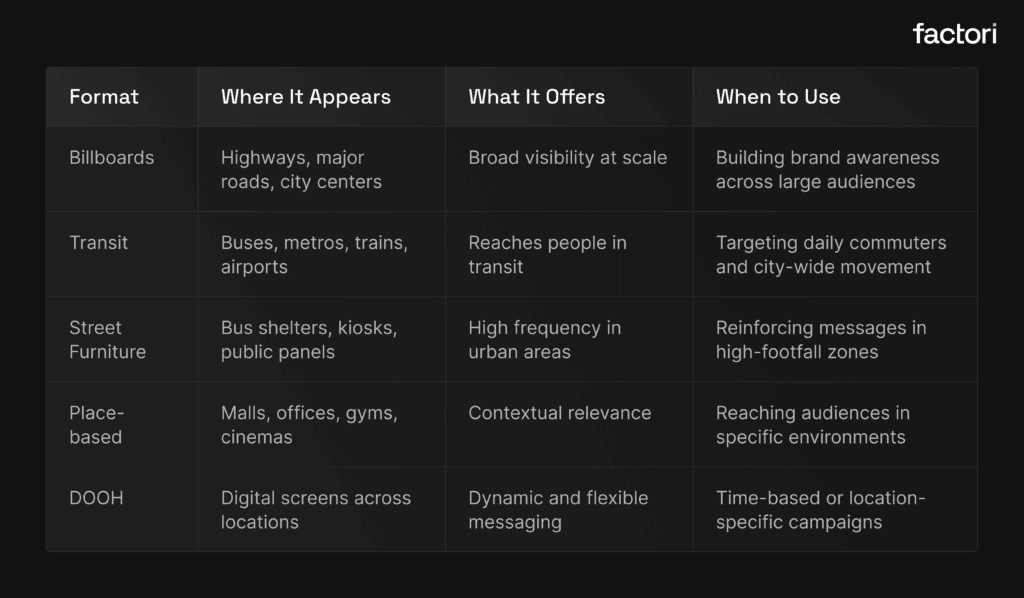
Each format offers a different balance of reach, context, and flexibility. Static billboards and transit ads are often used for broad visibility, while street furniture and place-based media can help brands stay present in more specific environments. DOOH adds more flexibility by allowing creative changes based on time, location, or campaign needs.
Why OOH Advertising Works
OOH advertising works because it delivers reliable, large-scale reach in the physical world. It allows brands to stay visible across key locations without depending on user intent, making it effective for building awareness across broad audiences.
Its value comes from a few clear benefits:
- Broad reach at scale by placing brand messages across high-traffic physical locations
- Strong visibility because ads remain present in the environment and cannot be skipped like many digital formats
- Better brand recall through repeated exposure across daily routes and routines
- Support for other channels by reinforcing campaigns running across mobile, social, search, and other media
- Presence in high-value locations such as retail zones, transit hubs, and commercial districts where decisions often happen
However, these outcomes depend on how well placements align with actual audience presence. Campaigns that rely only on estimated reach may deliver visibility, but not always impact.

OOH in an Omnichannel Strategy
OOH advertising works best when it supports a broader marketing strategy rather than running in isolation. It adds a physical layer to campaign messaging, helping brands stay visible in the real world while digital channels drive engagement, response, and conversion.
This makes OOH especially useful for reinforcing campaigns already running across mobile, social, search, or connected TV. A person may see an OOH ad during their commute and later respond to the same brand through a digital channel. In that way, OOH can strengthen familiarity before a click or conversion ever happens.
Its role in an omnichannel strategy is therefore less about acting alone and more about improving overall campaign effectiveness. When placements are aligned with target audience movement and other channel activity, OOH advertising can support stronger recall, better message consistency, and clearer market presence.
Limitations of OOH Advertising
While OOH advertising delivers strong visibility, it has some clear limitations when used on its own.
- Limited measurement clarity as it is difficult to know exactly who saw the ad, how often they were exposed, or whether it led to real-world action
- Reliance on estimated impressions instead of actual audience-level data or verified outcomes
- Broad targeting since ads reach everyone in a location, not just the intended audience
- Wasted exposure risk when the audience in a location does not match the campaign objective
- Lack of real-time performance signals compared to digital channels that offer clicks, conversions, and engagement data
- Limited optimization ability as campaigns are harder to adjust once they are live
These limitations do not reduce the value of OOH advertising, but they highlight the need for better data and measurement approaches to improve precision and accountability.
The Missing Layer: Understanding Real-World Audience Movement
Traditional OOH advertising focuses on locations and visibility, but it often misses a critical factor: how people actually move through those locations.
Two locations may have similar traffic levels, but the audience passing through them can be very different. One may attract daily commuters, while another sees occasional visitors or a completely different demographic. Without understanding these movement patterns, OOH planning relies on broad assumptions rather than actual audience behavior.
This is the missing layer in most campaigns. Knowing where ads are placed is not enough. Brands need to understand who is present, how frequently they visit, where they come from, and where they go next.
Adding this layer of real-world audience movement makes it easier to identify high-value locations, reduce wasted exposure, and align campaigns more closely with the intended audience.
How Real-World Data Helps
Real-world data helps improve OOH advertising by making planning and measurement more grounded in actual behavior. Instead of relying only on estimated impressions, brands can use real-world signals to understand where the right audiences are present, how they move through an area, and whether exposure is likely to lead to action.
The most useful inputs usually include movement data, place data, and visit data. Movement data helps show how people travel through locations and which routes create repeated exposure. Place data adds context by showing what surrounds an ad location, such as retail zones, transit hubs, office districts, or entertainment areas. Visit data helps measure outcomes by showing whether exposed audiences later visited a store or relevant destination.
When these data layers are used together, OOH advertising becomes easier to plan with more precision and measure with more confidence. Brands can choose better locations, reduce wasted exposure, and evaluate campaign impact using real-world results, not just estimated reach.
How Factori Enables Smarter OOH Advertising
Factori helps improve OOH advertising by turning real-world signals into usable inputs for planning and measurement. Instead of working with isolated metrics like impressions or traffic estimates, teams can use connected data on movement, places, and visits to make better decisions.
For planning, Factori enables:
- Audience-led site selection by identifying where target audiences are actually present
- Route and exposure analysis to understand repeated movement patterns
- Location context mapping to evaluate what surrounds each placement
For measurement, Factori enables:
- Visit-based attribution to assess whether exposed audiences visit stores or key locations
- Campaign impact analysis by comparing movement and visit patterns before and after exposure
- Market-level insights to understand how campaigns perform across different areas
This makes OOH advertising more measurable and accountable. Instead of relying only on visibility, teams can evaluate how campaigns influence real-world behavior and use those insights to improve future planning.
Conclusion
OOH advertising remains a strong channel for building visibility in the real world, but its effectiveness depends on how well it is planned and measured. Traditional approaches focus on location and reach, which can deliver exposure but often lack clarity on actual impact.
Adding real-world data changes this. By understanding how people move, where audiences are present, and how exposure connects to real actions, OOH advertising becomes more precise and measurable. This allows brands to move beyond assumptions and make decisions based on actual behavior.
As marketing becomes more data-driven, OOH advertising is shifting from a broad awareness channel to a more accountable and integrated part of the overall strategy.
FAQ
What is OOH advertising?
OOH advertising refers to ads placed in public spaces to reach people outside their homes, such as billboards, transit ads, street furniture, and digital screens.
Why is OOH advertising effective?
OOH advertising is effective because it builds strong visibility in high-traffic locations and keeps the brand present in the physical world through repeated exposure.
What are the main types of OOH advertising?
The main types include billboards, transit advertising, street furniture advertising, place-based media, and digital out-of-home advertising.
What are the limitations of OOH advertising?
OOH advertising can be difficult to measure precisely, and traditional campaigns often rely on estimated impressions rather than actual audience behavior or outcomes.
How does real-world data improve OOH advertising?
Real-world data helps brands choose better locations, understand audience movement, and measure outcomes such as store visits, making OOH advertising easier to plan and evaluate.