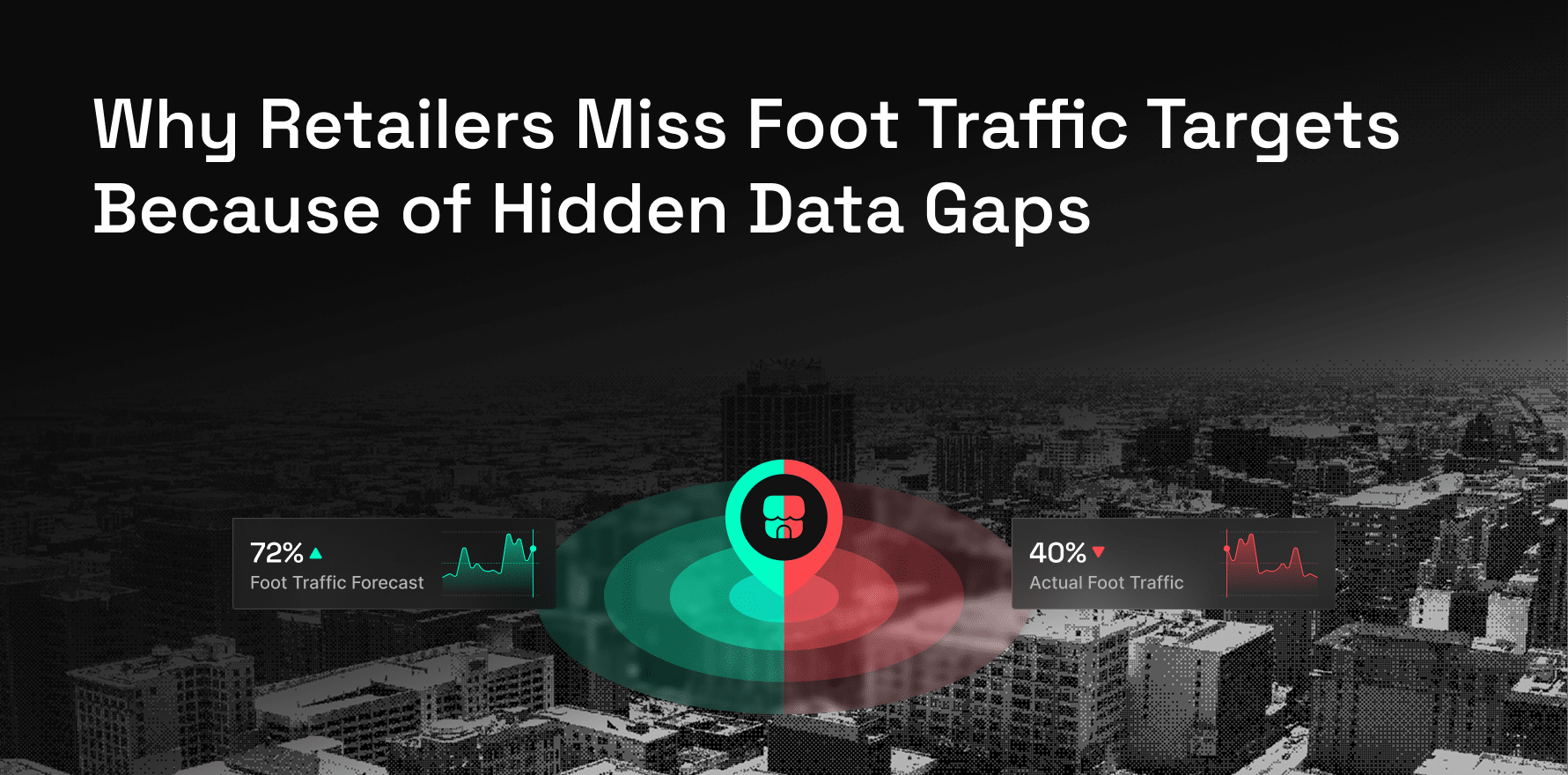
A retailer opens a new location in a trade area that every model said was underserved. Six months in, foot traffic is half of forecast. Nothing was wrong with the analysis. The data feeding it just didn’t know a competitor had quietly opened two blocks away, or that a “thriving” anchor tenant had closed months earlier.
This happens more often than retailers realize, and it rarely gets traced back to its actual cause: the data behind the decision came from one place, updated on someone else’s schedule, and missed exactly what mattered.
The Blind Spot Every Retailer Inherits From Single-Source Data
No single source sees the whole picture. A delivery app knows restaurants. A telecom knows footfall near its towers. A directory knows listings that haven’t been touched in a year. Each is accurate within its own lane and blind everywhere else.
For a retailer, that means closures that haven’t been flagged, new competitors that haven’t been logged, category shifts that haven’t been updated, and trade areas that look healthier on paper than they are on the ground. Site selection, trade area mapping, and local ad targeting all inherit whatever gaps sit inside the source feeding them, and those gaps rarely announce themselves until a location underperforms.
What Closes the Gap
The fix isn’t a better single source. It’s not relying on one. This is where aggregated places data earns its keep: information pulled from many independent sources and checked against each other, so no single feed’s blind spot becomes the retailer’s blind spot.
A few things separate teams that get this right:
Coverage That Matches the Trade Areas That Matter
A large global point count means little if the specific metro or category a retailer is expanding into is thin. Coverage should be checked at the market level, not the aggregate level.
Freshness That’s Been Verified, Not Just Claimed
Businesses open, close, and rebrand constantly. What matters is whether closures and new openings get caught quickly, not just whether a feed is “updated monthly” on paper.
Cross-Checked Accuracy
When multiple independent sources agree on a location’s status, category, and details, confidence goes up. When they don’t, that disagreement is exactly where errors hide, and it’s worth knowing which provider actually reconciles conflicts rather than picking one source and moving on.
Attribute Depth Beyond Name and Address
Category, hours, brand affiliation, and building-level context are what turn a map pin into something a site selection or targeting model can actually use.
Consistency Across Every Market a Retailer Operates In
A dataset that’s strong in one region and thin elsewhere quietly caps any strategy meant to scale nationally or globally.
Why This Matters More for Retail Than Almost Any Other Category
Retail moves fast. Storefronts turn over, categories shift, and trade areas change composition month to month, faster than most single sources can keep up with. A site selection model, a competitive density map, or a geofenced ad campaign is only as good as its weakest input, and in retail, that weak input is usually a location record nobody double-checked.
Retailers working from aggregated places data, rather than trusting one feed’s version of the world, consistently catch closures, new competitors, and category shifts faster than those relying on a single source. That gap shows up directly in forecast accuracy and, ultimately, in foot traffic.
How Factori Helps
Factori combines places data with mobility, people, and property signals to give retail teams a more complete view of what is happening around a location.
Retailers can use this data for site selection, trade area analysis, competitive intelligence, and local targeting, with access through APIs, direct data delivery, or MCP-based workflows.
Conclusion
Retailers working from aggregated places data, rather than trusting one feed’s version of the world, consistently catch closures, new competitors, and category shifts faster than those relying on a single source. That gap shows up directly in forecast accuracy and, ultimately, in foot traffic.
FAQs
Why Is Aggregated Places Data Important for Retail Decisions?
Retail decisions depend on having an accurate view of the businesses, competitors, and destinations around a location. Aggregated places data helps reduce gaps caused by stale, incomplete, or single-source records, giving retailers a stronger foundation for site selection, trade area analysis, and local targeting.
How Can a Retailer Tell If Their Current Data Has Blind Spots?
Pull a sample of locations in a market the team knows well and check it against ground truth. Look specifically for closures that weren’t flagged and new competitors that aren’t listed. Those are the clearest signs of a single-source gap.
Does This Only Matter for Large National Chains?
No. Smaller and regional retailers are often more exposed, since national datasets tend to concentrate coverage in major metros and thin out elsewhere, exactly where many regional chains operate.
Is This Relevant to AI-Driven Site Selection Tools?
Increasingly, yes. AI models used for site selection or trade area analysis are only as reliable as the location data behind them. Thin or stale inputs lead directly to bad recommendations, no matter how sophisticated the model.