
Cross visitation data helps businesses understand how customers move between locations, brands, and categories. It adds context beyond single-location metrics and helps teams see how places connect through real customer behavior. With cross visitation data, businesses can spot audience overlap, understand competitive pressure, track movement patterns, and make better decisions across marketing, expansion, customer analysis, and forecasting. To use it well, teams also need to understand its limits, apply the right methods, and turn movement insights into practical action.
What Is Cross Visitation Data?
Cross visitation data shows how visitors to one location also visit other locations over time. It helps businesses understand how places are connected through shared customer movement.
This goes beyond measuring visits at a single store, venue, or point of interest. It shows whether the same audience also visits nearby competitors, related brands, or different categories as part of their routine.
For example, someone visiting a supermarket may also visit a pharmacy or coffee shop nearby. Cross visitation data helps reveal these links and makes customer behavior easier to understand.
This added view helps businesses move past isolated location metrics. Instead of only knowing that a visit happened, they can see how one place fits into a wider customer journey.
Cross visitation data can help answer questions such as:
- Which other brands do these visitors also visit?
- Are customers comparing nearby options before making a decision?
- Which categories share the same audience?
- How do movement patterns change by market or location?
In simple terms, cross visitation data does not just show where visits happen. It shows how customer movement connects one place to another.
Why Cross Visitation Data Matters
Cross visitation data matters because customer behavior cannot be understood by looking at one location alone. People move between brands, compare nearby options, combine multiple stops in one trip, and follow routines that stretch across locations and categories. When a business only analyzes one place at a time, it misses the wider pattern behind those visits.
This broader view helps businesses understand how customers actually move across brands, stores, and categories. It shows whether nearby locations attract the same audience, where demand overlaps, and where competition is stronger than it may appear in single-location analysis. That makes it easier to identify shared and contested demand pools and uncover competitive blind spots that would otherwise stay hidden.
Cross visitation data also improves decision-making by adding real-world behavioral context. Instead of relying only on static performance metrics, businesses can see how locations relate to each other through repeated movement patterns and shared audiences. This leads to better strategy, stronger forecasting, and a clearer understanding of how customer behavior shapes business outcomes.
Read About: How to Use Aggregated Mobility Data to Improve Demand Forecasting
Key Applications of Cross Visitation Data
Cross visitation data becomes most useful when businesses apply it to real decisions. It helps teams move beyond surface-level location metrics and understand how customer movement affects performance, competition, and growth.
Competitive intelligence
Cross visitation data helps businesses see which brands or locations share the same audience. This makes it easier to understand where competition is strongest and which businesses attract similar customers.
Marketing and advertising
Marketing becomes more effective when it reflects real behavior. Cross visitation data helps teams understand where audiences spend time, which categories they engage with, and how places connect within everyday routines.
This supports better audience targeting, sharper campaign planning, stronger local messaging, and more informed media placement decisions.
Real estate and expansion planning
For expansion decisions, location potential is not only about traffic volume. It is also about the kind of traffic a place attracts and how that audience moves across the surrounding area.
Customer and operational insights
Customer movement patterns can reveal how people interact with physical spaces before, during, and after a visit. For example, teams can use these insights to identify common visitor paths, understand peak activity patterns, improve on-site experience and support staffing and operational planning.
Partnership and adjacency strategy
Not all nearby businesses are competitors. Some attract the same audience in ways that create partnership opportunities. Cross visitation data can help identify these natural connections.
Demand forecasting and market planning
Forecasting improves when businesses understand not just how many people visit a place, but how movement patterns shift across locations and categories. Cross visitation data adds that extra layer of context.
How Customer Movement Patterns Drive Business Outcomes
Customer movement patterns matter because they show how people behave across places, not just at one location. That added context helps businesses understand what is influencing performance and where new opportunities or risks may be building. A single visit does not explain much on its own. A store may be getting steady traffic, but that does not show whether customers are also visiting competitors, combining multiple stops in one trip, or shifting their routines over time.
When businesses understand these patterns, they can make better decisions across multiple areas. They can assess whether a location is attracting the right kind of traffic, see where competitive pressure is increasing, and build marketing strategies that reflect real customer behavior. Movement patterns also strengthen forecasting by helping explain changes across markets, seasons, or store formats, while giving operations teams better visibility into peak periods, visit flows, and how people interact with locations over time.
In simple terms, customer movement patterns turn visits into usable business insight. They help businesses move beyond counting activity and start understanding what is driving performance.
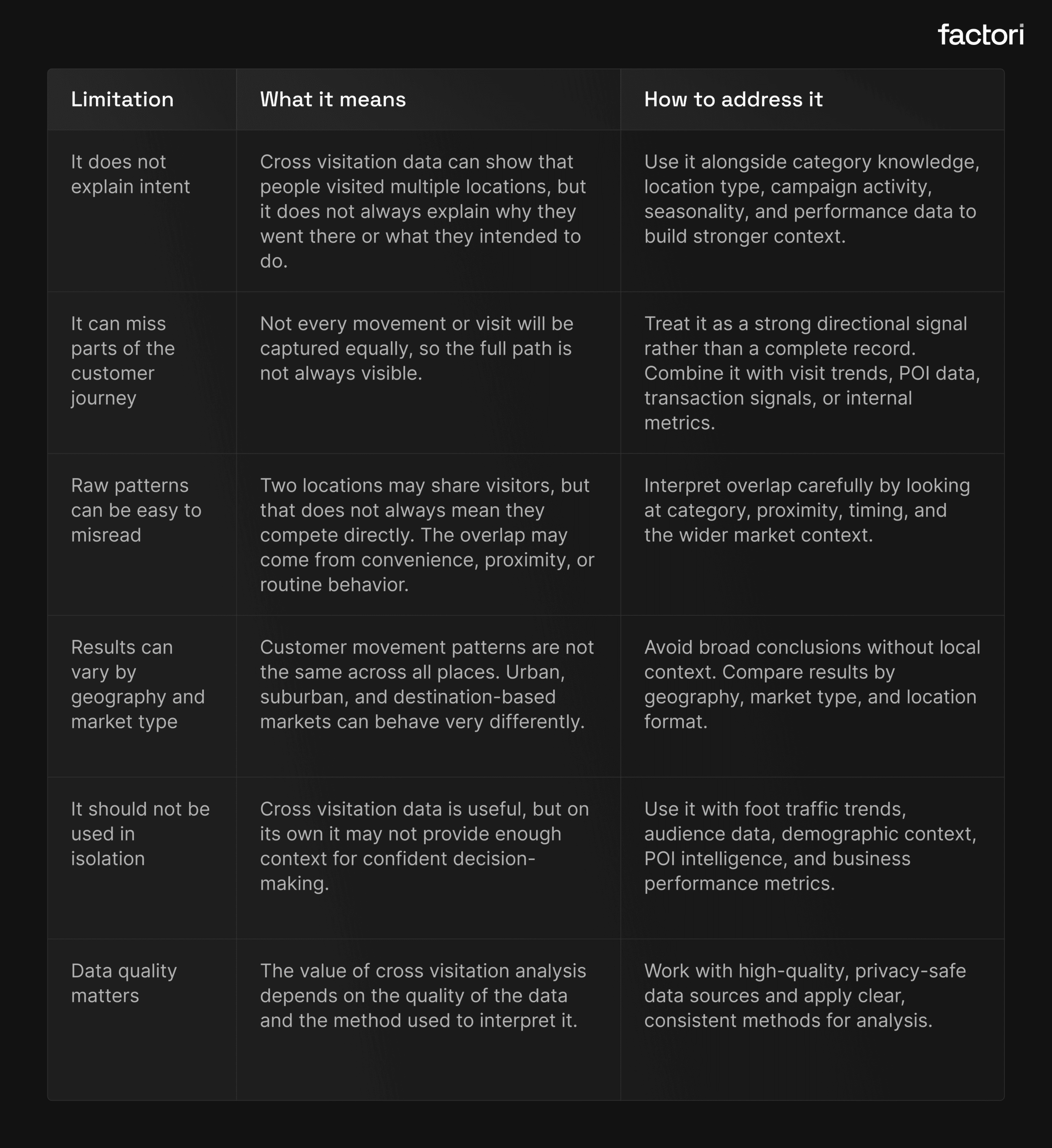
Limitations of Cross Visitation Data and How to Address Them
Cross visitation data can offer useful insight, but it should not be treated as a complete view of customer behavior on its own. Like any data source, it has limits. The key is to understand where those limits exist and use the data with the right context.
7 Best Practices for Using Cross Visitation Data
Cross visitation data is most useful when businesses use it as part of a broader decision-making process. The goal is to turn movement patterns into practical and reliable business insight.
- Start with a clear business question: This helps shape the analysis and makes the findings more useful for goals such as competitor analysis, expansion planning, or tracking customer behavior changes.
- Combine it with other data sources: Cross visitation data works best with other signals. Foot traffic, POI data, audience insights, sales data, and market context help explain what movement patterns actually mean.
- Interpret patterns in context: Shared visitors do not always mean direct competition. Category, proximity, timing, and local market conditions all matter when interpreting overlap between locations.
- Compare like with like: The analysis is more reliable when similar locations are compared. Looking at similar store formats, market types, and trade areas helps produce more meaningful insights.
- Focus on patterns, not single signals: Better decisions come from repeated trends over time. Consistent overlap and recurring movement patterns are usually more useful than isolated signals.
- Keep privacy and data quality front and center: Cross visitation data should be handled with strong privacy standards and reliable methods. Good data quality makes the analysis more trustworthy and more useful.
- Turn insight into action: The value of cross visitation data comes from how it is used. Businesses should apply the insights to improve planning across marketing, competition, site selection, partnerships, and forecasting.
About Factori
Factori is a partner-powered real-world data platform offering 13 standardized, enterprise-ready datasets including:
Mobility | Places | People | Audiences | Identity | Retail | Market | Economic | Events | Property | Business I Geo
Each dataset is governed, privacy-safe, and designed to join cleanly with your existing data stack, whether you’re working in SQL, a data warehouse, a BI tool, or an ML pipeline. No black boxes, no mystery sources, just real-world signals about how people move, shop, work, and live, delivered the way your team works: via API, raw data, app, MCPs, or agentic workflows. Explore datasets suitable for your use case and available for your market
Talk to an Expert
Conclusion
Cross visitation data helps businesses understand how customers move across locations, brands, and categories. This added context makes it easier to see audience overlap, competitive pressure, and the broader patterns behind location performance.
When used with the right data layers and market context, cross visitation data can support better decisions across marketing, expansion, customer analysis, and forecasting. To see how these insights can support your strategy, get started with Factori.
FAQs
What is cross visitation data?
Cross visitation data shows how visitors to one location also visit other locations over time. It helps businesses understand how places are connected through shared customer movement.
How is cross visitation data different from foot traffic data?
Foot traffic data measures visits to a single location. Cross visitation data adds more context by showing how those visitors also move across other brands, stores, or categories.
Why is cross visitation data important for businesses?
It helps businesses understand audience overlap, competitive pressure, movement patterns, and the relationship between locations. This gives teams more context for decisions across marketing, expansion, and forecasting.
What can cross visitation data be used for?
It can be used for competitive intelligence, marketing and advertising, expansion planning, customer analysis, operational planning, partnership strategy, and demand forecasting.
What are the limitations of cross visitation data?
Some common limitations include incomplete journey visibility, limited insight into intent, and the risk of misreading overlap between locations. These can be addressed by using the data with other datasets and the right market context.