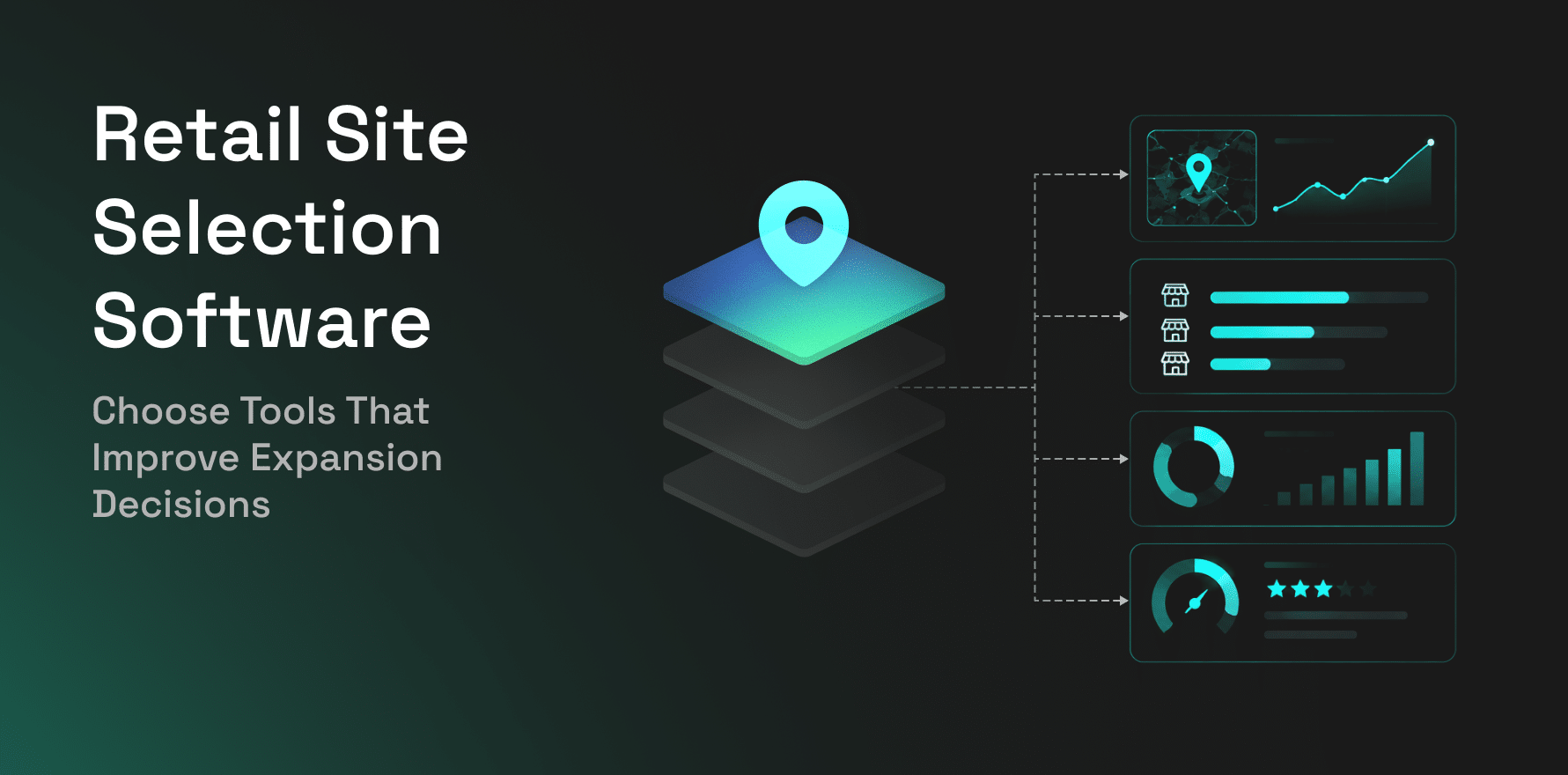
Retail site selection software helps retailers screen markets, compare candidate locations, analyze trade areas, score sites, forecast performance, and standardize expansion decisions.
For senior retail teams, buying software is not mainly a technology decision. The platform can influence where the business commits expansion capital.
A useful evaluation asks four questions: Does it fit the decision? Is the evidence credible? Can the organization operationalize it? And does the retailer retain enough commercial control?
Key Takeaway
- Retail site selection software should improve expansion decisions, not simply make site analysis faster.
- The right platform depends on where the retailer needs help, from market screening and trade areas to forecasting, cannibalization, and post-opening review.
- Site scores and forecasts should be transparent enough for analysts to understand which data and assumptions drive the result.
- Trade-area methodology, data quality, historical depth, and geographic consistency can materially affect site recommendations.
- Vendor accuracy claims should be tested through holdout or forward validation rather than accepted as standalone percentages.
- Retailers should pilot software on their own strong stores, weak stores, recent openings, and active candidates before buying.
- Enterprise buyers should evaluate underlying data access, APIs, exports, historical data, warehouse integration, and reproducibility alongside the dashboard.
- The strongest platform is the one that fits the retailer’s workflow and produces more consistent, explainable, measurable, and defensible expansion decisions.
Evaluate the Software Against the Decision
Start with the existing expansion workflow:
Market screening → Candidate evaluation → Trade-area analysis → Site scoring → Forecasting → Network impact → Approval → Post-opening review
Different tools solve different parts of this process. Location-intelligence tools emphasize market context, predictive platforms focus on scoring and forecasting, while enterprise GIS offers more spatial flexibility.
Start by identifying where the current process breaks.
| Current problem | What the software should improve |
| Too many markets to review manually | Market screening |
| Candidate comparisons depend heavily on judgment | Standardized evaluation |
| Trade areas rely on fixed assumptions | Better catchment methodology |
| Data sits across disconnected sources | Data consolidation |
| Scores are difficult to explain | Transparent scoring |
| Store forecasts are inconsistent | Predictive modeling |
| Nearby-store impact is unclear | Cannibalization analysis |
| Decisions cannot be reviewed later | Reproducibility |
The right category of software depends on which of these problems matters most.
Retail Site Selection Software to Evaluate
The following platforms represent different approaches to retail site selection rather than a ranking. Some provide end-to-end site selection and forecasting workflows, while others provide the location, mobility, demographic, or geospatial data used to build custom site-selection models.
| Platform | Primary role to evaluate | Best for | Verdict |
| Factori | Real-world data, site intelligence, candidate comparison, trade areas, demographics, footfall, competitive context, and cannibalization analysis | Teams that want to compare locations using multiple real-world signals | Strong option when site decisions need current real-world behavior, demographic context, trade areas, competition, and movement signals in one analysis workflow |
| SiteZeus | AI-powered site selection, revenue forecasting, market analysis, trade areas, competitor analysis, and expansion planning | Franchise and multi-unit brands looking for a dedicated site-selection and revenue-forecasting workflow | A specialized site-selection platform for teams that want predictive scoring and sales forecasting built directly into the expansion process |
| SiteSeer | Site evaluation, predictive modeling, sales forecasting, whitespace analysis, territory optimization, portfolio planning, and cannibalization modeling | Retail, restaurant, and franchise teams that want customizable predictive models | Well suited to organizations that need configurable forecasting models and strategic network-planning capabilities |
| Kalibrate | Location strategy, site forecasting, market potential analysis, whitespace analysis, cannibalization, and portfolio optimization | Larger retail and multi-location businesses managing expansion and existing networks | Strong fit for enterprise-scale network planning where new-site decisions must be evaluated alongside the performance of the existing estate |
| Placer.ai | Foot traffic analytics, trade areas, audience behavior, cross-shopping, competitive benchmarking, site comparison, and cannibalization analysis | Teams where visitation and competitive traffic patterns are major site-selection inputs | Particularly useful when physical visitation, customer movement, trade areas, and competitor performance are central to the decision |
| Esri | Enterprise GIS, demographic analysis, suitability modeling, market planning, territories, trade areas, and customizable spatial analysis | Organizations with established GIS teams | A flexible GIS foundation for sophisticated spatial analysis, but typically requires more internal configuration than purpose-built site-selection software |
| SafeGraph | POI, business-location, geometry, brand, store, and aggregated spend data that can feed internal site-selection models | Data and analytics teams building their own location models | Better viewed as a location-data input than a complete site-selection platform. Best when teams already have the analytics capability to build their own decision models |
| Foursquare | Global POI and place intelligence for competitive analysis, market context, database enrichment, APIs, and site-selection applications | Developers and data teams needing large-scale POI data and APIs | A strong underlying location-data layer for custom applications, but not a replacement for an end-to-end retail site-selection workflow |
| Buxton | Customer analytics, sales forecasting, site selection, market optimization, cannibalization, traffic analysis, and existing-store assessment | Retail and restaurant brands tying site decisions to customer profiles and predicted sales | Useful for brands that want customer segmentation and predictive store-performance modeling closely connected to real-estate decisions |
| Tango Analytics | Retail real-estate analytics, GIS mapping, site modeling, predictive analytics, revenue forecasting, market planning, and real-estate workflows | Retail real-estate teams managing both site selection and portfolio processes | Particularly relevant when the requirement extends beyond site analysis into lease, project, and broader real-estate management workflows |
| CARTO | Cloud-native spatial analytics, site-selection applications, data enrichment, whitespace analysis, revenue prediction, trade areas, and custom geospatial workflows | Data and geospatial teams building custom site-selection applications | Best treated as a flexible spatial-development platform. It offers considerable customization but requires stronger internal data and geospatial capabilities |
| Precisely | Location data, demographics, POIs, mobility and visitation context, accessibility analysis, spatial analytics, and site-selection enrichment | Enterprises needing governed location and demographic data | Strong as an enterprise data and enrichment layer, particularly when location intelligence needs to support multiple business applications beyond site selection |
Current official materials show these platforms emphasizing different combinations of location intelligence, predictive modeling, site selection, trade areas, network planning, and spatial analysis.
These tools overlap, but they are not interchangeable. A GIS-heavy organization may prioritize flexibility, while an expansion team may prioritize fast candidate comparison and forecasting.
The better question is “Which platform fits the way our organization makes expansion decisions?”
Test the Evidence Behind the Score and Forecast
More data does not automatically produce a better site decision. Useful variables are the ones that help explain or predict store performance.
Test five things.
Data quality: Does the platform offer enough geographic coverage, freshness, historical depth, and consistency for the markets you operate in?
Geography: Can your team control how trade areas are defined? A five-mile radius, drive-time polygon, and observed customer catchment can produce different populations, competitor sets, and demand estimates. Trade area analysis should reflect the behavior of the format rather than a software default.
Score transparency: If Site A scores 88 and Site B scores 79, can analysts see why? A descriptive score that summarizes demographics, traffic, accessibility, and competition is not the same as a predictive sales forecast.
Forecast methodology: If the platform predicts $4.8 million in first-year sales, ask what outcome is being modeled, what stores were used for training, how error is calculated, and whether results change by format or market.
Network impact: Gross new-store sales are not always incremental sales. If a proposed store is forecast to generate $6 million, the retailer still needs to understand how much may be genuinely new demand, captured from competitors, or transferred from existing stores.
That makes cannibalization analysis a software-evaluation issue, not an afterthought.
The same applies to movement data. High foot traffic does not automatically indicate a strong site if the visitors are commuters or tourists who rarely convert into customers.
For analytics and data-science teams, the core question is simple:
Which features and models add decision value beyond what we already use?
Pilot the Software on Your Own Store Network
A demo shows what the software can display, not whether it works for your retail format.
Pilot top performers, average stores, known misses, recent openings, and active candidates. Measure whether the software can:
- rank stronger opportunities above weaker ones
- explain why stores differ
- estimate performance with acceptable error
- work consistently across markets
- reduce analyst effort
- produce repeatable results
Predictive claims also need the right validation.
In-sample fit shows whether a model can explain stores it already knows.
Holdout validation tests stores excluded from training.
Forward validation scores a location before opening and later compares the prediction with actual results.
Forward validation is closest to the real expansion decision.
When a vendor presents an accuracy percentage, ask:
Accuracy on what, across which stores, over what horizon, and using which validation method?
The retailer should also preserve the assumptions behind the original recommendation. If a store misses forecast later, the team needs to know whether the model failed, market conditions changed, or the store itself underperformed.
Evaluate Operating Fit and Commercial Control
The dashboard is only one part of the buying decision.
Expansion and real-estate teams may need maps and candidate reports. Strategy teams may need portfolio comparisons. Data scientists may need historical features and APIs. Engineering teams may need bulk delivery, stable schemas, and warehouse integration.
A useful dashboard can still become an enterprise data silo if the underlying data cannot leave it.
Before signing, clarify:
- geographic coverage and update frequency
- historical data availability
- API, export, seat, or usage limits
- implementation and onboarding costs
- model-change notifications
- data and analysis export rights
- what happens to saved work if the contract ends
This also shapes whether the retailer should buy, build, or use a hybrid approach.
Turnkey software favors speed and self-service.
Internal builds favor proprietary methodology and control.
Hybrid stacks combine external location data and business-user tools with internal models, GIS, BI, and warehouse workflows.
For larger retailers, this operating fit can be as important as the site-selection features themselves.
How Factori Supports Retail Site Selection
Factori provides real-world datasets across Mobility, Places, People, Business, Economic, Market, Property, Events, and related domains.
Retail expansion teams can use these signals to compare candidate locations, while analytics and data teams can integrate the same data into custom scoring, forecasting, trade-area, competitive, and site-selection workflows. Factori’s current Site Selection app also supports drive-time trade areas, configurable scoring, and cannibalization checks.
The aim is not to maximize the number of external variables used. It is to identify which signals consistently improve the retailer’s own expansion decisions.
Conclusion
Retail site selection software should reduce uncertainty around expansion decisions, not simply make analysis faster.
The right platform should fit the retailer’s workflow, make its evidence open to challenge, integrate with the teams and systems that depend on the data, and prove its value using the retailer’s own network.
Look beyond demos and feature lists. Test known winners, known misses, recent openings, and active candidates. Examine how scores are produced, forecasts are validated, data is accessed, and past recommendations are reproduced.
A platform earns its place in the expansion process when it helps retailers make decisions that are more consistent, explainable, measurable, and defensible before capital is committed.
FAQs
How should we test retail site selection software before buying it?
Use your own top-performing stores, average stores, known misses, recent openings, and current candidates. Compare ranking quality, forecast error, explanation quality, analyst effort, and repeatability rather than relying only on a vendor demonstration.
How do predictive site-selection platforms differ from GIS or location-intelligence tools?
Predictive platforms focus more heavily on ranking and forecasting. GIS tools provide broader spatial flexibility, while location-intelligence tools often emphasize customer movement, market conditions, trade areas, and competitive context. Enterprise retailers may combine these approaches.
What data access should enterprise retailers require from site selection software?
Requirements vary by team, but buyers should consider exports, APIs, historical data, bulk access, warehouse integration, stable schemas, and the ability to preserve earlier analyses, scores, and model outputs.