A retail site can have strong demographics, good visibility, and heavy traffic and still underperform after opening. The problem is usually not that one metric was wrong. It is that the location was evaluated without understanding how demand, competition, customer movement, accessibility, and the existing store network interact.
A retail site selection checklist creates a consistent way to compare locations before a lease is signed. Instead of asking whether a site “looks good,” use the same eight questions for every candidate.
Key Takeaway
- A strong retail site should match the customer profile and trading patterns of your best-performing locations.
- Trade areas should reflect actual visitor behavior, not just fixed radii or drive-time assumptions.
- Foot traffic matters only when it aligns with the right dayparts, customer occasions, and retail format.
- Low competition can signal whitespace or weak demand, so surrounding market context needs to be tested.
- New sites should be evaluated for incremental network demand, not only store-level potential.
- Accessibility, surrounding businesses, and unit economics should all be checked before a lease is signed.
- The final site should still work under a downside scenario where sales come in below forecast.
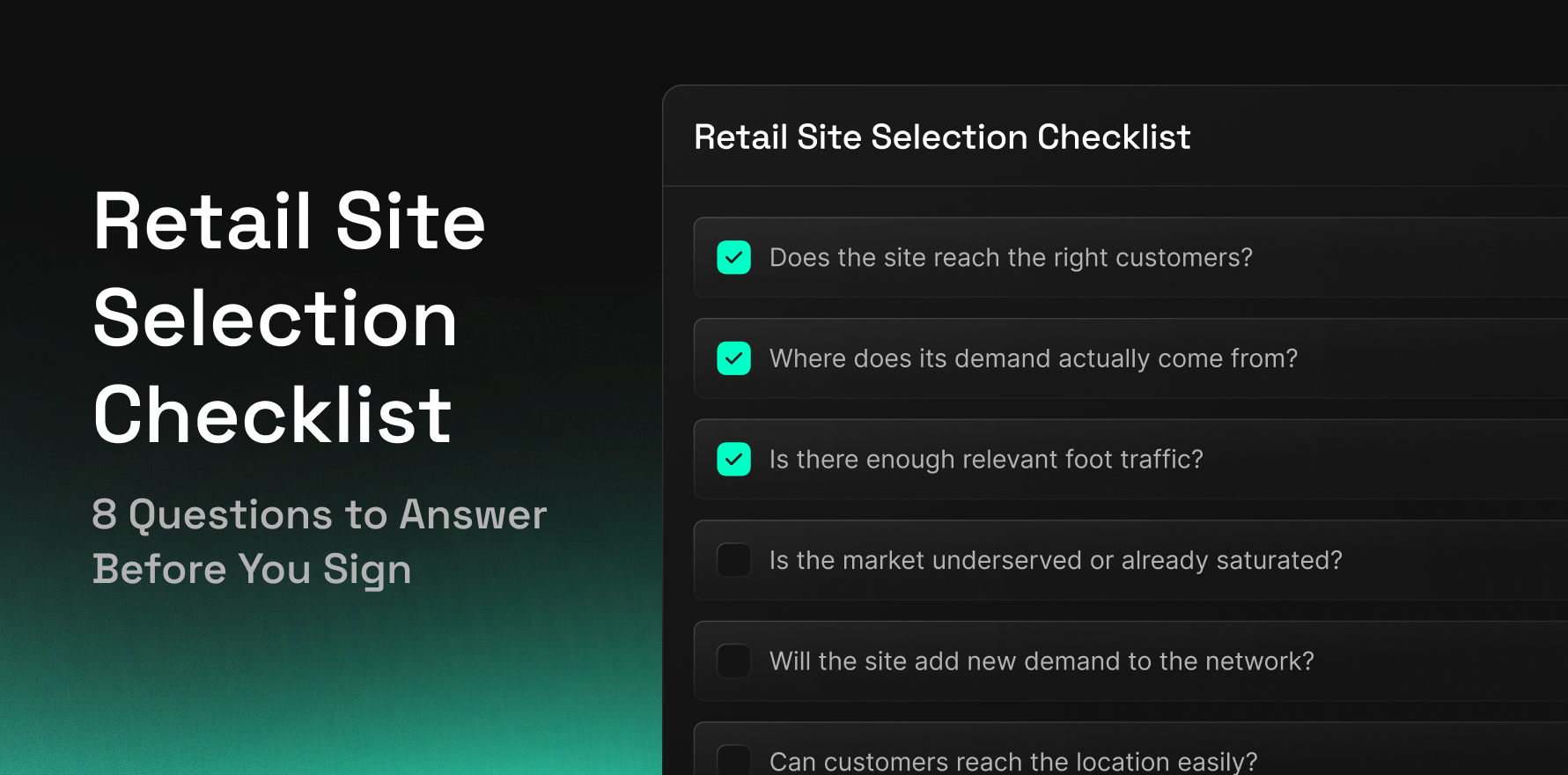
Retail Site Selection Checklist
Before approving a location, confirm:
- Does the site reach the right customers?
- Where does its demand actually come from?
- Is there enough relevant foot traffic?
- Is the market underserved or already saturated?
- Will the site add new demand to the network?
- Can customers reach the location easily?
- Do the surrounding businesses strengthen the site?
- Do the economics still work under a downside scenario?
If a candidate cannot answer several of these questions convincingly, it should not move forward simply because the real estate is available.
1. Does the Site Reach the Right Customers?
Start with customer fit, not total population.
A site with 150,000 people nearby is not automatically stronger than one with 100,000 if the smaller market contains more of the households, workers, or visitors associated with successful stores.
Compare candidate locations against the customer profile of your strongest existing units. Relevant variables may include income, age, household composition, daytime population, occupation, or other characteristics linked to the category.
Checklist
- Does the surrounding population resemble customers at strong stores?
- Is the relevant audience present during the hours you trade?
- Does customer fit remain strong across the actual trade area, not just the ZIP code?
- Are demographic changes strengthening or weakening the market?
The goal is not the largest audience. It is the most relevant addressable audience.
2. Where Does the Site’s Demand Actually Come From?
A three-mile ring or 15-minute drive time tells you who could reach a store. It does not tell you who actually will.
Trade area analysis can add observed visitor origins to the decision. This helps show whether demand is concentrated nearby, follows commuter routes, or reaches farther into surrounding neighborhoods.
Suppose two stores each have 200,000 people within a 15-minute drive. One attracts 80% of visitors from inside that area, while the other pulls 35% of visits from farther away.
Those locations serve different market roles despite looking similar on a radius map.
Checklist
- What percentage of demand comes from nearby neighborhoods?
- Does the site behave like a local or destination location?
- Are highways, rivers, transit lines, or other barriers changing the catchment?
- Does the observed trade area resemble successful stores?
3. Is There Enough Relevant Foot Traffic?
Foot traffic matters, but raw volume can be misleading.
A location surrounded by 50,000 weekday commuters may be excellent for coffee or convenience retail but weak for a format that depends on long weekend visits.
Use Mobility Data to compare visitation by day, daypart, visitor origin, and repeat behavior rather than relying on one average traffic number.
Checklist
- When does traffic peak?
- Does activity remain strong on your most important trading days?
- Are visitors moving through the area or spending time there?
- How does traffic compare with successful existing locations?
- Is activity stable, rising, or declining?
A busy site is useful only when the movement around it matches the retail occasion.
4. Is the Market Underserved or Already Saturated?
Low competition does not automatically mean opportunity. Sometimes it means demand is weak.
High competition does not automatically make a site unattractive either. Retail clusters often form because multiple brands benefit from the same destination demand.
Use Places Data to examine direct competitors, complementary businesses, anchors, and the broader commercial environment.
For example, a location with five competitors but strong category traffic may be more attractive than one with no competitors and little evidence of category demand.
Checklist
- How many relevant competitors operate nearby?
- Are they gaining or losing traffic?
- Which complementary businesses attract similar visitors?
- Are new businesses opening or existing ones closing?
- Is the market showing genuine whitespace or simply low demand?
5. Will the New Store Add Demand or Shift It?
A strong individual site can still be a weak network decision.
Suppose Site A has a traffic index of 130 but 40% of its likely trade area overlaps with an existing store. Site B has a traffic index of 115 but only 10% overlap.
Site A may generate higher store-level activity, while Site B could create more incremental network growth.
Factori’s site selection can help compare candidate locations with existing stores and analyze potential demand overlap.
Checklist
- Which existing stores share the candidate’s likely trade area?
- How much visitor-origin overlap exists?
- Does the new site reach neighborhoods the network currently misses?
- Could the opening shift customers rather than create new demand?
Trade-area overlap is not proof of cannibalization, but it should trigger deeper analysis.
6. Can Customers Actually Reach the Store?
Distance is not the same as accessibility.
A location may sit only two miles from a large residential area but require a difficult turn, cross a congested intersection, or lack convenient parking.
Evaluate the site through the customer’s journey.
Checklist
- How long does the trip take during peak shopping periods?
- Is ingress and egress simple?
- Is parking sufficient for the format?
- Is the store visible from relevant approaches?
- Can customers reach it by transit or on foot where that matters?
- Are there physical barriers between the site and key demand areas?
Visit the site at different hours and days. A Tuesday morning inspection rarely tells you what Saturday demand feels like.
7. Does the Surrounding Business Mix Strengthen the Location?
Retail locations operate within ecosystems.
A grocery anchor, gym, school, cinema, office cluster, restaurant district, or other destination can materially change who visits an area and when.
Look for businesses that generate trips compatible with your own customer journey.
A coffee shop may benefit from offices and transit. A sporting-goods store may perform better near fitness, outdoor, or family-oriented destinations.
Checklist
- Which anchors generate recurring visits?
- Are neighboring businesses complementary to the category?
- Does the surrounding mix support your key dayparts?
- Are anchor tenants stable?
- Is the commercial environment strengthening or weakening?
Do not count POIs simply because they are nearby. Focus on businesses that create relevant demand.
8. Do the Economics Work if the Forecast Is Wrong?
Site analysis should end with a downside test.
Suppose a location is forecast to generate $4 million in annual sales with $400,000 in annual occupancy costs. That produces a 10% occupancy-cost ratio.
Now reduce the sales forecast by 15%.
Revised sales:
$4M × 85% = $3.4M
Revised occupancy-cost ratio:
$400,000 ÷ $3.4M = 11.8%
The question is whether the store still works at that level.
Include rent, common-area charges, taxes, utilities, buildout costs, labor, delivery requirements, and expected marketing costs rather than evaluating base rent alone.
Checklist
- What is the base-case sales forecast?
- What happens if sales are 10–20% below forecast?
- What occupancy-cost ratio is acceptable?
- What capital is required to open?
- How long does the store have to reach maturity?
- What lease flexibility exists if performance disappoints?
A strong site should survive more than the optimistic scenario.
Put the Checklist Into One Scorecard
Do not let different teams evaluate sites using different definitions.
A simple candidate scorecard might look like:
| Decision area | Site A | Site B | Site C |
|---|---|---|---|
| Customer fit | Strong | Strong | Moderate |
| Trade area | Moderate | Strong | Strong |
| Relevant foot traffic | Strong | Moderate | Strong |
| Competition | Moderate | Strong | Weak |
| Network overlap | Weak | Strong | Moderate |
| Accessibility | Strong | Strong | Moderate |
| Surrounding business mix | Strong | Moderate | Strong |
| Economics | Moderate | Strong | Strong |
The purpose is not to reduce every site to one number. It is to make the trade-offs visible before the team commits.
Final Go/No-Go Checklist
Before approving the site, confirm that:
- The target customer exists in sufficient numbers.
- The trade area reflects realistic visitor behavior.
- Relevant traffic supports the retail format.
- Competition indicates viable demand rather than saturation.
- The site adds enough incremental network opportunity.
- Customers can reach and enter the location easily.
- The surrounding commercial environment supports the concept.
- The investment still works under a downside scenario.
If the team cannot confidently answer one of these, resolve it before signing.
Conclusion
Retail site selection becomes more reliable when every candidate is evaluated through the same sequence.
Start with the customer. Map the real trade area. Measure relevant traffic and competition. Check how the location interacts with the existing network. Then evaluate accessibility, surrounding businesses, and unit economics.
For teams comparing multiple candidates, Factori’s site selection brings trade areas, visitation, demographics, competition, network overlap, and location comparison into the same workflow.
The goal is not to find a site with perfect metrics. It is to understand the trade-offs well enough to know why one location deserves the investment.