Location intelligence for retail is important for store success because almost every store decision has a geographic dimension. It connects where customers live and move with trade areas, competition, local demand, marketing response, and store performance. Retailers can use those signals to reduce site-selection risk, plan expansion, respond to competitors, improve operations, and manage an existing network.
But access to more location data does not automatically produce better decisions. The value comes from choosing the right signals, understanding how they were produced, and testing whether they actually improve the business outcome being measured.
Site Selection: Reducing Risk Before the Store Opens
Opening a store creates a multi-year commitment across leases, fit-outs, staffing, inventory, and operating costs before the location’s true performance is known. That makes site selection one of the most consequential uses of location intelligence.
Demographic screening is useful, but incomplete on its own. A strong population profile around a candidate site does not show:
- Whether those customers can easily reach the location
- Whether competitors already capture much of the category demand
- Whether the actual trade area matches a radius drawn around the site
- Whether activity around the location resembles the retailer’s successful stores
A three-mile ring, for example, may include households separated from the site by a highway while excluding customers slightly farther away with a direct route.
Research using real-world store data has also shown that combinations of POIs, competition, market characteristics, and location variables can be used to improve store-location screening and performance prediction.
A 2024 retail location study examined these relationships across hundreds of stores. The practical value of location intelligence is therefore not another map layer. It is the ability to identify which local conditions are actually associated with stronger store performance.
Expansion and Network Planning: Scaling the Right Pattern
A poor site can be corrected or closed. A poor expansion model can repeat the same mistake across dozens of openings before the problem becomes obvious.
Location intelligence allows expansion teams to compare new markets against their existing portfolio. Instead of treating every candidate market as a blank spreadsheet, teams can ask:
- Which store formats work in comparable trade areas?
- Which competitive environments are associated with weaker performance?
- What types of catchments does the brand consistently draw from?
- Does the proposed location extend the network or overlap with existing demand?
Coverage also matters when expansion crosses markets. Geographic availability, definitions, refresh rates, and methodologies can vary by country, making consistency important when the same scoring model is used across regions.
For expansion teams, the objective is not simply to find more attractive markets. It is to identify conditions that can be repeated without repeating the same assumptions.
Competitive Intelligence: Understanding What Sales Data Cannot Explain
Suppose a competitor opens two miles from an existing store and sales decline six weeks later.
Point-of-sale data can show exactly how much performance changed. It cannot explain whether customers moved toward the competitor, reduced category spending, changed visit frequency, or shifted when they shop.
Aggregated visitation patterns can add another layer of evidence. If traffic weakens at one store while activity increases around the competing location, competitive pressure becomes a more plausible explanation.
That still does not prove that individual customers defected. The value is in narrowing the explanation and giving regional teams evidence they can test against sales, loyalty, promotion, and market data.
Marketing Measurement: Connecting Campaigns to Store Visits
Retail marketing often has a gap between what a campaign bought and what the business wanted it to achieve.
Digital campaigns may close with impressions, clicks, and cost metrics. Out-of-home or geo-targeted campaigns designed to increase store activity may still struggle to answer whether visits actually changed.
Location intelligence can help measure visitation patterns during and after a campaign. But an increase in visits is not automatically proof that the campaign caused the increase.
Incrementality requires a designed comparison, such as:
- Control markets
- Holdout periods
- Comparable stores that did not receive the campaign
This is the same principle behind geo experiments used to measure advertising effectiveness.
Without a comparison, teams can show that campaign timing and store activity moved together. With one, they can make a stronger claim about incremental impact.
Store Operations: Matching Resources to Local Demand
Location intelligence remains useful after the store opens.
Demand can vary significantly by weekday, weekend, daypart, local event activity, and the type of customers a location attracts. That context can inform staffing, inventory planning, assortment, and other store-level decisions.
A coffee shop with heavy weekday commuter traffic may require a different staffing pattern from a location that peaks on weekend afternoons. A restaurant near an event venue may need different inventory levels on event days than its historical daily average suggests.
This does not replace first-party sales and operational data. It adds the external context that helps explain why demand changes and when similar changes may happen again.
Network Health: Store Success Is Not Always a Store-Level Question
A location score reflects what the business believed would drive performance when the store was evaluated. Those assumptions should be tested after opening.
This becomes particularly important when deciding which stores to expand, relocate, or close.
An underperforming store may still protect part of the network by serving a catchment that nearby stores do not fully cover. Closing it does not guarantee that all of its demand transfers elsewhere.
Trade-area and aggregated visit-origin analysis can help estimate where catchments overlap and where a closure may create a coverage gap rather than simply move customers to another store.
That changes the question from:
“Which store performs worst?”
to:
“What happens to the network if this store disappears?”
Not Every Location Signal Represents the Same Kind of Evidence
Location intelligence combines information produced in different ways. Treating every field as equally certain can create false confidence.
| Evidence type | What it means |
| Observed | Based on measured records or activity |
| Estimated | Inferred or expanded from sampled observations |
| Modeled | Produced using statistical or predictive methods |
| Indexed | Expressed relative to a defined baseline |
For example, the U.S. Census Bureau’s American Community Survey produces survey-based population and demographic estimates with sampling uncertainty. Those should not be interpreted in exactly the same way as a directly recorded store transaction.
Modeled data is not inherently less useful. In many cases, estimation or modeling is necessary.
The problem is presenting observed, estimated, modeled, and indexed values as if they carry identical certainty. Before a signal enters a location score or forecast, teams should understand how it was created, its geographic resolution, its refresh rate, and its limitations.
Location Intelligence Should Improve a Measurable Decision
The strongest test of location intelligence is not how many variables a dataset contains. It is whether adding those signals improves a business decision.
| Decision | What to measure |
| Site selection | Forecast error and site-ranking accuracy |
| Expansion | Incremental catchment and market coverage |
| Cannibalization | Trade-area overlap and demand substitution |
| Marketing | Incremental visits and campaign lift |
| Store operations | Forecast, staffing, or inventory variance |
| Network optimization | Retained demand and network performance |
For forecasting, teams can compare a first-party baseline model against a model enriched with external location signals and measure changes in MAPE, MAE, or ranking accuracy.
The same principle applies elsewhere. Location intelligence creates value when it changes a measurable outcome, not simply when it adds more information to the dashboard.
How Factori Helps
Factori connects Places, Mobility, People, and other real-world signals through the Real World Graph so retail teams can combine standardized external context with their own store and performance data.
These signals can support site selection, trade-area analysis, expansion, competitive intelligence, marketing measurement, network planning, and demand forecasting through Factori’s platform, APIs, cloud delivery, and MCP.
Conclusion
Location intelligence matters for retail success because store performance is shaped by geography. Demand, customer movement, competition, accessibility, marketing response, and network overlap all change from one location to another.
The value does not come from collecting more location data. It comes from connecting the right signals to measurable business outcomes and understanding how much confidence each signal deserves.
FAQs
What is the difference between location data and location intelligence?
Location data is the underlying information, such as POIs, mobility signals, demographic estimates, or trade areas. Location intelligence combines those signals with geographic and business context to support a specific decision.
What data can help predict retail store performance?
The useful signals depend on the retailer and store format. Common inputs include trade-area demand, mobility, competition, POIs, accessibility, customer characteristics, and first-party store performance. The most reliable approach is to test which features improve predictions for the retailer’s own locations.
How do retailers know whether location intelligence is reliable?
Retailers should understand whether each signal is observed, estimated, modeled, or indexed, along with its geographic precision, methodology, refresh frequency, coverage, and limitations. For analytical use cases, the data should also be tested against first-party outcomes.
How is location intelligence used beyond site selection?
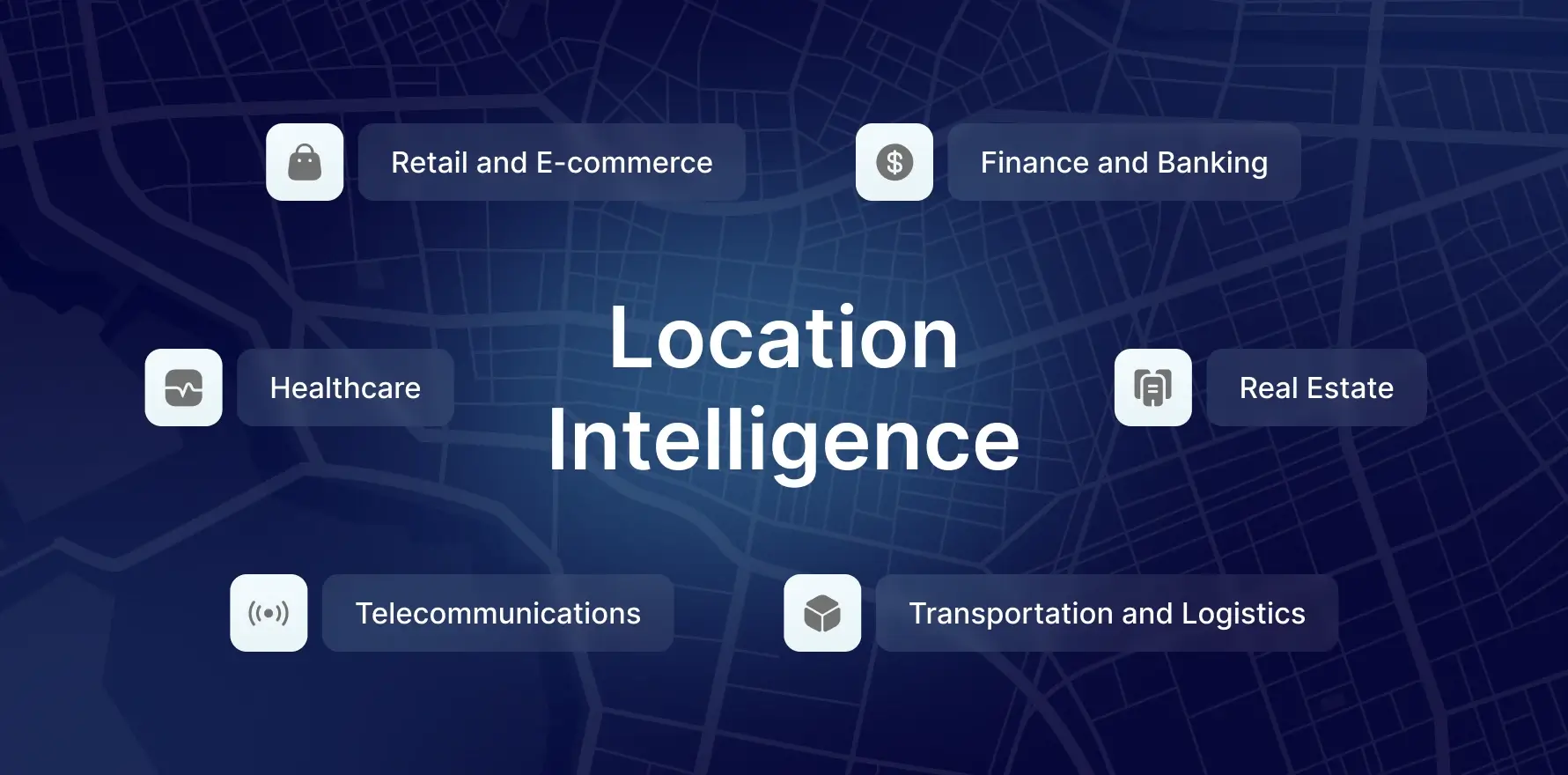
Retailers use location intelligence for market expansion, competitive analysis, marketing measurement, staffing and inventory planning, trade-area analysis, cannibalization analysis, network optimization, and demand forecasting.
Can location intelligence predict whether a store will succeed?
Location intelligence can improve the features used in a store-performance model, but it cannot guarantee success. Reliable forecasts require clearly defined outcomes, relevant first-party data, appropriate external signals, leakage-safe modeling, and validation on stores or periods not used to build the model.