“Location, location, location” has always mattered in business.
What has changed is how much businesses can now learn from location.
Today, location data can show where people go, how they move, which places attract demand, and how behavior changes across markets.
This is where location intelligence becomes useful.
It turns raw geographic data into business insights that can support site selection, marketing, market expansion, customer analysis, operations, and forecasting.
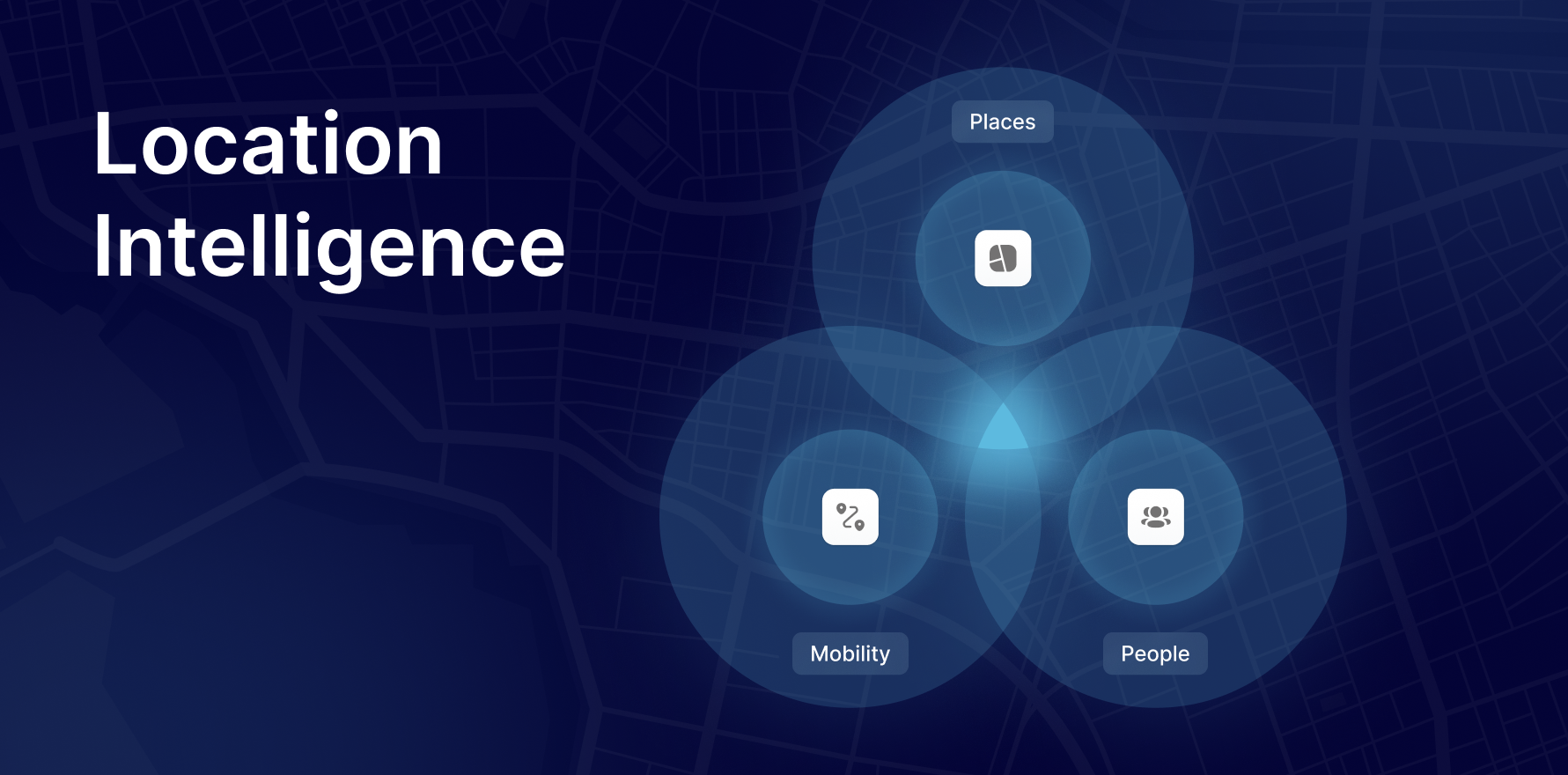
At Factori, location intelligence brings together Mobility, Places, and People data to help businesses understand what is happening in the real world and use that context in their decisions.
What Is Location Intelligence?
Location intelligence is the process of using location data to understand patterns, improve decisions, and identify changes in real-world behavior.
It goes beyond maps and coordinates.
Location intelligence can help answer questions such as:
- Where are customers spending time?
- Which locations attract the most visits?
- How do people move between places?
- Which markets show stronger demand?
- Where is competition increasing?
- Which areas may support future expansion?
Location-based business intelligence combines geographic information with movement, place, audience, and business data.
This allows teams to move from simply knowing where something is to understanding what is happening around it.
The Three Main Layers of Location Intelligence
Location intelligence becomes more useful when several types of real-world data are connected.
At Factori, three important layers are Mobility, Places, and People.
1. Mobility: Understanding How People Move
Mobility data shows how people move between locations, neighborhoods, cities, and regions.
Factori’s mobility intelligence uses more than 90 billion daily signals across 150+ countries.
These signals can help businesses understand:
- Travel patterns
- Visit frequency
- Dwell time
- Foot traffic
- Peak activity periods
- Changes in movement over time
This provides more context than a single location signal.
For example, a retailer can study which neighborhoods generate the most visits to a store. A marketer can identify where relevant audiences spend time. A business planning expansion can compare movement across several markets.
By using mobility data, teams can understand how real-world activity changes by place and time.
Read more about Mobility Data use cases.
2. Places: Understanding What Exists Around a Location
Places or Points of Interest describe the physical locations that shape markets.
These may include:
- Stores
- Restaurants
- Offices
- Hotels
- Shopping centers
- Schools
- Venues
- Transport hubs
Factori’s Places data covers more than 200 million POIs across 229 countries.
Each location can include details such as business category, operating information, building footprint, nearby amenities, and other place attributes.
When POI data is combined with mobility data, businesses can understand both where people go and what exists around those destinations.
This supports site selection, competitive analysis, logistics, market planning, and customer experience.
3. People Intelligence: Understanding the Audience
Knowing where people go is useful.
Understanding the audience behind those visits adds more context.
Factori’s people intelligence connects real-world activity with demographic, behavioral, interest, and lifestyle attributes.
Businesses can use these insights to understand how audience groups differ across places and markets.
This can support:
- Audience segmentation
- Market profiling
- Campaign planning
- Personalization
- Customer analysis
- Predictive modeling
People intelligence helps businesses move beyond broad demographic assumptions.
Instead of looking only at age or income, teams can combine audience attributes with real-world movement and place activity.
Explore Factori’s pre-built audience segments to apply behavioral intelligence across campaigns.
Location Intelligence Examples Across Industries
Location intelligence can support many different business decisions.
Its value depends on the industry and the question being asked.
Retail and Ecommerce
Retailers use location intelligence to understand store performance, choose new locations, compare trade areas, and improve local marketing.
For site selection, teams can combine mobility, POI, audience, and demographic information.
This helps them evaluate:
- Foot traffic
- Competitor presence
- Customer fit
- Nearby businesses
- Trade area size
- Accessibility
- Demand patterns
Location intelligence can also help retailers identify when traffic rises or falls and adjust promotions, staffing, or inventory.
Read more: 5 reasons to use location intelligence in retail.
Financial Services
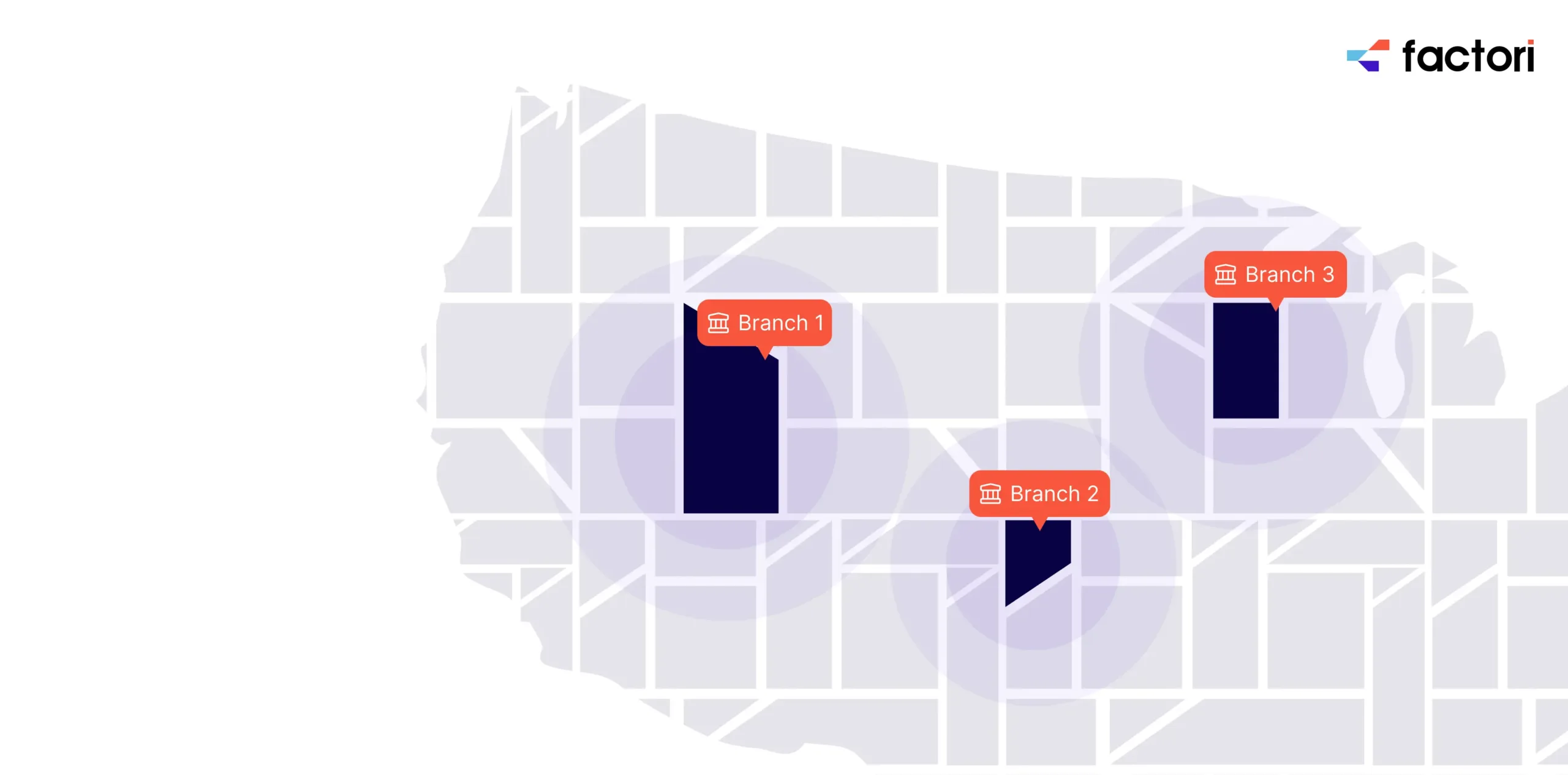
Banks and financial institutions can use location intelligence for banking and finance to improve branch and ATM planning.
They can study customer activity, competitor networks, market demand, and accessibility.
This may help teams decide where to relocate an ATM, where to open or close a branch, or which markets need better coverage.
Location data can also provide additional context for regional market and risk analysis.
Discover more financial use cases.
Real Estate
Real estate companies can use location intelligence to compare markets and identify areas with changing demand.
For example, mobility data can show how activity changes around new transport infrastructure.
POI data can add context about nearby schools, parks, shops, offices, and commercial centers.
Together, these signals can help teams evaluate development areas and compare potential investments.
See how Factori supports the real estate industry with real-world location data.
Insurance
Insurance businesses can use location intelligence to understand environmental, infrastructure, and activity-related risk.
For example, mobility and POI data may help teams identify areas with higher traffic or unusual activity patterns around insured properties.
This adds location context to existing risk models.
EV Charging
Location intelligence can also support EV charging network planning.
Businesses can study commuting patterns, commercial activity, nearby destinations, and existing charging infrastructure.
This helps identify areas where charging demand may be underserved.
Instead of choosing sites only by population or road access, teams can use real-world movement to understand where drivers actually travel and spend time.
How Location Intelligence Improves Business Decisions
Location intelligence is valuable because it adds real-world context to business data.
A sales report may show that a store is underperforming.
Location intelligence can help explain whether that is linked to weaker foot traffic, changing competition, poor accessibility, or a shift in local demand.
The same approach can support:
- Market expansion
- Site selection
- Audience targeting
- Media planning
- Store operations
- Competitive analysis
- Logistics
- Demand forecasting
The goal is not to add more maps.
It is to understand what is changing in the real world and how that change affects the business.
How to Get Started With Location Intelligence
Businesses do not need to begin with a large location intelligence program.
A focused use case is usually a better starting point.
1. Define the Business Question
Start with one clear decision.
For example:
- Which market should we enter?
- Where should we open the next store?
- Which locations are underperforming?
- Where should we increase media spend?
- Which audiences are most relevant to this market?
2. Choose the Right Data
The required data depends on the question.
A site selection project may need mobility, Places, audience, demographic, and competitor data.
A marketing project may need audience, visit, and campaign data.
3. Connect Location Data With Internal Data
Location intelligence becomes more valuable when external signals are combined with internal business data.
This may include:
- Sales
- CRM records
- Store performance
- Campaign data
- Customer data
- Inventory
- Transactions
4. Track Business Outcomes
Teams should measure whether location intelligence improves the decision.
Useful metrics may include:
- Foot traffic
- Store performance
- Campaign ROI
- Market coverage
- Customer acquisition
- Forecast accuracy
- Site evaluation time
Learn how demand forecasting with location intelligence can help businesses respond to changes in real-world demand.
Download the buyer’s checklist for data acquisition.
Location Intelligence and the Future of Business Decision-Making
Location intelligence is becoming more useful as businesses connect real-world data with analytics, AI, and forecasting workflows.
The opportunity is not simply to collect more location data.
It is to connect Mobility, Places, People, audience, and business data in a way that improves a real decision.
This can help businesses better understand markets, customers, competitors, and demand.
It can also help teams act earlier when behavior changes.
At Factori, location intelligence is designed to help businesses turn real-world signals into practical insights for growth, planning, targeting, and measurement.
Conclusion
Location intelligence turns geographic data into business context.
It helps businesses understand where people go, how markets behave, which places matter, and where demand may be changing.
By combining Mobility, Places, and People data, teams can improve decisions across site selection, marketing, customer analysis, operations, and forecasting.
The value comes from connecting location data with a clear business question and measurable outcome.
Talk to one of our experts to explore how location intelligence can support your use case.
FAQs
What Is Location Intelligence?
Location intelligence is the process of analyzing geographic, mobility, place, and audience data to understand what is happening in the real world.
Businesses use it to improve decisions about markets, customers, locations, operations, and growth.
How Is Location Intelligence Different From Location Data?
Location data shows where something is or where activity happens.
Location intelligence goes further by analyzing that data to identify patterns, relationships, trends, and business opportunities.
What Are Common Location Intelligence Use Cases?
Common use cases include site selection, trade area analysis, audience targeting, media planning, competitive analysis, store performance, demand forecasting, logistics, and market expansion.
Which Industries Use Location Intelligence?
Retail, financial services, real estate, insurance, travel, hospitality, advertising, telecom, logistics, public services, and EV infrastructure companies all use location intelligence.
The exact use case depends on the business decision being made.
What Data Is Used in Location Intelligence?
Location intelligence can combine mobility data, POI and Places data, audience and demographic data, visit intelligence, geographic boundaries, and internal business data such as sales, CRM, transactions, and store performance.