A POI dataset can contain millions of locations and still be unreliable for the markets that matter to your business.
Missing businesses, stale records, duplicate locations, incorrect categories, weak coordinate accuracy, and incomplete attributes can all affect downstream analysis. For buyers, the real question is not how many POIs a provider offers. It is whether the dataset is reliable enough for the decisions your team needs to make.
Key Takeaway
- POI record count alone does not indicate data quality.
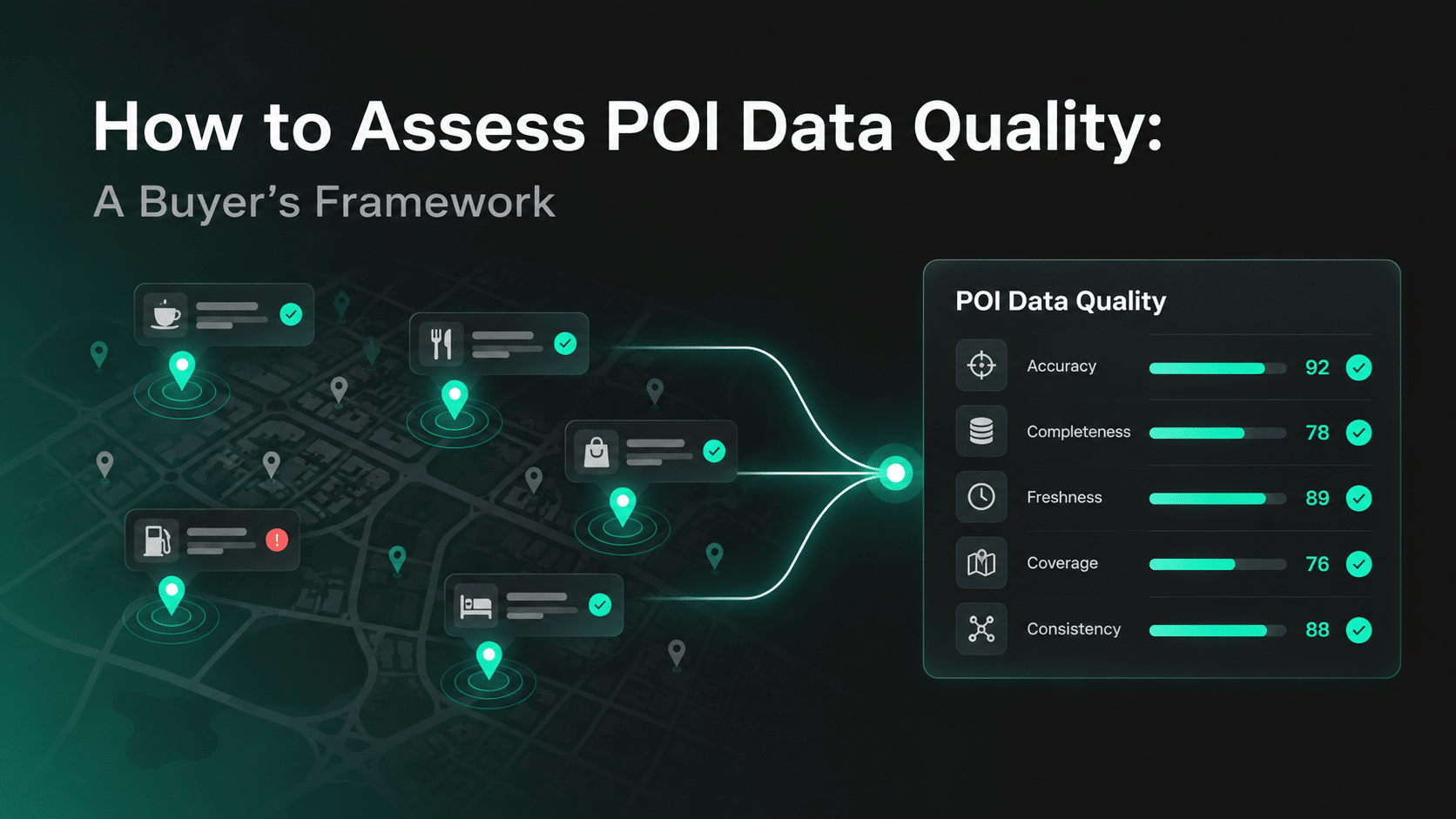
- Buyers should test coverage, record accuracy, freshness, consistency, spatial precision, and attribute completeness.
- POI samples should be tested in the actual markets and categories relevant to the business.
- Precision and recall both matter: records should be correct, and important locations should not be missing.
- Global averages can hide weak category or geographic performance, so buyers should ask for localized quality metrics.
- Freshness should be evaluated through real-world change detection, not just the vendor’s refresh schedule.
- Data lineage, licensing, taxonomy maintenance, stable identifiers, and correction workflows are important enterprise buying criteria.
- A representative sample is one of the best ways to validate whether a POI provider fits the intended use case.
A Bigger POI Database Is Not Necessarily a Better One
POI providers often lead with total record count, number of countries, categories, or attributes.
Those numbers are useful, but they do not tell you whether the data is accurate.
A large dataset can still contain:
- businesses that have already closed
- missing locations in important markets
- duplicate records
- incorrect coordinates
- inconsistent categories
- outdated brand names
- sparsely populated attributes
Completeness, positional accuracy, and category accuracy can vary significantly across datasets. Buyers therefore need to test the data against their own use case rather than relying only on provider-level coverage claims.
In practice, buyers are also testing two related ideas: precision, whether the POIs returned are actually correct, and recall, whether the dataset captures the places that should be there.
The strongest POI dataset is not necessarily the largest one. It is the one that performs consistently in the places, categories, and workflows that matter to your business.
Evaluate POI Data Across the Dimensions That Affect Your Use Case
POI quality is easier to assess when buyers separate different types of quality problems.
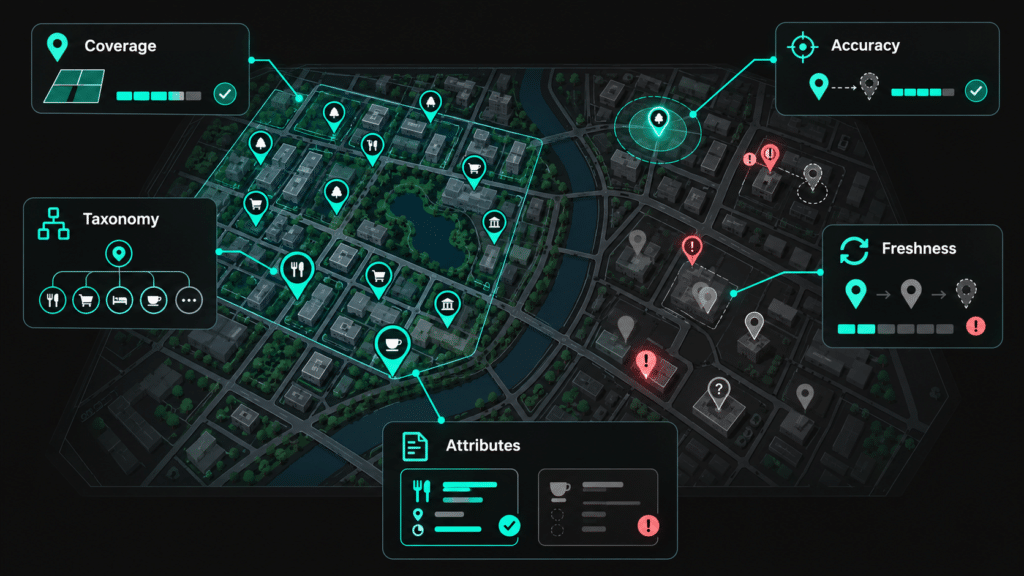
| Area to evaluate | What to check |
| Coverage | Are the locations you expect actually present? |
| Record accuracy | Are names, addresses, categories, brands, status, and coordinates correct? |
| Freshness | Does the dataset reflect openings, closures, relocations, and rebrands quickly enough? |
| Consistency | Are categories, identifiers, and records standardized across markets? |
| Attribute completeness | Are the fields you need actually populated? |
| Spatial precision | Is each POI positioned accurately enough for the intended analysis? |
The importance of each dimension depends on the use case.
A retailer comparing competitor density may care most about category accuracy, brand identification, and coverage.
A team running geofencing or visit attribution may place more weight on coordinate precision.
A global market intelligence team may care more about consistency across regions.
Global averages can also hide weak areas. Ask for coverage, accuracy, and attribute fill rates by specific geography and category rather than relying only on one overall number.
For example, a strong global coverage rate tells you little if the categories you care about are weak in the markets where you operate.
The evaluation criteria should follow the decision, not the other way around.
Test the Data in Your Own Markets and Categories
A vendor sample should represent the markets where your business actually operates.
Do not evaluate only a large city or a geography selected by the provider.
Choose a few representative markets yourself. Include the categories that matter most to the use case. If suburban, secondary, or rural markets are important, test those too.
Then compare the sample against locations your team already knows.
Check whether:
- expected locations are present
- closed locations are still included
- coordinates match the real location
- brands are identified correctly
- categories are appropriate
- one location appears multiple times
- the fields you need are consistently populated
Coordinate accuracy deserves particular attention.
A POI that is placed on the wrong parcel, road, or building may still look correct at a city level, but it can create problems for proximity analysis, trade areas, geofencing, and mobility analysis.
Category quality can create similar issues.
For example, comparable businesses might appear under different labels such as “coffee shop,” “café,” “bakery,” or a broad restaurant category. If taxonomy is inconsistent, market comparisons can become difficult even when the underlying locations are correct.
Attribute completeness should also be measured rather than assumed.
If operating hours, website, brand, status, category, or another field matters to your workflow, ask what percentage of the relevant records actually contain valid values.
A provider offering an attribute is different from a provider reliably populating it.
Freshness Needs More Than a Refresh Schedule
POI data changes constantly.
Businesses open, close, relocate, rebrand, change operating hours, and move between categories.
That means freshness matters, but a stated refresh schedule does not tell the whole story.
A provider may say a dataset refreshes weekly. That does not necessarily mean every POI was verified during that week.
Buyers should understand how changes enter the dataset.
Ask:
- How are new locations discovered?
- How are permanent closures detected?
- How quickly are relocations reflected?
- How are brand changes handled?
- How are conflicting sources resolved?
- Can the provider show when a record was last updated or validated?
The right level of freshness depends on the use case.
A team using POI data for annual market planning may tolerate a different update cycle from a team using it for active advertising, store monitoring, or frequent competitive analysis.
The important question is how quickly the dataset reflects changes that could affect your decision.
What to Ask Before Choosing a POI Data Provider
Once you have tested a sample, evaluate the provider behind the dataset.
Start with coverage.
Ask whether coverage is consistent across the markets and categories you need. A strong global record count can hide weak performance in specific regions or business types.
Then understand the validation process.
How does the provider combine different sources? How are conflicting records resolved? How are duplicates identified? How is taxonomy maintained?
Also ask about data lineage.
You should know where records and attributes come from, whether the provider uses licensed sources, public records, partner feeds, direct collection, or other methods, and how those sources are reconciled.
Licensing should be evaluated separately from data quality. Confirm whether the data can be used for your intended internal analysis, customer-facing products, models, enrichment, redistribution, or other derivative use cases.
Stable identifiers are another important consideration.
If the ID associated with a location changes every time the dataset refreshes, maintaining historical analysis, joins, models, or internal databases becomes harder.
Enterprise buyers should also review delivery and integration.
Ask whether the data can be delivered through APIs, bulk files, cloud storage, or warehouse integrations. Review schema documentation and make sure the identifiers and attributes can fit into existing systems without extensive restructuring.
Provider transparency matters too.
Ask where the dataset performs well, where known gaps exist, and what happens when your team reports an incorrect POI. A strong correction process should include investigation, record updates, and propagation into future deliveries rather than treating the issue as an isolated support ticket.
Before making a purchase decision, clarify:
- geographic and category coverage
- source and validation methods
- data lineage and provenance
- update and change-detection processes
- duplicate handling
- taxonomy maintenance
- attribute fill rates by geography and category
- identifier stability
- historical availability
- delivery formats
- licensing and permitted use
- sample availability
- known coverage limitations
- correction and remediation process
The goal is not to find a provider claiming perfect data.
It is to understand where the dataset is strong, where limitations exist, and whether those limitations matter for your use case.
How Factori Approaches POI Data
Factori’s Places Data provides structured information about physical locations, including names, coordinates, categories, brands, status, and other location attributes.
The data is cleaned, normalized, categorized, geocoded, and deduplicated so it can be used across market analysis, location intelligence, enrichment, and other enterprise workflows.
Factori also supports multiple delivery methods so teams can integrate POI data into existing analytics and data environments.
The right POI dataset, however, is still the one that performs well when tested against the locations, attributes, categories, and markets your business actually depends on.
Conclusion
POI data quality cannot be judged by record count alone.
Buyers need to test whether the dataset accurately represents the physical locations they care about, whether those records stay current, whether categories and identifiers remain consistent, and whether important attributes are actually usable.
A representative sample is one of the best ways to identify those problems before purchase.
The most useful POI provider is not necessarily the one with the largest database. It is the one whose data remains reliable when applied to your real markets and real business decisions.
FAQs
How can you measure POI data quality?
POI data quality can be evaluated by checking coverage, record accuracy, coordinate precision, freshness, duplicate rates, taxonomy consistency, and attribute completeness. The tests should focus on the specific geographies and categories relevant to the intended use case.
How often should POI data be updated?
There is no single ideal update frequency. The required cadence depends on how quickly the relevant businesses change and how sensitive the use case is to stale information. Buyers should also understand how quickly the provider detects real-world changes, not only how often the dataset is republished.
What should you test before buying POI data?
Request a representative sample and compare it against locations you already know. Look for missing POIs, closed businesses, incorrect coordinates, category errors, duplicate records, and incomplete attributes. Buyers should also review data lineage, licensing, identifier stability, delivery options, known limitations, and how the provider handles reported errors.