Demand planning and forecasting are central to modern supply chains, but the terms are often used interchangeably.
They are closely connected, but they serve different purposes. Demand forecasting predicts future demand. Demand planning turns that forecast into decisions about inventory, production, distribution, and capacity.
Together, they affect inventory efficiency, service levels, costs, and profitability.
Traditionally, both processes relied heavily on historical sales. Today, demand can change because of local movement, economic conditions, competition, traffic, and other real-world factors.
Modern demand planning and forecasting therefore need to move beyond static, backward-looking models toward systems that can respond to new signals.
What Is Demand Forecasting?
Demand forecasting is the process of estimating how much customer demand a business is likely to see in the future.
If you are asking what is demand forecasting, the simplest definition is using available data to estimate future demand over a specific period.
Forecasting typically uses:
- Historical sales
- Trends and growth patterns
- Seasonality
- Promotions and pricing
- External demand signals
The output is a quantitative estimate that becomes the starting point for inventory, production, and supply chain decisions.
This is also the basic definition of forecasting in supply chain operations. Forecasting estimates what is likely to happen before teams decide how to respond.
When people ask what is forecasting in supply chain, the answer is broader than demand alone. Supply chain forecasting can cover future demand, inventory needs, capacity, logistics requirements, and supply availability.
Demand forecasting, however, focuses specifically on expected customer demand.
What Is Demand Planning?
Demand planning takes the forecast and turns it into an executable business plan.
It connects expected demand with inventory, production, distribution, capacity, and business priorities.
Demand planning commonly includes inventory allocation, replenishment, production planning, and coordination across supply chain, sales, operations, and finance.
This is why supply chain demand planning is not simply another forecasting model.
Forecasting asks:
What is demand likely to be?
Planning asks:
What should the business do about it?
Demand Planning vs Forecasting
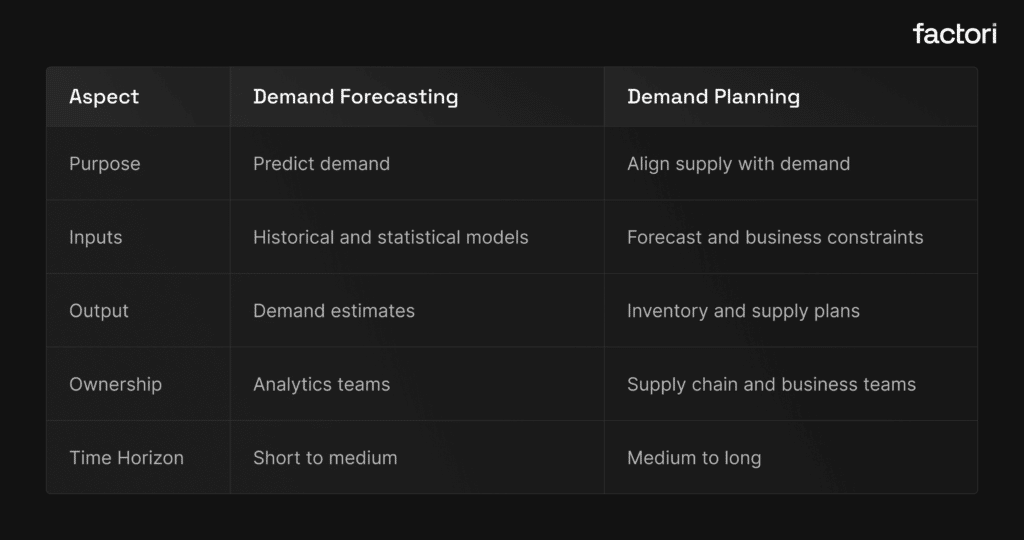
Demand planning forecasting works as one connected process.
A forecast without planning has little operational value. A plan based on a poor forecast can create excess inventory, stockouts, or capacity problems.
This connection is especially important for demand forecasting and inventory management. Forecast accuracy affects how much inventory businesses buy, where they place it, and when they replenish it.
What Are the Main Demand Forecasting Methods?
Teams asking what is demand forecasting and its methods usually need to understand three broad approaches: qualitative, statistical, and advanced predictive forecasting.
There is no single supply chain forecasting technique that works for every business.
Qualitative Forecasting
Qualitative demand forecasting methods rely on human judgment rather than large historical datasets.
Examples include expert judgment, market research, sales estimates, and the Delphi method.
These approaches are useful for new products, new markets, or situations where historical demand is limited.
Their main weakness is subjectivity.
Time Series Forecasting
Time series models use historical demand patterns to estimate future demand.
Common demand forecasting techniques include moving averages, exponential smoothing, and trend analysis.
These approaches work well when demand is relatively stable or seasonal.
However, they depend heavily on the assumption that previous patterns remain relevant.
Causal Forecasting
Causal demand forecasting methods include external variables that may influence demand.
Regression models, for example, can connect demand with pricing, promotions, economic conditions, or market activity.
These methods are useful when demand changes because of several measurable drivers.
AI and Machine Learning
Modern supply chain forecasting models can use machine learning to process larger and more complex datasets.
They can combine internal data with external signals such as mobility, traffic, economic activity, and location behavior.
This makes them useful in markets where demand changes quickly.
When comparing methods of demand forecasting techniques, the key question is not which method is most advanced. It is which method fits the data, business problem, forecast horizon, and market conditions.
Types of Forecasting in Supply Chain Management
Supply chain forecasting methods can cover more than customer demand.
Common types of forecasting in supply chain management include:
- Demand forecasting
- Inventory forecasting
- Supply forecasting
- Capacity forecasting
- Logistics forecasting
Supply forecasting focuses on future availability of materials, products, or resources.
Supply chain demand forecasting focuses on what customers are expected to buy.
Demand forecasting in logistics can also help teams estimate shipment volumes, delivery requirements, warehouse activity, and transport capacity.
These forecasts often work together.
How to Forecast Demand in Supply Chain Operations
For teams asking how to forecast demand in supply chain environments, the process should begin with the business decision rather than the model.
1. Define the Forecast
Decide what needs to be predicted.
This may be demand by product, store, region, channel, or time period.
2. Prepare Historical Data
Use sales, orders, pricing, promotions, inventory, and other relevant internal data.
Data quality matters. Missing or inconsistent history can reduce forecast accuracy.
3. Select the Forecasting Method
Choose the demand forecasting methods that fit the problem.
Stable demand may suit time series forecasting. More dynamic demand may require causal models or machine learning.
4. Add Relevant External Signals
Include variables that can explain changes not visible in sales history.
These may include mobility, visits, economic indicators, traffic conditions, events, or local market activity.
5. Compare Forecasts With Actual Results
Track error metrics and identify where the model consistently over- or under-predicts demand.
Then update the model.
This is the practical answer to both how do you forecast demand and how to do demand forecasting effectively: define the problem, use the right data, choose the right model, validate it, and keep improving it.
How Demand Forecasting and Planning Work Together
Forecasting and demand management should operate as a continuous cycle.
The forecast provides an expected view of demand. Planning then adjusts that view based on capacity, supply constraints, business targets, and operational priorities.
A simplified process is:
Forecast → Align → Plan → Execute → Monitor → Improve
Many businesses manage this through Sales and Operations Planning, or S&OP.
This process creates a common view across supply chain, sales, operations, and finance.
It also creates a feedback loop. Actual performance is compared with the original forecast, and those results improve future planning.
Role of Real-World Data in Demand Planning and Forecasting
Historical data remains important, but it does not always explain current changes in demand.
Local activity can shift because of customer movement, competition, road access, events, economic conditions, or changes in nearby places.
Real-world data adds this context.
Useful signals include:
- Mobility patterns such as footfall movement and catchment behavior
- Traffic and accessibility signals
- Place intelligence showing nearby businesses and competitive density
- Economic and property data
- Local market activity
These signals can be especially useful for demand forecasting in inventory management because inventory requirements often vary by location.
Two stores with similar historical sales may need different inventory levels if local demand is moving in different directions.
From Raw Signals to Forecasting Features
Simply adding external data does not automatically improve a model.
Raw signals need to be converted into useful forecasting features.
For example, mobility data may become a foot traffic index. Location data may become a catchment activity score. Economic information may become a market-level demand indicator.
The data should also be aligned to the correct location and time period.
For predictive modeling, teams should make sure that each feature was available before the forecast date. This prevents data leakage.
Well-designed supply chain forecasting tools should make these inputs easier to prepare, combine, test, and monitor.
Modern demand planning and forecasting use real-world signals as model-ready features rather than relying only on historical sales.
Improving Supply Chain Forecasting
Improving supply chain forecasting is not just about choosing a more advanced algorithm.
Businesses should improve the entire system around the forecast.
That includes better data, stronger model validation, more frequent updates, external demand signals, and tighter links between forecasts and operational decisions.
Modern systems increasingly use demand sensing to update forecasts as new signals arrive.
This moves forecasting in supply chain management away from occasional planning cycles toward more adaptive decision-making.
The goal is not constant model complexity.
It is faster detection of meaningful demand changes.
Common Mistakes to Avoid
1. Relying Only on Historical Sales
Historical data explains what happened before.
It may not capture a recent change in foot traffic, competition, customer movement, or economic conditions.
2. Treating Forecasting as a One-Time Exercise
Demand changes.
Forecasts should be reviewed and updated as new information becomes available.
3. Adding External Data Without Testing It
More data does not always produce a better forecast.
Each external feature should improve prediction or explain a meaningful demand driver.
4. Ignoring Cross-Functional Planning
Forecasts need to connect with inventory, capacity, production, logistics, sales, and finance.
Otherwise, forecasting and demand management remain disconnected.
5. Ignoring Location-Level Differences
Demand is rarely uniform across markets.
Aggregated forecasts can hide important differences between individual stores, regions, and trade areas.
Conclusion
Demand planning and forecasting serve different but connected roles.
Forecasting estimates future demand. Planning turns that estimate into decisions about inventory, production, logistics, and capacity.
Modern demand forecasting in supply chain operations increasingly combines historical data with external signals such as mobility, place activity, traffic, and economic conditions.
The result is a shift from static forecasts toward systems that can adapt as market conditions change.
For businesses focused on better demand forecasting and inventory management, the goal is not simply to predict a number more accurately. It is to create a forecasting process that leads to better operational decisions.
Explore our detailed demand planning and forecasting guide for more on building signal-driven forecasting systems.
Frequently Asked Questions
What Is Supply Chain Forecasting?
What is supply chain forecasting? It is the process of estimating future demand, supply requirements, inventory needs, capacity, or logistics activity to support supply chain decisions.
Demand forecasting is one part of the broader supply chain forecasting process.
What Is Demand Forecasting and Its Methods?
Demand forecasting estimates future customer demand.
Common demand forecasting and methods include qualitative forecasting, time series models, causal models, and AI or machine-learning approaches.
Which Supply Chain Forecasting Methods Should Businesses Use?
The best supply chain forecasting methods depend on data availability, market conditions, forecast horizon, and the decision being supported.
Many organizations combine several methods rather than depending on one model.
How Does Demand Forecasting Support Inventory Management?
Demand forecasting in inventory management helps businesses estimate how much stock will be needed and when.
Better forecasts can reduce both stockouts and excess inventory.
What Should Businesses Look for in Supply Chain Forecasting Tools?
Supply chain forecasting tools should support relevant forecasting models, internal and external data integration, location and time-based analysis, model monitoring, and forecast-versus-actual measurement.
They should make improving supply chain forecasting easier without adding unnecessary complexity.