Demand forecasting is the process of estimating future demand to support inventory, operations, and growth planning.
Forecast accuracy directly affects revenue, costs, and business risk.
Choosing the right forecasting method is important, but the method alone does not determine accuracy. Forecasts become stronger when models also use real-world signals such as movement patterns, place activity, and other external demand drivers.
The key is to understand how each method works, when to use it, and which data can improve the result.
Key Takeaway
- Demand forecasting works best when the method matches the business problem, available data, market conditions, and forecast horizon.
- Qualitative methods are useful when historical data is limited, while quantitative methods such as time series, causal models, and AI-based approaches work better when reliable structured data is available.
- Historical sales alone can miss changes in movement, visits, competition, and local market activity, creating blind spots in the forecast.
- Real-world signals such as mobility, visit, POI, audience, and consumer data can help explain demand shifts earlier and improve location-level forecasting.
- The strongest forecasting approach usually combines multiple methods and only the external signals that genuinely improve the model’s ability to explain or predict demand.
Types of Demand Forecasting Methods
Demand forecasting methods are usually grouped by how demand is modeled and what data is available.
In practice, many businesses combine several methods instead of relying on one approach.
Qualitative Demand Forecasting Methods
Qualitative methods rely on human judgment and market knowledge rather than structured historical data.
They are most useful when past data is limited or unavailable.
Common approaches include:
- Expert judgment
- Delphi method
- Market research and surveys
- Sales force estimates
These methods are often used for new products, new markets, or early-stage businesses.
Their main strength is flexibility. They allow teams to use industry knowledge and local context when data is limited.
The main limitation is subjectivity. Results can vary depending on the people involved, which makes these methods harder to scale consistently.
Quantitative Demand Forecasting Methods
Quantitative methods use structured data and statistical or predictive models.
They are easier to scale and can provide more consistent results when enough reliable data is available.
Time Series Forecasting Methods
Time series methods use past demand patterns to estimate future demand.
Common approaches include moving averages, exponential smoothing, and trend analysis.
Moving averages help smooth short-term changes. Exponential smoothing gives more weight to recent data. Trend analysis identifies longer-term direction.
These methods work well when demand follows stable or seasonal patterns.
Their main limitation is that they depend heavily on past behavior.
Causal Forecasting Methods
Causal models estimate demand by looking at the factors that influence it.
For example, regression models may connect demand with pricing, promotions, economic conditions, or other market variables.
Econometric models can be used to understand broader relationships between demand and market conditions.
These approaches are useful when demand changes because of several external factors rather than historical patterns alone.
Advanced and AI-Based Forecasting Methods
Advanced forecasting methods use machine learning and AI to identify more complex patterns.
Machine learning models can process large datasets with many variables at the same time.
AI-based models can also adapt as demand conditions change.
These methods become more useful when they include external data such as mobility trends, visit patterns, and location intelligence.
For many businesses, the strongest approach is a combination of forecasting methods supported by both internal and external data.
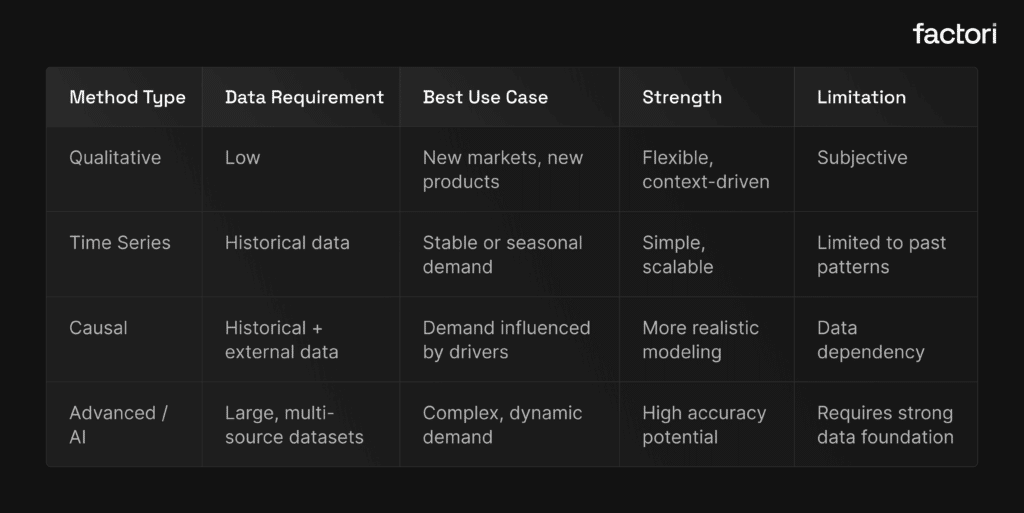
How to Choose the Right Demand Forecasting Method
There is no single forecasting method that works best for every business.
The right choice depends on the data available, the market, the forecast period, and the maturity of the forecasting process.
Data Availability
Businesses with reliable historical data can use quantitative methods.
When historical data is limited, qualitative methods may provide a better starting point.
Market Dynamics
Stable markets may be well suited to time series methods.
Markets with frequent changes may require causal or predictive models that can include external demand drivers.
Forecast Horizon
Short-term forecasts often depend more heavily on recent demand patterns.
Long-term forecasts usually require broader market, economic, and behavioral signals.
Business Maturity
More mature teams often combine several approaches.
For example, historical demand may provide the baseline while external market signals help explain recent changes.
Forecasting becomes stronger when the method and data are selected around the specific business decision.
Limitations of Traditional Demand Forecasting
Traditional forecasting often depends heavily on internal and historical data.
That information is useful, but it can create blind spots.
Past sales show what happened. They may not explain what is changing in the market now.
For example, a demand model may not immediately capture a change in local foot traffic, new competition, shifting customer movement, or changes around a store location.
Common limitations include:
- Heavy dependence on past demand
- Limited visibility into customer movement and visits
- Slow response to changing market conditions
- Weak understanding of location-level differences
Without external context, forecasts may miss important signals that show how demand is changing.
Improving Demand Forecasting With Real-World Data
Real-world data adds another layer of context to forecasting models.
Instead of relying only on sales history, businesses can also look at how people move, which places they visit, and how local market activity changes.
Mobility Data
Mobility Data shows how people move across locations and markets.
Changes in movement can indicate shifts in demand before they become clear in sales data.
Visit Data
Visit data shows foot traffic, visit frequency, and activity around specific places.
These signals can help businesses understand whether demand is increasing or declining at a location level.
POI Data
POI Data provides context about competitors, nearby businesses, and surrounding infrastructure.
This can help explain why demand differs between locations.
Audience and Consumer Data
Audience and consumer data adds context about the groups driving demand.
This can help businesses understand whether changes in activity are coming from relevant customer segments.
Business Impact of Better Demand Forecasting
Better forecasting can improve decisions across inventory, operations, staffing, and expansion.
Improved Forecast Accuracy
Real-world signals add context that historical data alone may not provide.
This can help forecasts reflect actual market activity more closely.
Better Inventory and Supply Planning
More accurate demand estimates can improve inventory allocation.
This helps reduce stockouts while also limiting excess inventory.
Faster Detection of Demand Changes
External signals can help teams identify demand shifts earlier.
This gives businesses more time to adjust inventory, staffing, marketing, or distribution.
Stronger Location and Market Decisions
Demand can vary widely between markets and individual locations.
Location-level data helps businesses understand those differences instead of relying only on regional or network averages.
More Efficient Resource Allocation
Better demand estimates can improve staffing, logistics, and distribution planning.
Resources can be allocated according to expected demand rather than broad assumptions.
Lower Decision Risk
Forecasting cannot remove uncertainty.
However, using current, observable signals alongside historical data can reduce the amount of uncertainty behind important decisions.
Combining Forecasting Methods and Data
Forecasting usually performs best when businesses avoid depending on a single model or dataset.
A time series model may provide a useful baseline.
Causal variables can explain changes caused by pricing, promotions, or economic conditions.
Mobility, visit, POI, and audience data can then add real-world context about how demand is changing across locations and markets.
The goal is not to add as many variables as possible.
Each signal should improve the model’s ability to explain or predict demand.
Conclusion
Demand forecasting methods provide the foundation for estimating future demand.
But forecast quality also depends on the data behind the model.
Historical sales remain important. However, they may not capture changing movement, visits, competition, or local market activity quickly enough.
Combining forecasting methods with real-world signals such as mobility, visit behavior, and place intelligence gives businesses a broader view of demand.
Forecasting then becomes less about running a model once and more about building a system that improves as market conditions change.
Explore our in-depth demand forecasting guide to learn more about building signal-driven forecasting systems.
FAQs
What Are the Main Types of Demand Forecasting Methods?
Demand forecasting methods are generally divided into qualitative and quantitative approaches.
Qualitative methods rely on expert knowledge and judgment. Quantitative methods use structured data and forecasting models.
Which Demand Forecasting Method Is Most Accurate?
There is no single method that is always the most accurate.
The right approach depends on the business problem, data quality, forecast horizon, and market conditions.
Combining multiple methods and relevant external data can often improve results.
Read more about data enrichment and how external datasets can improve analysis.
When Should Qualitative Forecasting Methods Be Used?
Qualitative methods are useful when historical data is limited or unavailable.
They are commonly used for new markets, new products, and early-stage businesses.
How Can Businesses Improve Forecasting Accuracy?
Businesses can improve forecasting by choosing the right model, using clean historical data, and adding relevant external signals.
These may include mobility trends, visit patterns, location activity, and market data.
What Data Can Improve Demand Forecasting?
In addition to historical sales, businesses can use mobility data, visit data, POI data, audience data, and broader market signals.
These datasets can help explain changes in demand that may not yet appear in internal sales records.