An identity graph helps businesses connect customer and audience data across devices, channels, platforms, and offline touchpoints.
A single customer may use a phone to browse products, a laptop to buy, and a loyalty account in a physical store. Without a way to connect these signals, each interaction may appear to come from a different person.
Identity graphs help solve this problem.
They connect identifiers such as emails, customer IDs, device IDs, login IDs, cookies, mobile advertising IDs, household signals, and CRM data. This creates a more consistent view of customers and audiences.
Businesses can use this connected view for identity resolution, audience targeting, data enrichment, personalization, media planning, measurement, and customer analytics.
What Is an Identity Graph?
An identity graph is a system that connects identifiers that may belong to the same customer, household, device, or audience.
A simple identity graph definition is:
A connected structure that links customer identifiers and attributes across different data sources.
Those sources may include:
- CRM systems
- Websites
- Mobile apps
- Ecommerce platforms
- Loyalty programs
- Advertising platforms
- Transaction systems
- Partner datasets
An identity graph helps teams understand how records from these systems relate to each other.
For example, the same customer may browse on a smartphone, purchase on a laptop, and use a loyalty ID in a store.
Without identity resolution, those actions may appear as three separate customer records. An identity resolution graph helps connect those signals into a more complete view.
Identity Graph Example
Consider a customer who interacts with a retailer in several ways:
| Interaction | Identifier |
|---|---|
| Creates an online account | Email address |
| Browses from a smartphone | Mobile device ID |
| Shops from a laptop | Cookie or login ID |
| Purchases in-store | Loyalty account |
| Receives advertising | Advertising ID |
An identity graph may connect these identifiers when there is enough evidence that they relate to the same customer or household.
This does not mean every identifier is automatically merged.
The quality of identity graph data depends on the strength of the match, the data available, and the rules used to connect records.
Why Identity Graphs Matter
Customer journeys rarely happen on one device or channel.
People move between websites, apps, physical stores, streaming platforms, social media, and advertising channels before making a purchase.
This creates fragmented data.
Without identity graphing:
- Marketing teams may target the same customer too often.
- Analytics teams may count one customer several times.
- Media teams may misread reach and frequency.
- Personalization may rely on incomplete profiles.
- Data teams may struggle to enrich first-party records.
- Attribution may miss parts of the customer journey.
Identity graphs reduce these gaps by linking related identifiers.
They give marketing, analytics, and data teams a stronger foundation for understanding customer and audience activity.
How Identity Graphing Works
Identity graphing usually involves four steps: collecting data, matching identifiers, resolving profiles, and activating the results.
1. Collect Identity Data
The process begins with identity graph data from different systems.
This may include:
- Email addresses
- Phone numbers
- Customer IDs
- Login IDs
- Device IDs
- Mobile advertising IDs
- Cookies
- Household signals
- CRM records
- Transaction data
The quality of these inputs matters.
Outdated, duplicated, or inconsistent records can weaken matching and create inaccurate connections.
2. Match Related Identifiers
The next step is identity matching.
The system looks for evidence that two or more identifiers belong to the same customer, household, or audience.
Some connections are direct. Others are based on probability.
For example, two devices using the same verified customer login may provide a strong connection.
Other signals may require several data points before the system considers the relationship reliable.
3. Build the Identity Resolution Graph
Once matching takes place, connected identifiers are organized into a graph.
The identity graph database stores relationships between identifiers and, where appropriate, related attributes.
The structure is often represented using nodes and connections.
A node may represent an email, device, customer ID, or household. A connection shows that two nodes have a known or likely relationship.
This is the basic idea behind identity graph math: different signals and confidence levels are used to determine how strongly identifiers are related.
The exact scoring method depends on the identity graph solution.
4. Activate the Connected Data
Once identities are resolved, businesses can use the results across marketing and analytics workflows.
This may include:
- Audience creation
- Personalization
- Data enrichment
- Cross-device measurement
- Frequency management
- Attribution
- Customer analytics
The graph becomes valuable when connected identity data can be used in real business workflows.
Deterministic vs. Probabilistic Identity Matching
Identity graph solutions often use deterministic matching, probabilistic matching, or a combination of both.
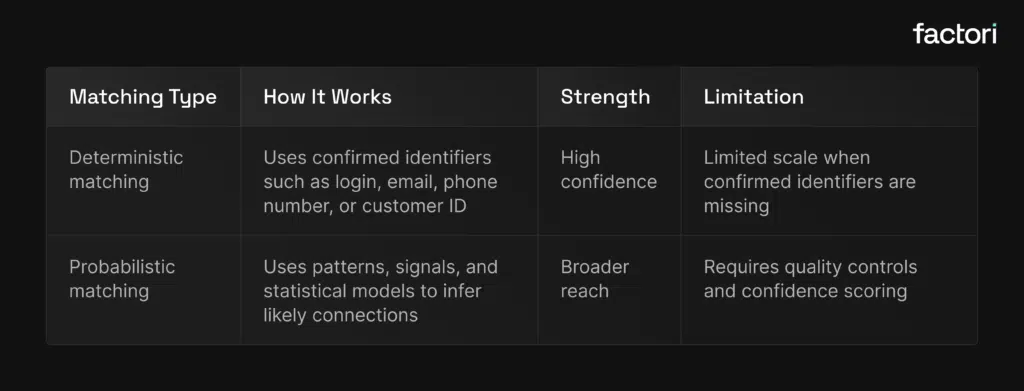
Deterministic matching usually provides higher confidence because the connection is based on a known identifier.
Probabilistic matching can extend coverage when direct identifiers are not available.
Many identity graphs use both methods. Deterministic links provide confidence, while probabilistic methods can improve scale.
The right balance depends on the available data, business use case, and required level of certainty.
Learn how privacy-first identity resolution can help businesses connect customer data without depending only on third-party cookies.
Identity Graph Use Cases
Identity graph use cases span marketing, data enrichment, analytics, media, and customer experience.
Audience Targeting
An audience targeting identity graph helps businesses connect audience records across devices and channels.
This can improve audience quality by reducing duplicate or disconnected profiles.
Marketing teams can use the connected data to build more accurate audience segments and activate them across campaigns.
Data Enrichment
Data enrichment with an identity graph helps businesses add useful attributes to existing customer records.
For example, first-party data may be enriched with demographic, consumer, behavioral, location, or audience attributes.
Businesses can use identity resolution to determine which external attributes should connect with which internal records.
This can improve segmentation, analytics, modeling, and campaign planning.
Personalization
Disconnected data can make personalization inconsistent.
A customer may receive one experience in an app and a different one on a website because the systems do not recognize the relationship between the two interactions.
Identity graphs help create a more consistent customer view.
This can support more relevant recommendations, messaging, and experiences across channels.
Media Planning and Measurement
Identity graph marketing can improve reach, frequency, and campaign measurement.
For example, a campaign may appear to have reached five different users when those records actually represent the same customer using several devices.
Identity resolution can reduce this duplication.
Media teams can then better understand:
- Unique audience reach
- Advertising frequency
- Cross-device exposure
- Campaign attribution
- Audience overlap
Cross-Device Intelligence
Customers often switch between phones, laptops, tablets, connected TVs, and other devices.
Identity graphs help connect these interactions.
This gives businesses a clearer view of cross-device customer journeys rather than treating each device as a different customer.
Customer Analytics
Identity graphs can strengthen customer journey analysis.
Analytics teams can connect browsing, engagement, purchase, and retention signals across systems.
This helps create a more complete view of customer behavior over time.
Retail and Location Intelligence
Identity graphs can also be combined with privacy-aware real-world signals.
Retailers may use aggregated mobility, visit, or place context to better understand how audience behavior changes between digital and physical environments.
For example, audience data can be enriched with broader location or visit patterns to support segmentation and market analysis.
Explore how mobility data can add real-world movement and visit context to identity strategies.
Customer Data Unification
Many businesses store customer information across CRM, ecommerce, advertising, analytics, and customer data platforms.
Identity graphs connect these records.
This makes customer and audience data easier to use across systems without forcing teams to treat every identifier as an independent person.
Identity Graph Benefits
The main identity graph benefits come from reducing fragmentation across customer and audience data.
Better Match Quality
Connecting related identifiers can reduce duplicated customer records and improve match rates across systems.
Stronger Audience Targeting
A more complete identity view can improve segmentation and help businesses avoid targeting the same customer as several separate users.
Better Data Enrichment
Identity graph data can help connect external attributes with the correct internal records.
This makes enriched profiles more useful for analytics and marketing.
Improved Cross-Channel Measurement
Connected identifiers help teams understand how customers move between devices and channels.
This can improve reach, frequency, attribution, and customer journey measurement.
More Consistent Personalization
Identity graphs can help businesses deliver more consistent experiences across websites, apps, media channels, and other customer touchpoints.
What to Look for in Identity Graph Solutions
Not every identity graph solution works the same way.
Businesses should evaluate:
- Match accuracy
- Data freshness
- Deterministic and probabilistic matching methods
- Supported identifiers
- Cross-device coverage
- Integration options
- Confidence levels
- Privacy controls
- Data governance
- Activation capabilities
An identity graph database should also be able to update as identifiers and customer relationships change.
A graph that relies on stale records can quickly become less useful.
The right identity graph solution should fit the business use case rather than simply provide the largest possible number of identity connections.
How Factori Supports Identity Graph and Audience Intelligence
Factori helps businesses strengthen identity and audience strategies through privacy-aware datasets, platform access, APIs, and MCP.
Teams can enrich first-party information using identity, cross-device, consumer, people, mobility, visit intelligence, POI, web stream, and high-fidelity data.
This can support:
- Audience targeting
- Data enrichment
- Media planning
- Campaign measurement
- Market intelligence
- Retail optimization
- Predictive analytics
Factori helps teams connect customer and audience information with real-world context while supporting privacy-aware data use.
Discover audience data targeting strategies that combine identity intelligence with real-world signals.
Conclusion
An identity graph connects fragmented identifiers into a clearer customer, household, or audience view.
It can improve identity resolution, data enrichment, audience targeting, personalization, cross-device analysis, and media measurement.
The value of identity graphing is not simply in connecting more identifiers. It comes from making fragmented data easier to understand and use.
As customer journeys become more complex, identity graphs give marketing, analytics, and data teams a stronger foundation for working across devices, platforms, and channels.
FAQs
What Is an Identity Graph?
An identity graph is a connected structure that links identifiers and attributes that may relate to the same customer, household, device, or audience.
It can help businesses connect customer data across systems and channels.
What Data Is Used in an Identity Graph?
Identity graph data may include emails, phone numbers, customer IDs, device IDs, login IDs, mobile advertising IDs, cookies, CRM records, transaction data, and other permissioned identifiers.
The exact data depends on the provider and use case.
What Is the Difference Between an Identity Graph and Identity Resolution?
Identity resolution is the process of matching identifiers.
An identity graph is the structure that stores and organizes the relationships created through identity resolution.
Can Identity Graphs Work Without Third-Party Cookies?
Yes.
Modern identity graphs can use first-party data, hashed identifiers, login information, customer IDs, device signals, and partner data instead of relying only on third-party cookies.
What Makes a Good Identity Graph?
A useful identity graph should have accurate matching, fresh data, clear confidence levels, scalable integrations, strong privacy controls, and practical activation options.
It should help teams use identity data across marketing, analytics, enrichment, and measurement workflows.