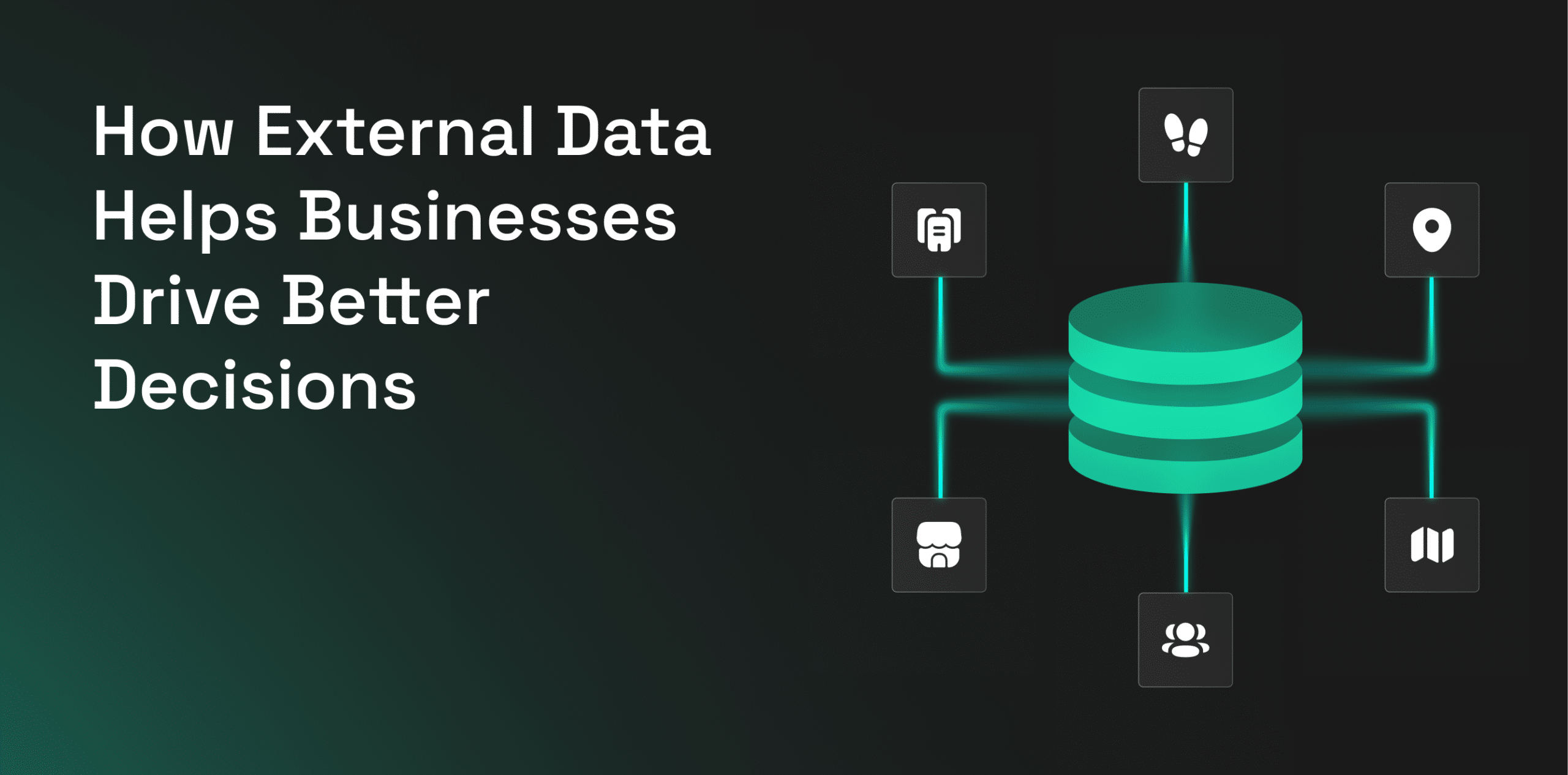
In today’s data-driven world, external data gives businesses the market context that internal metrics alone cannot provide.
External data helps businesses understand how it differs from internal data, where it creates the most value, why a formal data strategy matters, how to implement one, and which trends are shaping its future.
As of 2025, 68% of organizations have a formal data strategy in place, while 89% of executives plan to increase their investment in data analytics and decision intelligence over the next three years. In addition, 74% of enterprises use location data to create intelligent business context.
What Is External Data?
External data is information generated outside an organization’s internal systems. It provides context about the markets, customers, competitors, locations, and economic conditions that influence business performance.
Internal data usually includes sales transactions, CRM records, website activity, inventory levels, and operational metrics. It shows what is happening within the business.
External data captures the wider real-world conditions behind those results. Common examples include:
- Mobility and foot traffic data
- POI and Places data
- Consumer and audience attributes
- Economic and market indicators
- Business and property data
- Demographic and behavioral data
- Competitive activity
Explore Factori’s full product suite here.
For example, internal sales data may show that one store is underperforming. External data can help determine whether lower local foot traffic, changing customer profiles, increased competition, or weaker demand in the surrounding market contributed to the decline.
By connecting internal and external signals, businesses can understand not only what happened, but why it happened and what may happen next.
Benefits of External Data for Businesses
1. Better Market Insights
External data gives businesses a broader view of market conditions, customer demand, local activity, and competition.
Teams can use mobility, POI, economic, business, and consumer data to identify:
- High-growth markets
- Underserved customer segments
- Changes in local demand
- Competitor expansion
- Emerging category trends
- Areas with stronger commercial potential
A retailer evaluating a new market, for example, can compare foot traffic, nearby businesses, customer profiles, and competitive density instead of relying only on historical sales from existing stores.
2. Deeper Customer Understanding
Internal data shows how customers interact with a business. External data provides additional context about who those customers are, where they go, what interests them, and how their behavior differs across markets.
People, consumer, audience, mobility, and behavioral data can help businesses:
- Enrich first-party customer records
- Build more precise audience segments
- Identify high-value customer groups
- Improve campaign personalization
- Compare customer profiles across markets
- Develop stronger lookalike audiences
This gives marketing and analytics teams a more complete understanding of customers without relying only on first-party activity.
3. More Informed Decision-Making
External data adds real-world signals that internal systems may not capture.
Businesses can combine internal performance data with mobility, location, market, and economic signals to improve:
- Demand forecasting
- Site selection
- Market expansion
- Inventory planning
- Media planning
- Sales forecasting
- Territory optimization
A forecasting model based only on historical sales may miss changes in customer movement, market activity, or nearby competition. Adding relevant external signals can help the model respond more accurately to current conditions.
4. Stronger Risk Management
Many business risks develop outside an organization before they appear in internal reports.
External data can help teams detect:
- Declining market activity
- Economic pressure
- Competitor growth
- Changes in consumer behavior
- Weakening location performance
- Supply chain disruption
- Poor expansion opportunities
Earlier visibility allows businesses to adjust forecasts, reconsider investments, change operating plans, or prioritize lower-risk opportunities.
5. Faster Innovation and Product Development
External data can reveal emerging customer needs, underserved markets, and changes in category demand.
Businesses can use these insights to:
- Identify new product opportunities
- Enter promising markets
- Improve existing services
- Develop new customer segments
- Optimize promotions
- Discover underserved locations
- Prioritize product features
Instead of relying only on internal assumptions, teams can use real-world evidence to guide product and growth decisions.
Why Businesses Need an External Data Strategy
Access to more data does not automatically lead to better decisions.
Without a clear strategy, organizations may purchase overlapping datasets, create disconnected workflows, or rely on data that is outdated, inconsistent, or unsuitable for the intended use case.
An external data strategy connects business objectives with the right data sources, integration methods, governance standards, and performance measures.
Data Integration
External data becomes more valuable when it can be joined with internal sales, customer, operational, or location records.
A clear integration strategy should define:
- Which internal systems the data will connect to
- How customers, businesses, and locations will be matched
- How frequently the data will be updated
- Which teams will have access
- How insights will enter existing workflows
Standardized schemas, APIs, cloud platforms, and automated pipelines can reduce preparation time and make external data easier to use across the business.
Data Quality and Governance
Not every external dataset is suitable for business decision-making. Organizations should evaluate external data based on:
- Accuracy
- Geographic coverage
- Freshness
- Completeness
- Consistency
- Source reliability
- Privacy practices
- Intended use
Governance standards help teams determine whether a dataset is reliable enough for forecasting, targeting, planning, or operational analysis.
When using mobility, audience, or consumer data, organizations should prioritize aggregated insights, responsible sourcing, sensitive-place filtering, and privacy-aware use.
Scalability
Business data requirements change as organizations enter new markets, introduce products, and expand analytics programs.
A scalable strategy allows teams to add datasets, users, and regions without rebuilding their infrastructure for every use case. APIs, cloud-native access, reusable pipelines, and consistent schemas make external data easier to expand across teams and geographies.
Competitive Advantage
External data can help businesses identify changes before they become visible in internal performance metrics.
Organizations can use these signals to anticipate demand, understand competition, evaluate markets, and respond to customer behavior more quickly.
The advantage comes not from having more data, but from turning relevant external signals into faster and better decisions.
Resource Optimization
A structured strategy ensures that external data investments remain connected to measurable business goals.
Teams can prioritize datasets that support outcomes such as:
- Better forecast accuracy
- Faster site evaluation
- Higher campaign performance
- Lower market-entry risk
- Improved customer targeting
- Stronger store performance
This helps organizations avoid unnecessary data purchases and evaluate the return generated by each source.
How to Build an External Data Strategy
1. Define the Business Objective
Begin with the decision or outcome the business wants to improve.
Examples include reducing site evaluation time, improving demand forecast accuracy, identifying stronger expansion markets, enriching customer records, or optimizing media campaigns.
Each objective should be linked to a measurable result, such as lower forecast error, faster time-to-insight, higher conversion, or reduced investment risk.
2. Select the Right External Data Sources
Choose external data based on the business question rather than collecting as many datasets as possible.
| External data type | Best suited for | Example business question |
| POI and Places data | Site selection, competitive mapping, market analysis | Which locations have strong commercial potential and manageable competition? |
| Mobility data | Foot traffic analysis, trade areas, demand forecasting | Where and when is customer movement increasing or declining? |
| Visit intelligence | Store benchmarking, catchment analysis, location performance | Which stores attract more visits, and where do visitors come from? |
| People and consumer data | Customer enrichment, segmentation, market profiling | Which customer groups are most valuable in each market? |
| Audience data | Targeting, media planning, campaign activation | Which audiences should a campaign prioritize? |
| Economic and market data | Expansion planning, demand analysis, risk assessment | Which markets offer stronger growth potential and lower investment risk? |
| Property and business data | Territory planning and commercial analysis | Which areas have the right business density and development potential? |
Starting with one focused use case makes it easier to test the value of the data before expanding it across additional workflows.
3. Plan the Integration
Determine how external data will reach the systems and teams that need it.
Common integration methods include:
- APIs
- Cloud marketplaces
- Data warehouses
- ETL pipelines
- Bulk data files
- Enrichment platforms
- Business intelligence tools
The right method depends on the data volume, refresh frequency, technical resources, security requirements, and intended workflow.
4. Establish Governance Standards
Create clear policies for how external data is sourced, validated, accessed, transformed, and used.
A governance framework should cover:
- Data quality checks
- Access permissions
- Privacy and security
- Sensitive-data handling
- Data retention
- Model usage
- Vendor evaluation
- Compliance-aware practices
Teams should also document how external data is joined with internal records so that results remain explainable, reproducible, and auditable.
5. Build the Right Analytics Capabilities
External data creates value only when teams can turn it into usable insights.
Depending on the use case, businesses may need capabilities in:
- Predictive analytics
- Machine learning
- Geospatial analysis
- Data visualization
- Customer segmentation
- Demand forecasting
- Market scoring
- Location analysis
The goal is to transform raw data into business-ready features, model inputs, and decision workflows.
6. Measure Business Impact
External data should be assessed by the improvement it creates, not simply whether it has been integrated.
Useful performance measures include:
- Change in forecast error
- Time-to-first-insight
- Improvement in campaign conversion
- Reduction in site evaluation time
- Increase in audience match rates
- Improvement in model accuracy
- Reduction in poor investment decisions
If the data does not improve the intended outcome, teams should reassess the source, selected attributes, integration process, or analytical model.
7. Improve Continuously
External data strategies should evolve as markets, technology, and business needs change.
Teams should regularly review data quality, freshness, coverage, cost, user adoption, model performance, and return on investment.
Low-value sources can be removed, while effective datasets can be expanded into additional teams and use cases.
Emerging Trends in External Data
AI-Driven Data Enrichment
AI and machine learning are making it easier to transform raw external data into usable features and insights.
Organizations can automate record matching, classification, anomaly detection, segmentation, entity resolution, and feature creation. This reduces manual preparation and helps analytics teams move from raw data to model-ready inputs faster.
More Frequent Data Updates
Businesses increasingly need current signals rather than static datasets.
Frequently updated external data can support:
- Demand sensing
- Store performance monitoring
- Campaign optimization
- Market tracking
- Operational forecasting
- Competitive analysis
Freshness is particularly important when customer movement, local activity, or market conditions change quickly.
Privacy-Safe Data Collaboration
Organizations are placing greater emphasis on aggregated analysis, data minimization, sensitive-place filtering, and controlled collaboration.
Clean-room environments can help businesses combine first-party and external data without exposing individual-level information.
This allows teams to generate useful market and audience insights while maintaining responsible data practices.
External Data in Forecasting Models
External data is increasingly being embedded directly into predictive models rather than being used only as supporting context.
Mobility, location, market, economic, and consumer signals can help explain demand changes that historical internal data alone may miss.
The most valuable features are those that improve forecast accuracy and are available before the forecast period, helping teams avoid data leakage.
Cloud-Native Data Access
External datasets are increasingly delivered through APIs, cloud marketplaces, data warehouses, and modern data platforms.
This reduces manual file handling, shortens procurement and integration cycles, and allows teams to connect external signals directly to analytics, AI, and forecasting workflows.
How Factori Supports External Data Strategies
Factori helps businesses connect real-world movement, place, audience, consumer, and market data with existing analytics and decision workflows.
Factori datasets, APIs, and platform support use cases such as:
- Data enrichment
- Audience targeting
- Demand forecasting
- Site selection
- Market intelligence
- Retail optimization
- Media planning and measurement
With broad coverage, accurate data, consistent schemas, flexible access, and privacy-first practices, Factori helps teams move from raw external data to business-ready insights faster.
Discover Factori’s real-world data solutions here.
Conclusion
External data helps businesses understand the market forces, customer behaviors, competitive activity, and real-world conditions that internal systems cannot capture alone.
When connected with internal data, it can improve forecasting, customer understanding, market selection, risk management, and product development. However, its value depends on selecting the right sources, integrating them effectively, maintaining strong governance, and measuring their impact.
A focused external data strategy helps organizations move from collecting more information to making better decisions.
FAQs
What is external data in business?
External data is information generated outside a company’s own systems. It may include mobility patterns, POI data, market indicators, consumer attributes, audience data, economic information, and competitive activity.
What is the difference between internal and external data?
Internal data comes from company-owned systems, such as sales, CRM, website, and operational platforms. External data comes from outside sources and provides broader market, customer, location, and economic context.
What external data should businesses start with?
Businesses should begin with data that directly supports a priority use case. POI data can support site selection, mobility data can strengthen demand forecasting, and audience or people data can improve targeting and customer enrichment.
How can businesses integrate external data?
External data can be integrated through APIs, cloud marketplaces, data warehouses, ETL pipelines, bulk files, and enrichment platforms. The right method depends on data volume, refresh frequency, technical resources, and business requirements.
How can businesses measure the value of external data?
Businesses can measure improvements in forecast accuracy, time-to-insight, campaign performance, model quality, site evaluation speed, customer targeting, and investment risk.