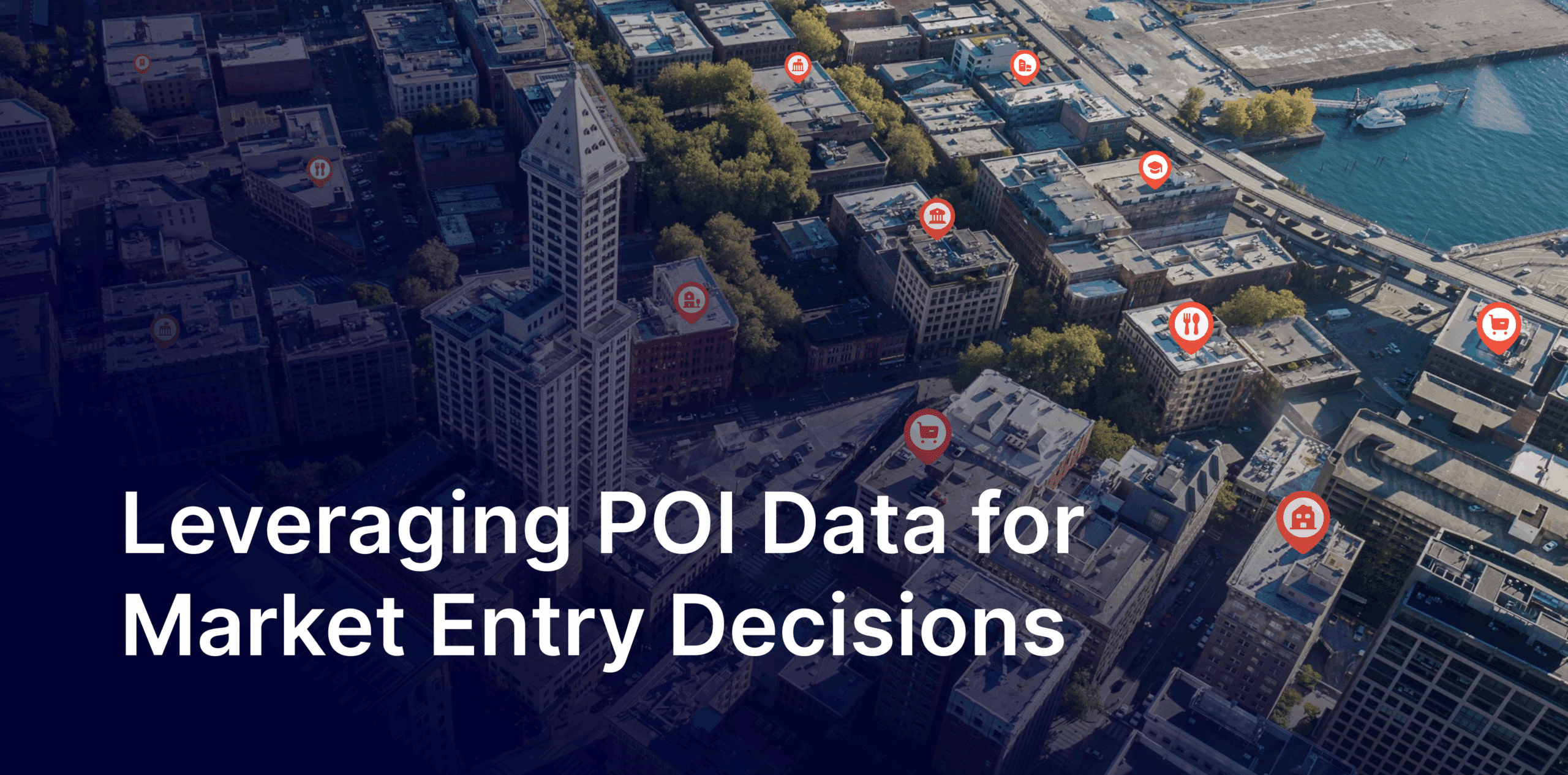
Every store, restaurant, hotel, office, branch, and transit hub exists within a wider physical market.
Understanding those places, where they are, what surrounds them, and how markets differ can improve decisions about expansion, competition, targeting, and demand.
POI data turns physical places into structured information businesses can analyze. It gives teams a location-level view of markets instead of relying only on broad geographic or demographic assumptions.
Key Takeaway
What Is a Point of Interest (POI)?
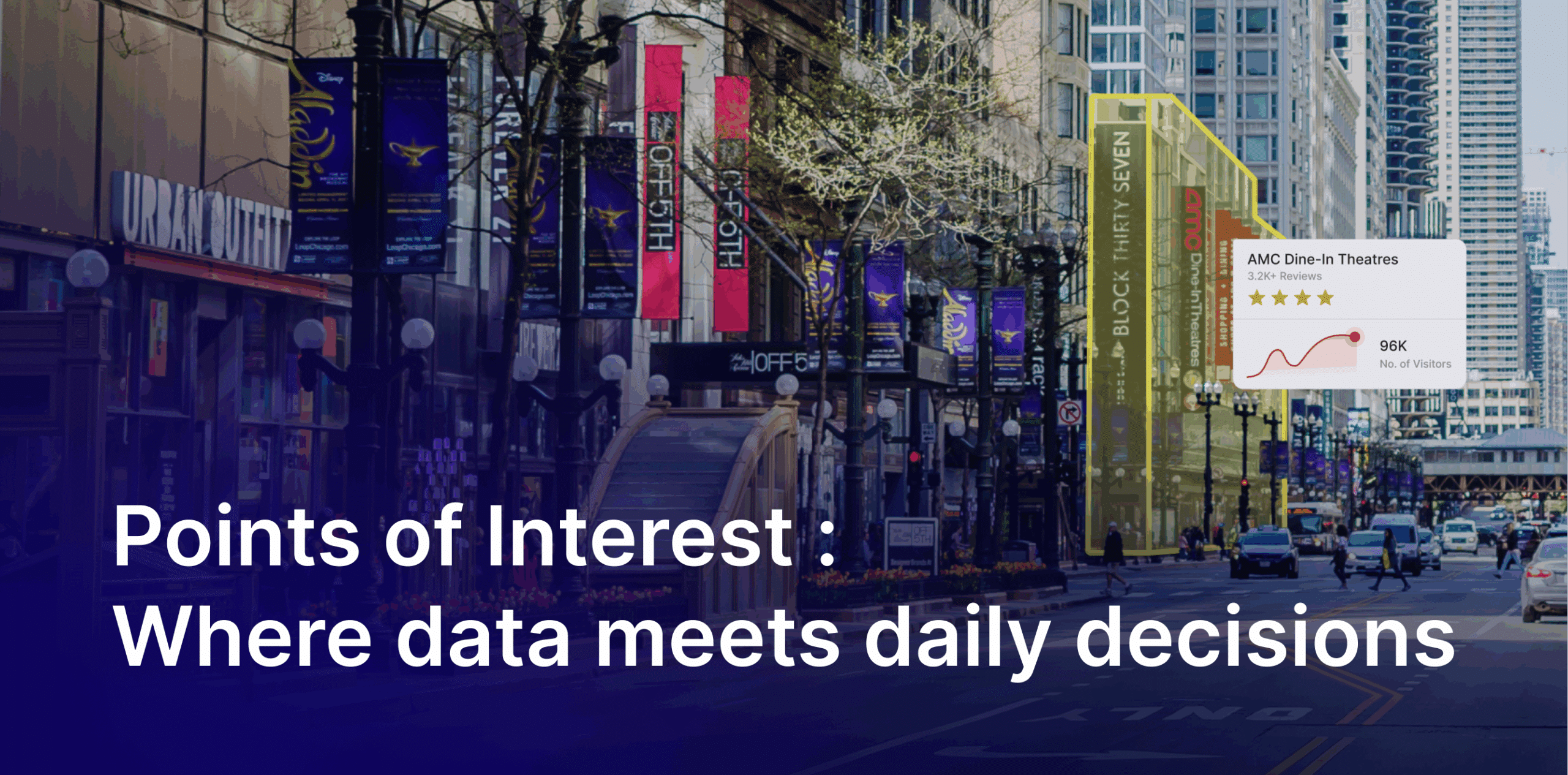
A point of interest, or POI, is a named physical location that people may visit, use, search for, or interact with. A POI can be a commercial location such as a retail store or restaurant, but it can also include offices, hospitals, schools, transit hubs, landmarks, entertainment venues, and other physical places.
In location data, each point of interest is treated as an identifiable place that can be represented through structured attributes such as its name, geographic coordinates, address, category, brand, operating status, and other available information.
A point of interest is the physical place itself. POI data is the structured information describing that place, while a points of interest database organizes many of those records into a consistent dataset that can be searched, mapped, compared, or joined with other data.
What Is POI Data?
POI data, or point of interest data, is structured information about physical locations that people may visit, use, search for, or interact with.
The terms POI data, point of interest data, points of interest data, and Places data are often used to describe closely related location datasets containing structured records about physical places.
Examples include:
- Retail stores
- Restaurants
- Hotels
- Banks and ATMs
- Offices
- Hospitals
- Schools
- Shopping centers
- Transport hubs
- Entertainment venues
- Landmarks
A POI record usually contains a location’s name, address, coordinates, category, and other attributes.
For businesses, POI data can answer questions such as:
- Where are competitors located?
- Which markets have more commercial activity?
- What surrounds a potential new site?
- Which areas appear underserved?
- Where are relevant places concentrated?
This makes POI data for business useful across retail, real estate, finance, advertising, travel, and market intelligence.
What Is Included in a Points of Interest Database?
A points of interest database, also called a POI database or Places database, is an organized collection of structured records representing physical locations.
Each record typically represents an individual location, such as one store within a retail chain, one restaurant, one hotel, or one branch. These records can then be filtered, mapped, compared, enriched, or joined with other business and geospatial datasets.
A useful POI dataset should contain enough information to identify, locate, classify, and compare places consistently.
| POI Attribute | What It Helps Describe |
| Place name | The business or location |
| Address | Where the place is located |
| Coordinates | Exact map position |
| Category | Type of place or business |
| Brand | Chain or brand relationship |
| Business status | Whether the location is active |
| Opening hours | When the place operates |
| Location ID | A consistent identifier for matching |
| Geometry or polygon | Physical footprint of the location |
| Additional attributes | Details specific to the place or category |
More advanced POI databases may include brand hierarchies, building geometry, popularity information, category-specific attributes, parent-child relationships, or timestamps showing when a record was last updated.
For example, a shopping mall can exist as one POI while individual stores inside that mall are represented as separate records. A well-structured database should preserve those relationships rather than treating every location as an unrelated point on a map.
The size of a POI database alone does not determine quality.
Accuracy, freshness, coverage, attribute completeness, taxonomy consistency, and the ability to distinguish duplicate records from genuinely separate locations are often more important.
How Is POI Data Collected?
POI data collection usually combines information from multiple sources.
These can include public records, business websites, mapping sources, commercial databases, partner datasets, direct business submissions, open datasets, and proprietary collection systems.
Because no single source captures every opening, closure, relocation, rebrand, category change, or attribute update, POI databases usually need to reconcile information from several sources before records are ready for analysis.
Raw records then need to be cleaned and standardized.
A POI data provider may need to:
- Standardize addresses and coordinates
- Remove duplicate records
- Normalize categories
- Connect locations with brands
- Identify openings and closures
- Resolve conflicting information
- Refresh changing attributes
This process matters because physical markets change constantly.
Businesses open, close, move, rebrand, and change their operating hours. A POI dataset should therefore be treated as a changing representation of the real world rather than a static directory.
How Is POI Data Cleaned and Maintained?
Creating a POI database is not only a collection problem. Records from different sources may describe the same location differently, use different categories, contain outdated addresses, or identify the same brand under several names.
Providers therefore need processes for entity resolution, which determines whether records from different sources refer to the same physical place. They also need deduplication rules that remove repeated records without accidentally combining two legitimate locations of the same brand.
Categories also need to be normalized into a consistent taxonomy. One source might describe a location as a “coffee shop,” another as a “café,” and another as a “restaurant.” A standardized taxonomy makes locations easier to compare across cities, countries, and source systems.
Freshness is another ongoing challenge. A POI database should be refreshed frequently enough to capture meaningful changes such as new openings, closures, relocations, rebrands, and updated business attributes.
The exact collection, validation, and refresh methodology varies by provider, which is why buyers should evaluate methodology alongside record count when choosing a POI data provider.
How Does POI Data Analysis Work?
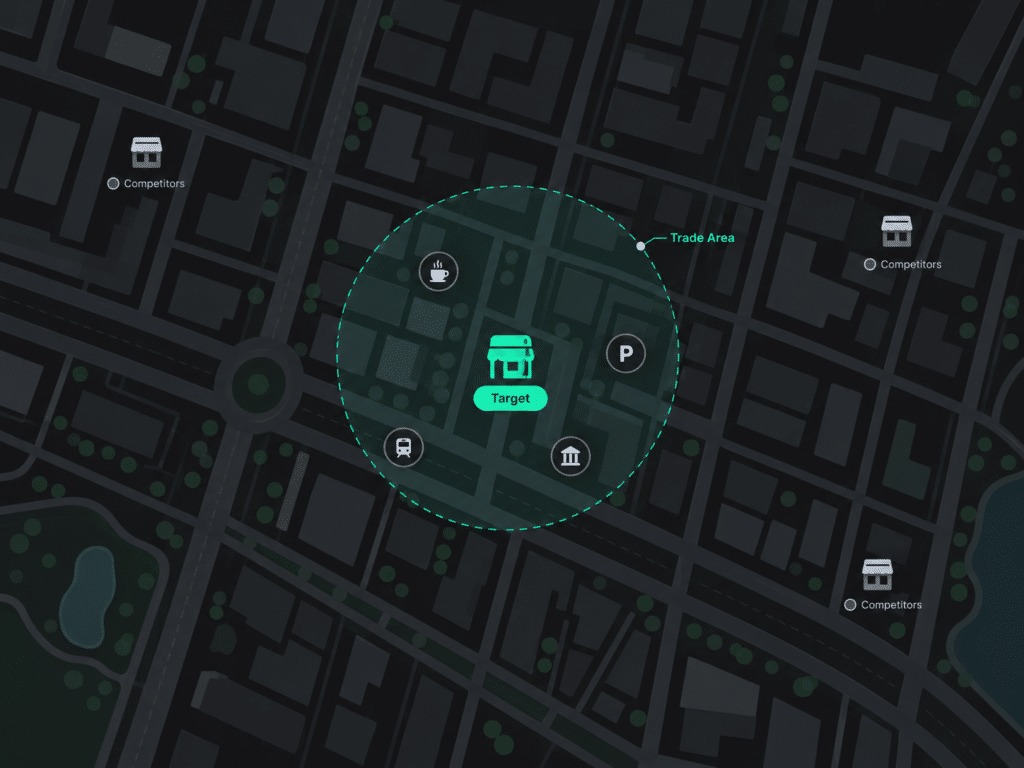
POI data analysis goes beyond plotting points on a map.
Businesses use POI data alongside location intelligence to analyze relationships between places and understand competition, accessibility, market structure, and opportunity.
Common techniques include:
- Proximity analysis: Find businesses or services near a location
- Density analysis: Identify commercial clusters
- Competitor analysis: Compare brand presence
- White-space analysis: Find markets with limited coverage
- Co-tenancy analysis: Study businesses that often appear together
- Trade area analysis: Understand places within customer catchments
- Network analysis: Compare portfolios across markets
For example, knowing that a competitor has 50 stores in a city tells you very little on its own.
POI data analysis can show where those stores cluster, what surrounds them, and which parts of the market remain less served.
Explore Factori Places Data for structured place and location attributes across markets.
What Are the Main POI Data Use Cases?
POI data use cases cover many decisions that depend on understanding physical markets.
Site Selection and Market Expansion
Businesses can use POI data to understand what surrounds a potential site before committing to a location.
Teams may evaluate:
- Competitors
- Nearby anchors
- Complementary businesses
- Commercial density
- Market saturation
- Accessibility
- Local amenities
When combined with mobility, demographics, visits, and internal performance data, POI data can support stronger retail site selection.
Competitive and Market Analysis
A POI dataset can map competitors across cities, trade areas, or entire markets.
This can reveal:
- Competitor concentration
- Expansion patterns
- Gaps in brand coverage
- Emerging clusters
- Differences in network density
These are common POI data applications for market intelligence.
Retail Network Planning
Retailers can compare their own locations with competitors, shopping centers, transport hubs, and other demand drivers.
This supports expansion, consolidation, network-gap analysis, and portfolio planning.
Audience Targeting and Media Planning
POI data can add physical location context to advertising.
Marketers may analyze places such as shopping districts, airports, dealerships, restaurants, hotels, entertainment venues, and business districts.
Combined with privacy-aware audience data and mobility data, these signals can support geographic targeting and OOH or DOOH planning.
Data Enrichment
Businesses often have customer, merchant, property, or store databases with incomplete location information.
POI data can add:
- Standardized names
- Coordinates
- Categories
- Brands
- Addresses
- Location IDs
- Surrounding place context
This makes internal data easier to connect with other location datasets.
Financial Services
Banks can use POI data to map branches and ATMs, compare competitor networks, and identify coverage gaps.
Travel and Hospitality
Travel businesses can analyze hotels, restaurants, attractions, and transport infrastructure within destinations.
What Are the Main POI Data Benefits?
The main benefit of POI data is more precise market context.
| Business Need | POI Data Benefit |
| Expansion | Compare markets and candidate sites |
| Competition | Understand competitor presence |
| Market intelligence | Identify clusters and gaps |
| Targeting | Add place-level context |
| Data enrichment | Improve internal location records |
| Network planning | Compare physical coverage |
| Forecasting | Add external market context |
POI data benefits increase when place information is combined with other datasets.
A restaurant list shows where restaurants exist. Add visit data and teams can compare activity. Add mobility data and they can analyze movement. Add audience data and they can understand which groups are relevant to those markets.
How Do You Choose a POI Data Provider?
Choosing a POI data provider based only on database size can be misleading.
Evaluate providers based on the business use case.
Accuracy
Are addresses, coordinates, brands, categories, and attributes correct?
Coverage
Does the provider cover the countries, cities, and categories you need?
Coverage should also be evaluated for consistency. A provider may claim global coverage while having much stronger completeness in some countries, cities, or POI categories than others.
Freshness
How quickly are openings, closures, relocations, and other changes updated?
Ask whether freshness is measured at the individual-record level, by market, or through a general database refresh schedule. These are not necessarily the same thing.
Completeness
Are important attributes consistently populated?
A large database with limited addresses, categories, brands, or business-status information may be less useful than a smaller but more complete dataset.
Taxonomy
Are categories standardized across locations and markets?
A useful taxonomy should allow analysts to compare similar businesses consistently even when source systems describe them differently.
Deduplication
Does the provider remove duplicate records while keeping separate locations distinct?
This becomes particularly important for chains with several locations close together or businesses located inside malls, airports, and mixed-use developments.
Geographic Precision
Are POIs positioned accurately enough for the intended analysis?
A coordinate located near a building may be sufficient for broad market analysis but insufficient for use cases such as precise geofencing, parcel analysis, or venue-level measurement.
Integration
Can the POI dataset connect with your warehouse, GIS, applications, analytics systems, or AI workflows?
The best POI data provider is not necessarily the one with the largest POI database. It is the provider whose coverage, methodology, freshness, attributes, and POI data access options fit your requirements.
How Can Businesses Access POI Data?
POI data access depends on how the data will be used.
Common options include:
- APIs
- Bulk files
- Cloud marketplaces
- Data warehouses
- GIS integrations
- Location intelligence platforms
A POI data platform can help business teams search, filter, map, compare, and export locations without building a complete data pipeline.
Data and engineering teams may prefer APIs or bulk access so the data can connect directly with existing infrastructure.
The right access model depends on the workflow.
How Does POI Data Work With Other Data?
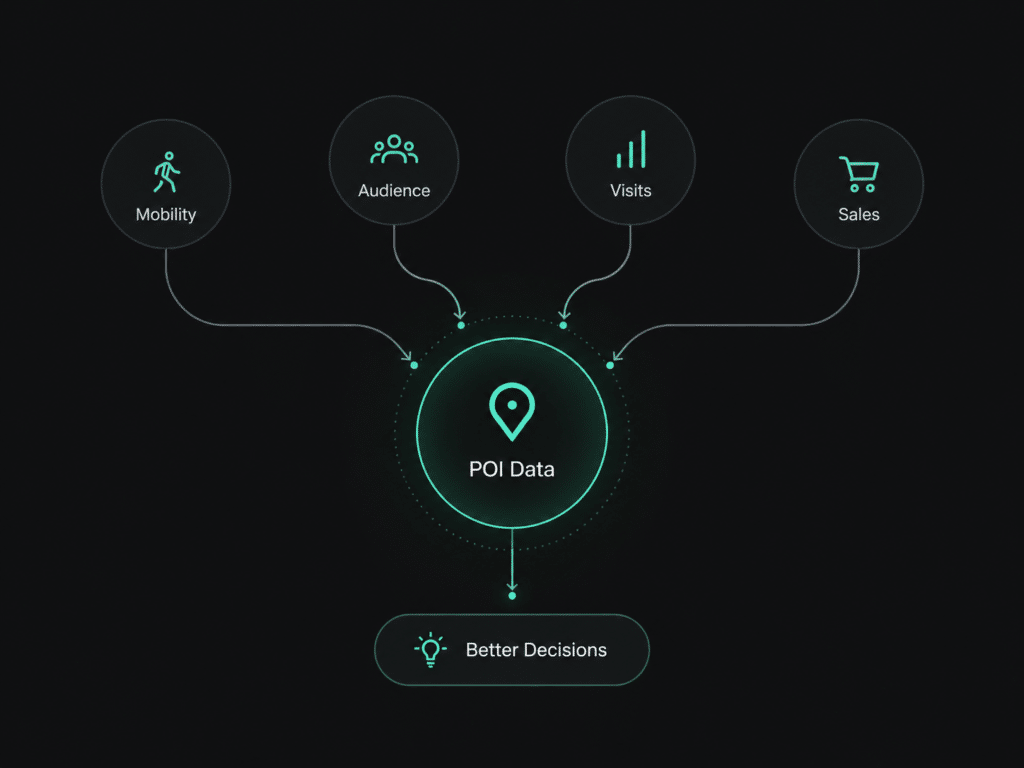
POI data tells businesses what places exist.
Other datasets add context about what happens around those places.
| Data Combination | Additional Insight |
| POI + mobility | How people move between places |
| POI + foot traffic analytics | Which places attract activity |
| POI + demographics | Who lives around the market |
| POI + audience data | Which audience groups are relevant |
| POI + sales data | How market context relates to performance |
| POI + weather or events | How external conditions affect activity |
Combining these signals turns a static map into a richer view of market behavior.
How Factori Helps Businesses Use POI Data
Factori provides POI and Places Data that businesses can combine with Mobility, Visit/Location Intelligence, People, and Consumer datasets.
Rather than treating a point of interest as only a latitude and longitude, Factori’s Places Data gives teams structured place-level information that can be used to identify, classify, compare, and connect physical locations across markets.
Teams can use these signals for:
- Site selection
- Market intelligence
- Retail optimization
- Audience targeting
- Media planning
- Data enrichment
- Predictive analytics
Factori provides POI data access through its platform, APIs, datasets, and other integration options.
This allows business, analytics, and data teams to bring place-level intelligence into existing workflows and connect POI data with other real-world signals.
Conclusion
POI data provides a structured view of the physical places that shape markets.
Its value goes beyond knowing where a store, restaurant, branch, or venue is located.
Businesses can use POI data to understand competitors, evaluate markets, enrich internal databases, plan physical networks, and add location context to targeting and forecasting.
The strongest results come from accurate, fresh, well-structured POI datasets that are easy to combine with other business and real-world signals.
FAQs
What Is POI Data?
POI data is structured information about physical locations such as stores, restaurants, hotels, offices, branches, and transport hubs. It typically includes attributes such as a location’s name, address, coordinates, category, brand, and business status.
What Is a Point of Interest?
A point of interest, or POI, is a physical location that people may visit, use, search for, or interact with. Examples include stores, restaurants, offices, hotels, schools, hospitals, transit hubs, and landmarks.
What Is the Difference Between a POI Database and a POI Dataset?
A POI database is the broader system used to store and manage structured place records.
A POI dataset is a collection or extract of those records, often filtered by geography, brand, or category.
How Is POI Data Collected?
POI data collection can combine public records, business websites, mapping sources, partner datasets, commercial databases, and proprietary systems. Records are then cleaned, standardized, matched, deduplicated, categorized, and refreshed.
What Should You Look for in a POI Data Provider?
Evaluate accuracy, geographic coverage, freshness, attribute completeness, taxonomy, deduplication, geographic precision, integration options, and access methods.