
Site selection analysis helps businesses compare potential locations before making a major investment.
A strong site selection and location strategy looks beyond whether a location appears attractive. It considers customer demand, foot traffic, competition, accessibility, trade areas, nearby businesses, and commercial viability.
The goal is simple: understand which location is most likely to support long-term business performance.
Key Takeaway
- Site selection analysis compares potential locations using a consistent set of business and market criteria.
- A strong site selection and location strategy considers demand, movement, competition, accessibility, audience fit, and commercial viability.
- Location selection should not rely on demographics or intuition alone.
- Site suitability analysis helps determine whether a location matches the operational and market needs of the business.
- Foot traffic should be evaluated for consistency and customer relevance, not just volume.
- Trade areas should reflect real customer movement rather than fixed-radius assumptions.
- A structured location selection strategy makes comparisons between candidate sites more objective.
- Demand forecasting can add another layer when testing the expected performance of shortlisted sites.
- Location intelligence helps connect mobility, visits, Places, and audience signals for stronger location decision making.
- Whether handled internally or through site selection consulting, the process works best when every location is evaluated against the same criteria.
What Is Site Selection Analysis?
Site selection analysis is the process of evaluating and comparing potential locations against a defined set of business criteria.
It helps answer questions such as:
- Is there enough customer demand?
- Is the location easy to reach?
- Who lives or spends time nearby?
- How strong is the competition?
- What businesses surround the site?
- Can the location support the business financially?
This makes location selection more structured.
Instead of choosing a site based mainly on intuition, businesses can compare locations using the same criteria and data.
Why Does Site Selection Analysis Matter?
Location decisions can affect demand, revenue, costs, and future growth.
A strong site selection strategy helps businesses reduce uncertainty before committing to a location.
Supports Location Performance
The right location can provide access to customers, traffic, and surrounding demand.
A poor location can limit visibility and visits even when the product, service, or pricing is strong.
Reduces Expansion Risk
Opening a new location requires significant investment.
Site selection and analysis can help businesses identify risks before making that investment.
Improves Resource Allocation
A structured location selection strategy helps teams focus on stronger markets instead of spending time evaluating locations with limited potential.
It also makes location decision making more consistent across different markets.
Key Factors in Site Selection Analysis
A good site suitability analysis looks at several factors together.
Customer Demand and Trade Area Potential
Businesses first need to understand whether enough demand exists around a site.
This includes:
- Where customers come from
- How far they travel
- Whether the site falls within a strong trade area
- Whether the area attracts the intended customer
Demand should be evaluated at the actual location level, not only across a broad market.
Foot Traffic and Movement Patterns
Foot traffic shows how much activity occurs around a site.
But volume alone is not enough.
Businesses should also understand:
- When traffic occurs
- Whether traffic is consistent
- Where visitors come from
- How people move through the surrounding area
These patterns provide more context about potential customer activity.
Demographics and Audience Characteristics
A location should fit the business’s target customer.
Demographic data can help evaluate income, household characteristics, and other audience traits.
For U.S. locations, the U.S. Census Bureau American Community Survey provides demographic, economic, housing, income, and commuting information.
Demographics are useful, but they should not be the only input into location selection.
Competitor Presence and Category Density
Competitors can affect the amount of demand available to a new location.
Businesses should evaluate:
- Number of competitors
- Type of competitors
- Category concentration
- Nearby complementary businesses
A cluster of similar businesses can signal strong category demand, but it can also increase competition.
Accessibility and Visibility
Customers need to be able to reach the location.
Road connectivity, parking, public transport, travel patterns, and site visibility can all affect performance.
For U.S. analysis, Census LEHD Origin-Destination Employment Statistics can provide information about where workers live and work, adding context to commuting and accessibility analysis.
Cost and Commercial Viability
High demand does not automatically make a site financially viable.
Rent, operating costs, and expected performance also need to be considered.
A high-traffic location may still be a weak investment if its costs are too high.
What Data Is Used in Site Selection Analysis?
Site selection becomes stronger when teams combine several types of data.
Instead of relying on one report, businesses can use different layers to understand demand, behavior, competition, and local context.
| Data Type | What It Shows | How It Improves Site Selection |
| Mobility and foot traffic data | How many people move through an area, when activity peaks, and how consistent movement is | Helps assess real demand, visibility, and daily or weekly traffic potential |
| Visit patterns and location intelligence | How often people visit locations, how long they stay, and how frequently they return | Helps identify strong commercial zones and understand location performance more clearly |
| POI and place data | Nearby businesses, category mix, commercial density, and surrounding place context | Helps evaluate competition, complementary demand drivers, and overall market context |
| Demographic and consumer data | Income levels, household characteristics, preferences, and spending behavior | Helps determine whether the local audience matches the target customer profile |
| Trade area and catchment data | Where customers actually come from and how far they travel | Helps define real customer reach and avoid relying on simple radius-based assumptions |
When these datasets are viewed together, businesses get a more complete picture of each location.
This is where location intelligence site selection becomes useful. Location intelligence connects different geographic and behavioral signals so that sites can be evaluated using real-world context rather than isolated metrics.
Site Selection and Location Strategy: A Step-by-Step Framework
A structured process makes location selection easier to repeat and compare.
1. Define Business Goals and Location Criteria
Start by defining what the site needs to achieve.
This may include:
- Reaching a target customer
- Supporting a sales goal
- Expanding market coverage
- Fitting a particular store or property format
Clear criteria create the foundation for the site selection strategy.
2. Identify High-Potential Markets
Before comparing individual sites, identify markets with stronger potential.
Look at demand, audience fit, commercial activity, and overall market conditions.
This narrows the search before more detailed site suitability analysis begins.
3. Analyze Demand and Movement Patterns
Next, understand where activity is concentrated.
Foot traffic and movement data can reveal whether a location sits near consistent customer flow.
This step adds real-world behavior to traditional market analysis.
4. Map Trade Areas and Customer Reach
A site’s opportunity extends beyond the properties immediately around it.
Trade area analysis helps businesses understand:
- Where customers may come from
- How far they travel
- Which neighborhoods contribute demand
- Whether trade areas overlap
This gives a more realistic view of customer reach.
5. Evaluate Competition and Local Context
Assess direct competitors, complementary businesses, and nearby destinations.
This helps determine whether the location operates within a strong commercial cluster or a crowded market.
6. Compare and Score Locations
Shortlisted sites should be compared using the same criteria.
A simple scoring framework can include:
| Factor | Question |
|---|---|
| Demand | Is there enough customer demand? |
| Audience fit | Are the right customers present? |
| Foot traffic | Is activity strong and consistent? |
| Competition | How crowded is the market? |
| Accessibility | Can customers reach the location easily? |
| Trade area | How large is the site’s realistic reach? |
| Viability | Can expected performance support the cost? |
This makes site selection and analysis more consistent.
7. Validate Projected Performance
Before choosing a final location, businesses should assess whether the shortlisted site can support expected business outcomes.
Demand forecasting in site selection can help connect location signals with expected future demand.
The goal is not to treat the forecast as certainty. It is to test whether the site still makes sense when demand, costs, competition, and business objectives are considered together.
Common Mistakes in Site Selection Analysis
Even a structured location selection process can fail when important signals are overlooked.
Relying Too Much on Static Demographics
Demographics show who lives in an area.
They do not show how people actually move or where they choose to spend time.
Ignoring Movement Patterns
A location may sit in a populated area but still receive weak customer traffic.
Movement data can help reveal this difference.
Underestimating Competition
A market may show strong demand while also having enough competitors to absorb most of it.
Competition therefore needs to be evaluated alongside demand.
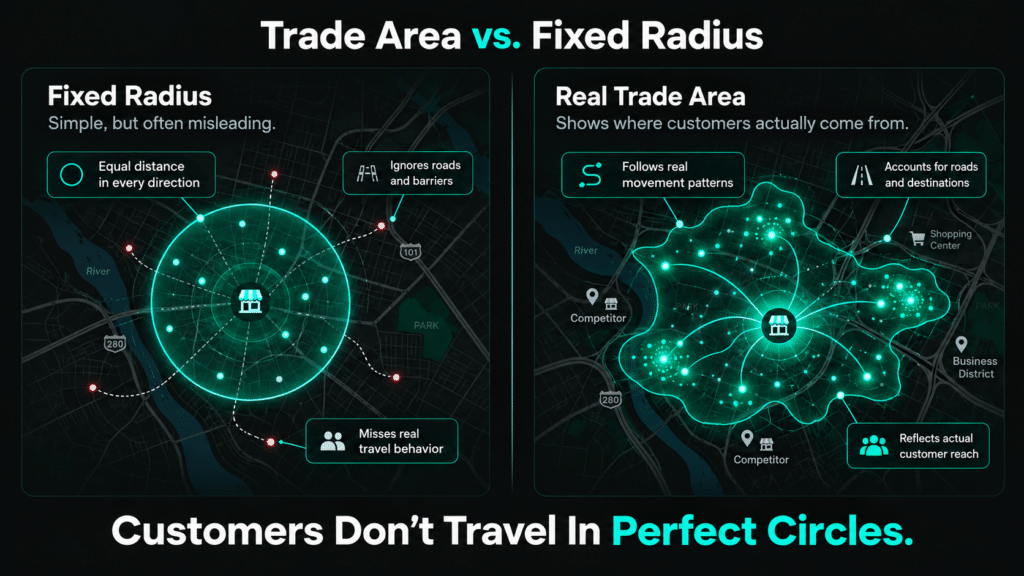
Customers do not travel in perfect circles.
Roads, public transport, competitors, work locations, and destination strength can change the shape of a trade area.
Comparing Sites Without Consistent Criteria
Location decision making becomes difficult when every candidate site is evaluated differently.
Using a defined framework makes comparisons more consistent.
Where Does Site Selection Consulting Fit?
Site selection consulting can help businesses structure the location selection process, define evaluation criteria, compare candidate markets, and interpret available data.
Whether the analysis is completed internally or with outside support, the same principle applies: locations should be evaluated using consistent criteria and relevant data.
The value comes from making the process repeatable, evidence-based, and connected to business objectives.
How Factori Supports Better Site Selection
Factori helps businesses use real-world data as part of their site selection and location strategy.
Teams can evaluate locations using signals such as movement, visits, surrounding Places, and audience characteristics.
These data layers help answer different questions:
- Mobility shows how people move.
- Visit data shows activity around locations.
- Places data adds competitor and surrounding-business context.
- People data adds audience context.
Together, these signals can support site selection analysis, trade area analysis, market comparison, competition analysis, and demand forecasting site selection workflows.
This gives businesses a clearer way to compare locations and make more informed location decisions.
Conclusion
Site selection analysis is not simply about finding an available location.
It is a strategic decision that can influence demand, growth, costs, and long-term performance.
A stronger location selection strategy evaluates demand, movement, audience fit, competition, accessibility, trade areas, and commercial viability together.
Combining these factors gives businesses a clearer view of location potential and helps reduce uncertainty before making a major investment.
FAQs
What Is Site Selection Analysis?
Site selection analysis is the process of comparing potential locations using factors such as demand, foot traffic, competition, accessibility, customer characteristics, and commercial viability.
What Is the Difference Between Site Selection and Location Strategy?
Site selection focuses on evaluating and choosing a specific location.
Location strategy is broader. It defines where a business should expand, what markets it should prioritize, and what criteria should guide future location decisions.
What Is Site Suitability Analysis?
Site suitability analysis evaluates whether a location meets the physical, commercial, customer, accessibility, and market requirements of a business.
What Data Is Used in Site Selection Analysis?
Common inputs include mobility and foot traffic data, visit patterns, Places or POI data, demographic information, audience data, competition, and trade area insights.
How Does Location Intelligence Help Site Selection?
Location intelligence site selection combines geographic, behavioral, market, and audience information to provide more context about how potential locations perform.