Consumer behavior data helps businesses understand how people act across digital and physical environments.
It can show what consumers are interested in, where they spend time, how they shop, which places they visit, and how they respond to campaigns.
For marketers, retailers, analysts, and data teams, this data is valuable because it turns broad market activity into measurable signals.
These signals can support better audience targeting, consumer segmentation, media planning, site selection, campaign measurement, and demand forecasting.
Key Takeaway
- Consumer behavior data helps businesses understand what people do across digital and physical environments, not just who they are.
- The strongest view combines purchase, digital, audience, location, visit, and campaign signals to reveal intent and demand more clearly.
- Businesses can use consumer behavior data for audience targeting, segmentation, media planning, site planning, data enrichment, and demand forecasting.
- Real-world signals such as store visits, movement patterns, trade areas, and competitor visits can add context that website or sales data alone may miss.
- Consumer behavior data creates the most value when it is tied to a clear business decision and combined with first-party data and privacy-safe external signals.
What Is Consumer Behavior Data?
Consumer behavior data is information about how people interact with brands, products, services, websites, apps, campaigns, and physical locations.
It can include purchase activity, website behavior, app usage, store visits, category interests, brand affinity, campaign engagement, and movement patterns.
In simple terms, consumer behavior data helps businesses answer questions such as:
- What are consumers interested in?
- Which products, categories, or brands attract attention?
- Where do consumers visit?
- How often do they return?
- Which audiences are most likely to engage?
- Which markets show stronger demand?
- Which campaigns influence real-world action?
Unlike basic demographic data, consumer behavior data focuses on actions.
It helps businesses understand what people do, not only who they are.
Why Consumer Behavior Data Matters
Businesses often make decisions with incomplete information.
Sales data may show what was purchased, but not the wider demand around it. Website data may show clicks, but not whether those users also visit physical stores.
Campaign data may show impressions, but not whether the campaign influenced real-world behavior.
Consumer behavior data helps close these gaps.
It gives teams a clearer view of how consumers act across channels, locations, categories, and markets.
This can help businesses build stronger audience segments, improve campaign planning, connect digital activity with physical visits, understand demand patterns, and strengthen forecasting.
For example, a retailer can use consumer behavior data to understand which areas attract repeat visits to similar stores.
A marketer can use it to identify audiences more likely to respond to a campaign.
A data team can use it to improve forecasts by adding real-world consumer signals to internal business data.
Types of Consumer Behavior Data
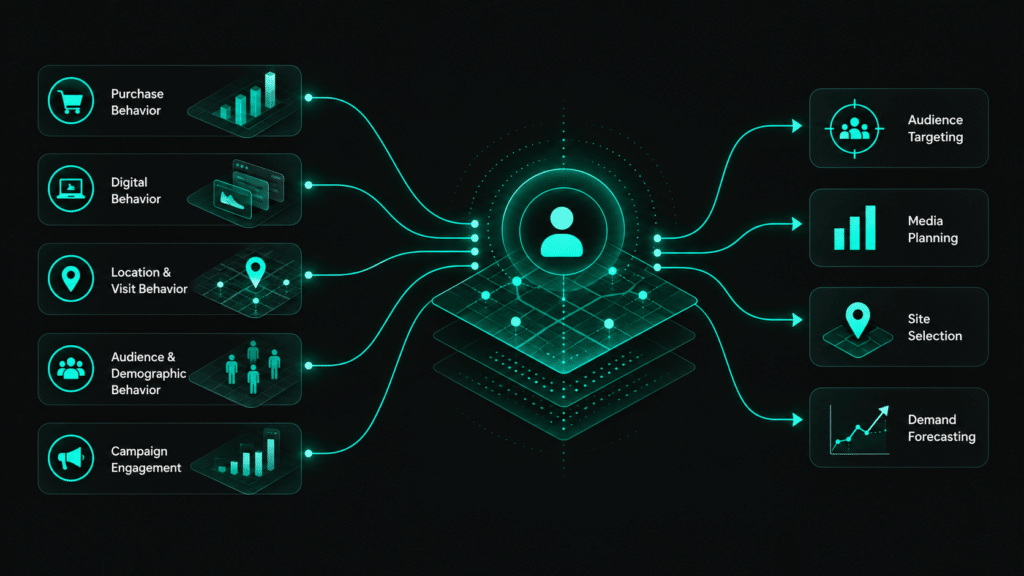
Consumer behavior data can come from several sources.
The most useful view usually combines purchase, digital, audience, location, and campaign signals.
Purchase Behavior Data
Purchase behavior data shows what consumers buy and how spending changes over time.
It can include transaction trends, order value, product preferences, basket size, buying frequency, repeat purchases, and category demand.
Businesses use this data to understand product demand, seasonal trends, brand preference, price sensitivity, and cross-selling opportunities.
Digital Behavior Data
Digital behavior data shows how consumers interact with websites, apps, emails, content, and online campaigns.
This can include page views, clicks, searches, product views, app sessions, cart activity, form fills, and email engagement.
Businesses can use this data to understand online intent, improve user journeys, personalize experiences, and identify where consumers drop off before converting.
Location and Visit Behavior Data
Location and visit behavior data shows how consumers interact with physical places.
It can include store visits, visit frequency, dwell patterns, trade areas, cross-visitation, competitor visits, and movement across neighborhoods or markets.
This is especially useful for retailers, restaurants, banks, travel companies, real estate teams, and media planners.
It helps teams understand where consumers go and where real-world demand exists.
Audience and Demographic Behavior Data
Audience and demographic behavior data helps businesses understand who consumers are and what they care about.
It may include age groups, household attributes, lifestyle signals, interests, category affinities, brand preferences, and audience segments.
This data can support targeting, segmentation, enrichment, media planning, and market analysis.
Campaign Engagement Data
Campaign engagement data shows how consumers respond to marketing activity.
It can include ad clicks, impressions, conversions, coupon redemptions, website visits, store visits after exposure, and channel-level engagement.
This helps marketers understand which campaigns influence action and which audiences respond most strongly.
Business Use Cases of Consumer Behavior Data
Consumer behavior data becomes most useful when it connects to a clear business decision.
It can help teams understand not only what happened, but also where to invest, who to target, and what to improve next.
Audience Targeting
Marketers use consumer behavior data to build more relevant audiences.
Instead of targeting only broad demographic groups, teams can create segments based on store visits, product interest, category affinity, travel behavior, competitor visits, or lifestyle signals.
For example, a fitness brand can target consumers who visit gyms, sporting goods stores, and wellness locations.
A travel company can reach audiences that frequently visit airports, hotels, or tourist destinations.
A restaurant chain can identify people who visit similar dining categories in nearby markets.
This can improve campaign relevance and reduce wasted media spend.
Consumer Segmentation
Consumer behavior data helps businesses group audiences based on what they do, where they go, and what they may need.
Common behavior-based segments include frequent visitors, high-intent shoppers, category buyers, brand loyalists, competitor visitors, travel-focused audiences, and price-sensitive consumers.
These segments can help marketers and analysts personalize campaigns, prioritize markets, and improve customer journeys.
For example, a retailer may create a segment of consumers who often visit premium malls.
A quick-service restaurant may identify people who visit competitor locations during lunch hours.
A travel brand may build an audience around consumers who regularly visit airports and hotels.
Media Planning and Measurement
Consumer behavior data can support both media planning and campaign measurement.
Before a campaign runs, teams can study where target audiences spend time, which locations they visit, and which markets show stronger audience density.
After a campaign, teams can review behavior signals to see whether audiences visited stores, engaged with locations, or showed stronger purchase intent.
This helps marketers move beyond clicks and impressions and connect media activity to real-world outcomes.
Retail and Site Planning
Retailers use consumer behavior data to make better location and market decisions.
Visit patterns, trade areas, repeat visits, competitor overlap, and nearby demand can help teams understand which locations perform well and which markets may support expansion.
Retail teams can use this data to understand:
- Which areas show strong demand
- Where competitors capture traffic
- Which locations have high foot traffic but weak performance
- Which trade areas are underserved
- Where cannibalization risk may exist
This can reduce site selection risk and improve expansion planning.
Data Enrichment
Consumer behavior data can enrich first-party customer data with more context.
A business may already have CRM records, purchase history, or loyalty information.
By adding audience, demographic, mobility, or place-based attributes, the business can build a better view of customer interests, behaviors, and likely needs.
Data enrichment can improve personalization, segmentation, lead scoring, audience creation, and campaign planning.
It also helps marketing and data teams connect internal customer data with external market behavior.
Predictive Analytics and Demand Forecasting
Consumer behavior data can improve forecasting by adding signals that show how demand is changing.
Data teams can use visit behavior, audience density, repeat visits, category interest, and market activity to strengthen demand models.
For example, a retailer may combine historical sales with visit behavior to forecast demand by location.
A restaurant chain may use visit trends to plan staffing.
A travel brand may use movement patterns to understand changing demand across destinations.
When these signals are added to forecasting models, businesses can detect changes earlier than they might through sales data alone.
How Factori Helps Businesses Understand Consumer Behavior
Factori helps businesses turn real-world movement, visit, place, and audience data into practical consumer behavior insights.
With Mobility Data, Visit and Location Intelligence, POI Data, People Data, Audience Data, and APIs, teams can understand where consumers go, which places they visit, and how behavior changes across markets.
These insights can support audience targeting, data enrichment, media planning, campaign measurement, site selection, market intelligence, and predictive analytics.
Factori is built with privacy-first practices, helping teams work with business-ready data without relying on invasive individual tracking.
Conclusion
Consumer behavior data gives businesses a clearer view of how people act across online and offline touchpoints.
It helps teams understand what consumers buy, where they go, how they engage, and which signals may indicate future demand.
When combined with first-party data and real-world signals such as visits, mobility, places, and audience attributes, consumer behavior data can improve targeting, segmentation, campaign measurement, site planning, enrichment, and forecasting.
FAQs
1. What Is Consumer Behavior Data?
Consumer behavior data is information about how people interact with brands, products, websites, apps, campaigns, and physical locations.
It helps businesses understand consumer actions, interests, preferences, and demand patterns.
2. What Are the Main Types of Consumer Behavior Data?
The main types include purchase behavior data, digital behavior data, location and visit behavior data, audience and demographic behavior data, and campaign engagement data.
3. Why Is Consumer Behavior Data Important?
Consumer behavior data helps businesses understand what people do, what they prefer, where they engage, and which signals show intent.
It supports targeting, segmentation, campaign measurement, site planning, enrichment, and forecasting.
4. How Do Marketers Use Consumer Behavior Data?
Marketers use consumer behavior data to build audience segments, personalize campaigns, measure engagement, improve media planning, and understand which channels or messages drive action.
5. How Do Retailers Use Consumer Behavior Data?
Retailers use consumer behavior data to understand foot traffic, trade areas, repeat visits, competitor overlap, store performance, and local demand across different locations.