

Corporate site selection is a high-impact decision that requires more than static analysis. Traditional approaches often rely on assumptions and incomplete data, making it difficult to accurately assess demand, competition, and market potential.
A structured, data-driven approach using real-world signals provides a clearer way to evaluate locations. By incorporating movement patterns, footfall, and location activity into each stage, businesses can assess demand, compare options, and validate key decisions such as site viability, expected performance, trade area strength, and competitive positioning before investment.
Why Traditional Corporate Site Selection Falls Short
Traditional site selection approaches were not built for stability. They were built around data limitations. In the absence of real-world and real-time signals, decisions relied on static datasets, periodic reports, and inferred indicators of demand.
Today, that constraint no longer exists. Markets have always been dynamic, but the ability to observe them in motion has fundamentally changed. Relying on static inputs now creates gaps in decision-making, especially when actual behavior can be measured.
- Static data does not reflect real-time market activity or changing demand patterns
- Decisions are often based on indirect indicators rather than actual behavior
- Trade areas are defined using assumptions rather than real customer movement
- Limited ability to validate a location before making capital investments
Without visibility into how people actually move, visit, and interact with locations, businesses risk selecting sites that do not align with real demand.
Importance of Real-World Data in Corporate Site Selection
Corporate site selection decisions often rely on indirect indicators such as demographics or historical reports, which provide only a partial view of the market. These inputs do not capture how people actually move, interact with locations, or generate demand in real time.
Real-world data addresses this gap by introducing observable, behavior-based signals into the decision process. It provides visibility into actual movement patterns, foot traffic, and location activity, allowing businesses to understand how markets function beyond static assumptions.
This is enabled through a combination of datasets:
- Mobility Data – shows how people move across locations and corridors
- Visit Data – measures footfall, visit frequency, and activity trends
- Places Data – provides context on places, competitors, and spatial distribution
- People Data – explains who the visitors are and their behavioral attributes
Together, these datasets create a more complete view of demand and market behavior.
This improves decision-making in several ways:
- Replaces assumed demand with actual demand patterns
- Reflects how people interact with locations, not just where they are located
- Captures changing market conditions as they evolve
- Enables more accurate comparison between locations
- Supports validation of site potential before investment
By grounding decisions in real-world behavior, businesses can move from assumption-led site selection to a more reliable and evidence-based approach.

7 Steps to Corporate Site Selection Using Real-World Data
Step 1: Define Business Objectives and Success Metrics
Start by clearly defining the purpose of the site selection decision, whether it is expansion, relocation, or network optimization. Establish measurable success criteria such as revenue targets, cost thresholds, and ROI expectations to guide evaluation.
Step 2: Identify Target Customers and Demand Drivers
Determine who the location is meant to serve by focusing on behavioral attributes such as preferences, spending patterns, and visit habits. Audience and consumer data help align location decisions with actual demand drivers rather than assumed profiles.
Step 3: Analyze Real-World Movement and Footfall
Assess how people move through and interact with potential locations by analyzing foot traffic, peak activity periods, and visit consistency. Mobility data and visit intelligence provide visibility into actual activity levels.
Step 4: Define Trade Areas Based on Actual Behavior
Move beyond radius-based catchments by identifying where visitors originate from and how they travel to locations. Movement patterns and origin-destination insights help map true trade areas.
Step 5: Evaluate Competition and Market Saturation
Analyze the competitive landscape by identifying nearby locations, understanding demand distribution, and assessing whether the market is saturated or under-served. Places data and visit trends provide the required context.
Step 6: Score and Compare Shortlisted Locations
Create a consistent framework to evaluate shortlisted locations across demand potential, accessibility, competition, and cost. Standardized scoring ensures objective comparison and reduces bias in decision-making.
Step 7: Validate Decisions with Predictive Insights
Before committing, validate assumptions by estimating potential performance using historical patterns and behavioral trends. This helps compare scenarios and reduces uncertainty in final site selection decisions.
What to Look for in a Real-World Data Partner
The effectiveness of a data-driven site selection approach depends on the quality and usability of the underlying data. Evaluating the right partner requires looking beyond data availability to how well it supports decision-making.
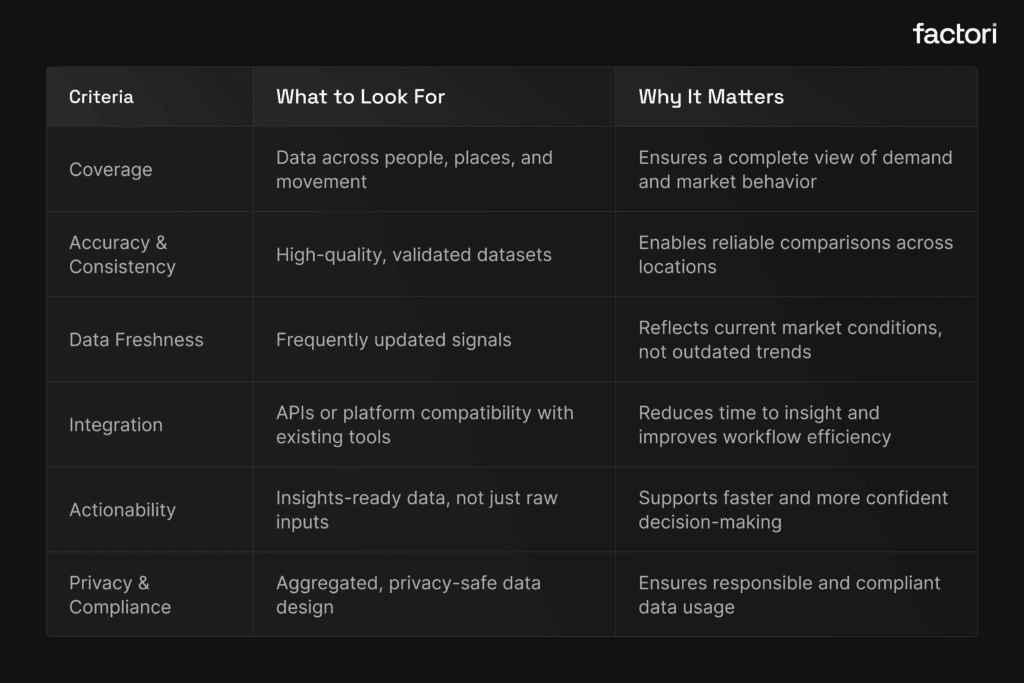
Selecting a partner that meets these criteria ensures that site selection decisions are supported by data that is reliable, current, and usable in real-world workflows.
About Factori
Factori is a partner-powered real-world data platform offering 13 standardized, enterprise-ready datasets including:
Mobility | Places | People | Audiences | Identity | Retail | Market | Economic | Events | Property | Business I Geo.
Each dataset is governed, privacy-safe, and designed to join cleanly with your existing data stack, whether you’re working in SQL, a data warehouse, a BI tool, or an ML pipeline. No black boxes, no mystery sources, just real-world signals about how people move, shop, work, and live, delivered the way your team works: via API, raw data, app, MCPs, or agentic workflows. Explore datasets suitable for your use case and available for your market.
Talk to an Expert Get Started
Conclusion
Corporate site selection requires more than static analysis and indirect indicators of demand. Markets are dynamic, and decisions need to reflect how people actually move, interact, and generate activity across locations.
By incorporating real-world data into a structured framework, businesses can evaluate locations based on observed behavior, compare options more effectively, and validate decisions before committing capital. This shifts site selection from assumption-led analysis to a more reliable and defensible decision-making process.
FAQs
What is corporate site selection?
Corporate site selection is the process of evaluating and choosing locations for business expansion, relocation, or optimization based on market, financial, and operational factors.
What is real-world data in site selection?
Real-world data refers to behavioral signals such as movement patterns, foot traffic, and location activity that reflect how people interact with physical places.
Why is real-world data important for site selection?
It provides visibility into actual demand and market behavior, helping reduce reliance on assumptions and improving decision accuracy.
How can businesses validate a site before investing?
By analyzing behavioral data and historical patterns to estimate potential performance and compare different location scenarios.
What datasets are used in corporate site selection?
Mobility data, visit data, Places data, and audience or consumer data are commonly used to support site selection decisions.