Artificial intelligence is getting better at analyzing patterns, generating insights, and supporting business decisions, but most systems still rely on static, historical, or internal data. That creates a gap in real-world decision-making, where outcomes are often shaped by how people move through places, which locations attract attention, and who is most likely to engage in a given market.
As AI becomes more embedded in forecasting, marketing, and operations, the next shift is not just better models but better access to real-world external signals. Connecting these changing real-world signals to AI workflow makes it possible to move from delayed analysis to more responsive, grounded decision-making.
Key Takeaway
- AI systems are only as useful as the context they can access. Static and historical data can miss changes in movement, location activity, audience behavior, and market demand.
- Real-world data gives AI a more current view of what is happening across people, places, and movement, making location-sensitive decisions more grounded.
- Factori MCP connects AI agents directly to real-world data, reducing the need for manual exports, fragmented tools, and complex data-access workflows.
- Adding real-world signals can improve forecasting, marketing, site selection, expansion planning, and market analysis by making outputs more relevant to current conditions.
- The main advantage is speed and decision quality: teams can move from question to insight to action faster, with less reliance on outdated assumptions or lagging indicators.
The Core Challenge: AI Without Real-Time Context
Most AI systems are trained on historical data and updated at fixed intervals, which means they reflect what has already happened rather than what is changing in the moment. While this approach works for analyzing trends, it creates limitations in environments where movement patterns, location activity, and audience behavior shift continuously.
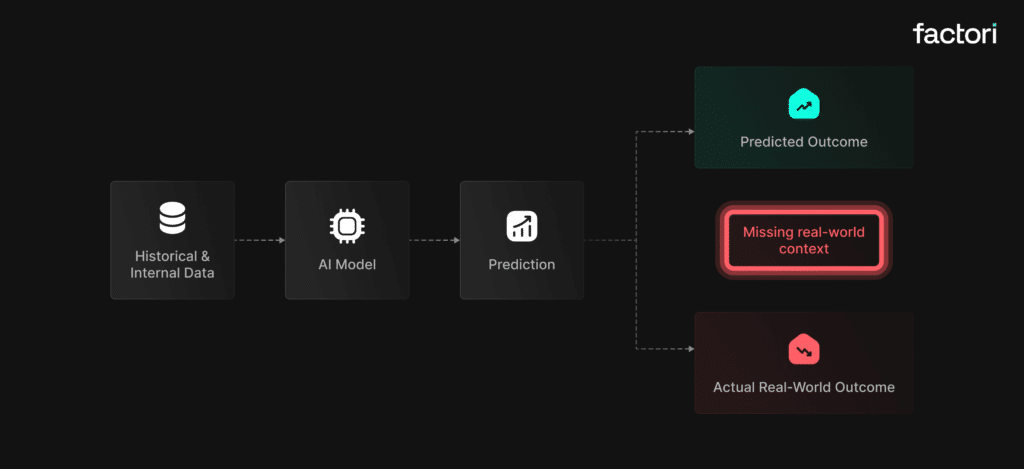
This gap becomes clear in real-world decision-making. Forecasts may fail to capture short-term changes in demand, marketing efforts can miss where relevant audiences are actually present, and operational plans may not align with how activity is distributed across locations.
In each case, the model is working as expected, but the data it relies on lacks current context. Without access to live external signals, AI systems are forced to make decisions based on an incomplete view of reality.
The Solution Layer: Factori MCP
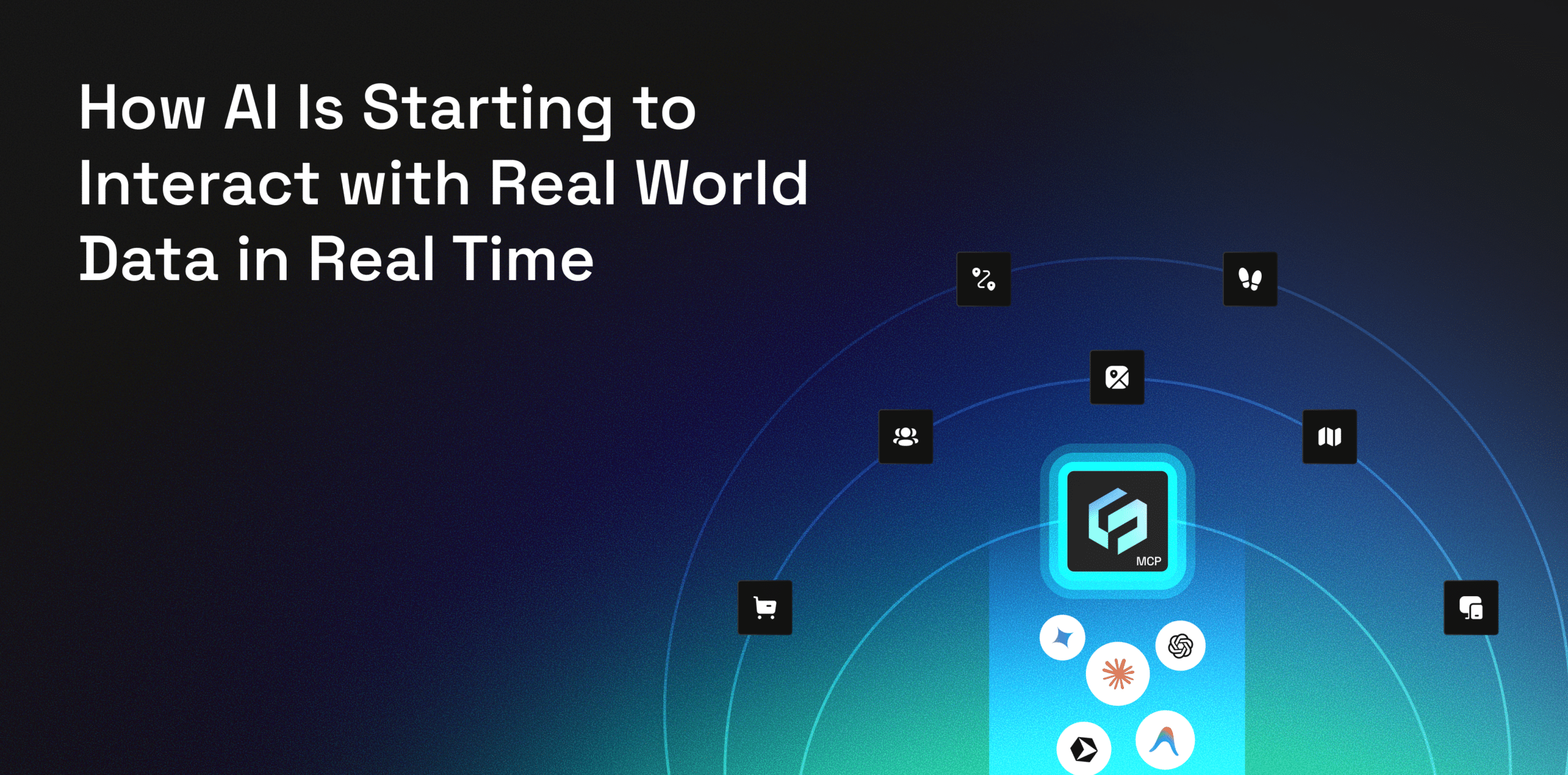
To ensure AI takes real-world context into account in decision-making, the missing piece is not just model quality, but access to current external data. Factori MCP is designed to close that gap by connecting AI agents directly to live real-world data and making it usable within everyday workflows.
Access to Real-World Data Signals
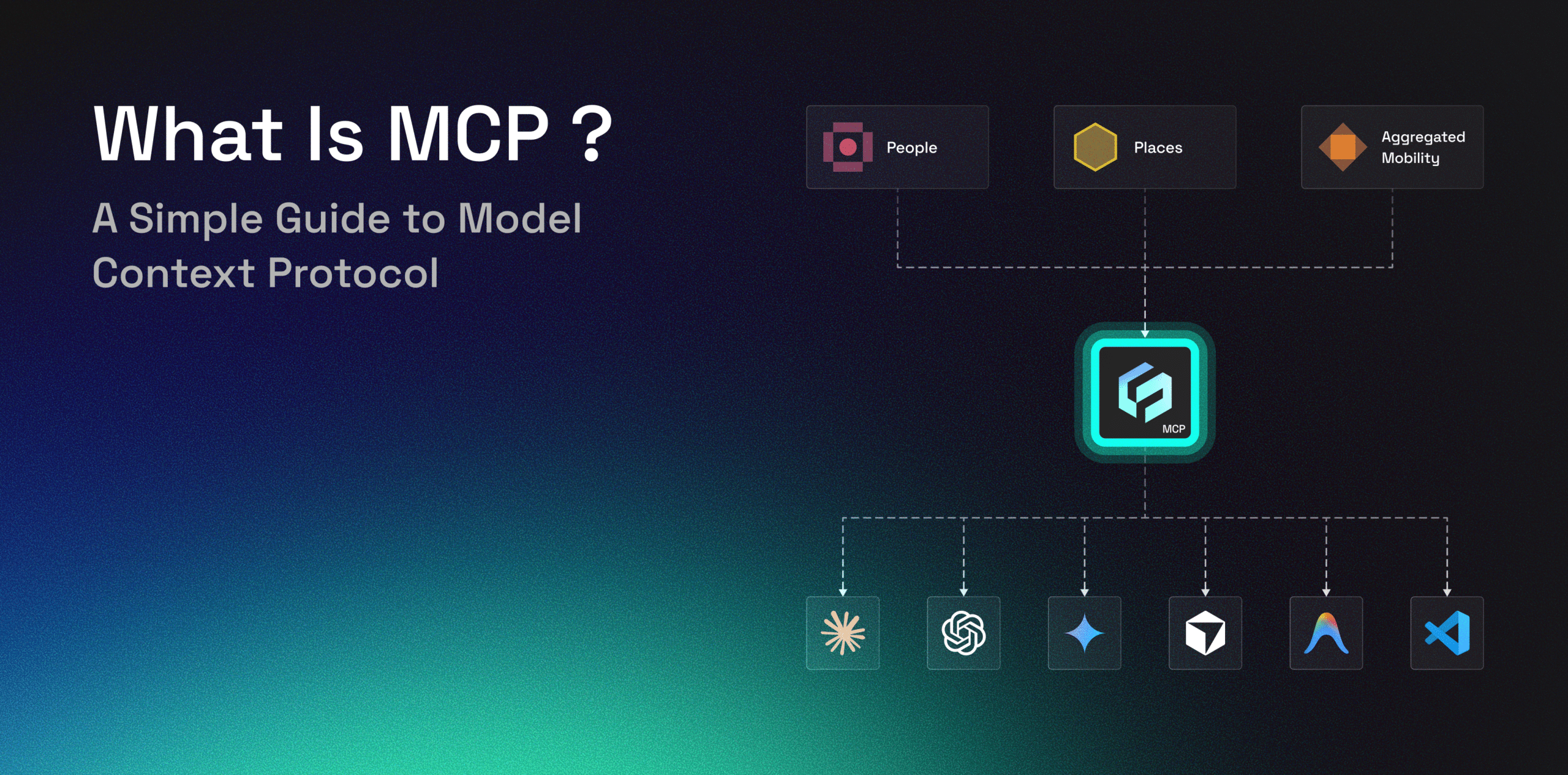
Factori MCP enables AI agents to work with real-world signals that reflect how markets actually behave. This includes context across people, places, and movement patterns, which are critical for location-sensitive decisions.
With this access, AI systems can:
- Understand who is present in an area and how audience composition varies
- Analyze which locations are active and how businesses are distributed
- Track how people move across areas and how activity shifts over time
This allows AI to move beyond static inputs and incorporate real-world context directly into decision-making.
Simplifying How Data Is Accessed and Used
Access alone is not enough if the data remains difficult to use. Factori MCP simplifies how teams interact with real-world data by removing the need for complex workflows and technical dependencies.
This addresses common challenges such as:
- Fragmented data access
Important market signals are often spread across multiple vendors and tools. - Delayed decision-making
Teams often rely on exports and periodic updates instead of current context. - Manual analysis overhead
Analysts spend time pulling, cleaning, and combining data before it can be used. - Limited AI usability
Even strong AI systems cannot answer location-sensitive questions well without relevant external inputs.
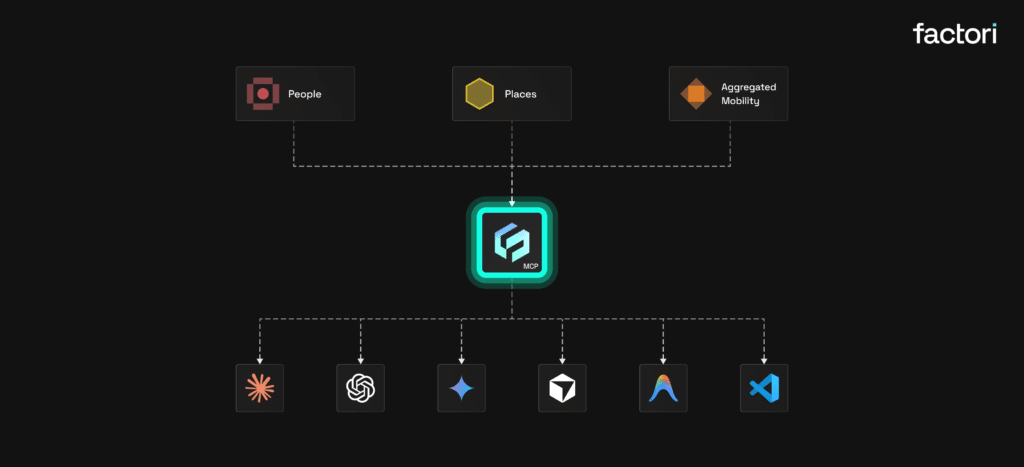
Factori MCP makes this data queryable in natural language, allowing teams to ask direct business questions and receive structured answers through the same AI interface. This removes the need for advanced analytics workflows, technical query building, or dedicated data engineering support.
With this approach, teams can move from question to insight much faster, making real-world data more accessible across business, strategy, and operational functions.
The result is a more practical and responsive AI system. Questions around expansion, location performance, demand, and market opportunity can be answered with greater relevance and speed because the data reflects what is happening on the ground.
In practice, this works by integrating Factori MCP with AI agents so they can access and use real-world data directly within their workflows, enabling faster and more context-aware decisions.
How This Improves Decision Outcomes
Access to real-world context does not just improve inputs, it changes the quality and speed of decisions across teams. When AI systems can work with live signals instead of static historical data, outputs become more relevant to current conditions and more actionable in practice.
This shows up across key business functions:
- More accurate forecasting
Predictions reflect actual movement and activity patterns, reducing gaps between expected and real outcomes. - Better marketing decisions
Campaigns can align with where relevant audiences are present, improving targeting and overall performance. - Stronger location and expansion planning
Decisions are based on how areas behave in reality, not just assumptions or historical trends. - Faster time to insight
Teams can move from question to answer in seconds without waiting on data preparation or manual analysis. - Reduced decision risk
With clearer visibility into demand and market behavior, decisions are less likely to rely on incomplete or outdated information.
The impact is both operational and measurable. Instead of working through multiple tools and delayed workflows, teams can access, analyze, and act within a single AI-driven interaction. This leads to faster execution, more consistent decision-making, and improved outcomes across forecasting, planning, and optimization.
As AI systems become more integrated into everyday workflows, the ability to combine reasoning with real-world context becomes a key advantage. It allows businesses to respond to change with greater precision and confidence, rather than relying on assumptions or lagging indicators.
Conclusion
AI is no longer limited by how well it can process data, but by the quality and timeliness of the data it can access. As decisions increasingly depend on changing conditions across locations and markets, relying only on static historical data creates a clear limitation.
Connecting AI to real-world signals changes how decisions are made. Instead of working with delayed insights and fragmented tools, teams can interact directly with current signals and get answers that reflect how markets are behaving now. Solutions like the Factori MCP Server enable this shift by making real-world data accessible within AI workflows.
As this approach becomes more common, the advantage will move toward organizations that can combine AI capabilities with continuous access to real-world data. The ability to move from question to insight to action, without delay, becomes a defining factor in how effectively businesses operate.
FAQs
What does it mean for AI to interact with real-world data in real time?
It means AI systems can access and use continuously updated external data instead of relying only on historical or internal datasets. This allows decisions and outputs to reflect current conditions rather than past trends.
Why is real-time context important for AI?
Real-world conditions change constantly across locations and markets. Without current context, AI models may miss shifts in demand, audience presence, or location activity, which can reduce the quality of predictions and decisions.
What is the Factori MCP Server?
The Factori MCP Server is a real-world data connector that allows AI agents to access external market signals within their workflows. It helps bring data related to people, places, and movement into a format AI systems can use more easily.
How does Factori MCP improve decision-making?
It helps AI systems work with more current and relevant context. This can improve decisions across forecasting, marketing, site selection, and market analysis by making outputs more aligned with real-world conditions.
What kinds of businesses benefit most from this approach?
Businesses that rely on location-sensitive decisions benefit the most, especially in retail, real estate, finance, logistics, and marketing. Any team that needs to understand how people, places, and markets are changing can use this approach to make faster and better-informed decisions.