
A site selection strategy is the structured approach businesses use to identify, evaluate, and choose the right locations for expansion, optimization, or investment. It plays a direct role in determining whether a new location succeeds or underperforms.
Many strategies fall short because they rely heavily on static inputs like demographics, past performance, or surface-level market data. What’s often missing is a clear understanding of how people actually move, behave, and interact with places in the real world.
A more effective approach combines these traditional inputs with real-world signals and follows a clear, repeatable process. The steps below outline a practical framework to build a site selection strategy that is both data-driven and decision-ready.
Why a Structured Site Selection Strategy Matters
Location decisions have a long-term impact on revenue, operational efficiency, and overall business performance. A well-chosen site can drive consistent demand and support growth, while a poor choice can limit visibility, reduce footfall, and increase risk.
Many decisions still rely on incomplete or static data. This creates gaps between projected and actual performance, especially in dynamic markets where customer behavior is constantly changing.
A structured site selection strategy reduces this uncertainty. It brings consistency to how locations are evaluated, allows for objective comparisons, and ensures that decisions are based on measurable factors rather than assumptions.

Step 1: Define Business Goals and Location Objectives
The first step is to clearly define what the business is trying to achieve with a new location. Not all site selection decisions are driven by the same objective.
Some locations are opened for expansion into new markets, others to optimize an existing network, and some to improve coverage or accessibility. Each objective requires a different evaluation lens.
Aligning the site selection process with business goals ensures that every decision supports a broader strategy, whether it is revenue growth, market penetration, or operational efficiency.
Step 2: Identify Target Customers and Demand Drivers
A strong site selection strategy starts with a clear understanding of the customers you want to attract.
This includes looking beyond basic demographics to understand behavior, spending patterns, and preferences. Knowing where customers spend time, how frequently they visit certain areas, and what influences their choices helps define true demand.
Relying only on demographic data can lead to overestimating potential. A more accurate view comes from combining audience insights with behavioral signals that reflect real-world activity.
Step 3: Analyze Real-World Movement and Footfall
Understanding how people move through an area is critical to evaluating its potential.
Footfall patterns reveal when and how often people visit a location, how long they stay, and how activity changes throughout the day or week. These patterns help identify high-traffic zones and uncover hidden demand that may not be visible through static data.
Mobility and footfall data provide this layer of insight. Instead of assuming demand, businesses can observe actual movement and use it to assess whether a location aligns with customer behavior.
Step 4: Define Trade Areas and Customer Catchments
Trade areas represent the geographic zones from which a location draws its customers. Defining these accurately is essential for understanding demand.
Traditional methods often rely on simple radius-based assumptions. However, real-world behavior is rarely that uniform. Factors such as accessibility, road networks, and competing locations influence how far customers are willing to travel.
A more effective approach maps actual customer movement to identify true catchment areas. This helps businesses understand where demand is coming from and how it may overlap with existing locations.
Step 5: Evaluate Competition and Surrounding Places
No location exists in isolation. The surrounding environment plays a significant role in determining performance.
This includes evaluating both direct competitors and complementary businesses in the area. Nearby stores, malls, offices, or entertainment venues can influence footfall and customer mix.
Points of Interest (POI) data helps provide this context by mapping the broader landscape. Understanding co-tenancy and area dynamics allows businesses to assess whether a location benefits from its surroundings or faces strong competitive pressure.
Step 6: Compare and Score Potential Locations
Once multiple locations are identified, the next step is to evaluate them using a consistent framework.
A structured scoring model allows businesses to compare locations based on key factors such as demand, accessibility, competition, and customer fit. Each factor can be weighted based on its importance to the business objective.
This approach removes subjectivity and enables data-driven decision-making. Instead of relying on intuition, businesses can rank locations based on measurable criteria and make more confident choices.
Step 7: Forecast Performance and Validate Decisions
Before finalizing a location, it is important to estimate its potential performance.
This includes forecasting expected footfall, revenue potential, and operational viability. By combining historical patterns with real-world data, businesses can create more accurate projections.
Validation is equally important. Testing assumptions against actual data helps identify risks early and avoid costly mistakes. A data-driven validation step ensures that decisions are grounded in reality rather than optimistic projections.
Read About: Site Selection Analysis: A Data-Driven Guide to Choosing High-Performing Locations
Traditional vs Data-Driven Site Selection Strategy
Traditional site selection methods can provide a starting point, but they often rely on static data and assumptions. A data-driven strategy gives businesses a clearer view of real demand, movement, competition, and location potential.
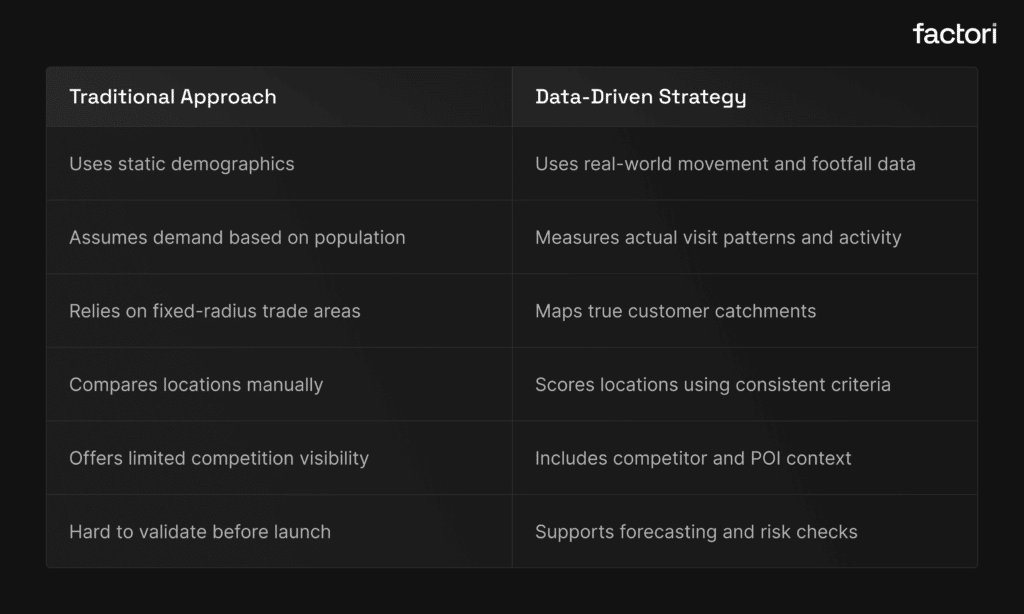
A data-driven approach makes site selection more objective, scalable, and aligned with how customers actually behave.
How Data Improves Site Selection Outcomes
Incorporating the right data layers into site selection improves both decision quality and business outcomes. Instead of relying on assumptions, businesses can evaluate locations using real-world signals across demand, movement, and context.
- Better demand estimation
Using Mobility Data and Visit Data, businesses can understand actual footfall, visit frequency, and peak activity patterns instead of relying only on projected demand. - Stronger customer understanding
People Data and Consumer Data help identify who is visiting an area, their behavior, and spending potential, enabling better alignment with target customers. - More accurate trade area definition
Mobility Data helps map real customer catchments based on movement patterns, replacing simple radius-based assumptions. - Deeper competitive and location context
POI Data provides visibility into surrounding places, co-tenancy, and competitive density, helping assess how a location fits within its environment. - Lower expansion risk
Combining Visit Data, Mobility, and POI Data allows businesses to validate assumptions before launch and avoid overestimating location potential. - Faster and more consistent decisions
With structured datasets feeding into a unified framework, teams can compare locations more efficiently and make scalable, data-backed decisions.
By combining these datasets, site selection becomes a measurable and repeatable process, leading to more predictable performance and better long-term outcomes.
About Factori
Factori is a partner-powered real-world data platform offering 13 standardized, enterprise-ready datasets including:
Mobility | Places | People | Audiences | Identity | Retail | Market | Economic | Events | Property | Business I Geo.
Each dataset is governed, privacy-safe, and designed to join cleanly with your existing data stack, whether you’re working in SQL, a data warehouse, a BI tool, or an ML pipeline. No black boxes, no mystery sources, just real-world signals about how people move, shop, work, and live, delivered the way your team works: via API, raw data, app, MCPs, or agentic workflows. Explore datasets suitable for your use case and available for your market.
Talk to an Expert Get Started
Conclusion
Site selection is no longer just about finding available space in a promising area. It has become a data-led strategy problem that requires a deeper understanding of demand, movement, and market dynamics.
Businesses that adopt a structured and data-driven approach gain a clear advantage. They can reduce risk, improve forecasting accuracy, and make more confident expansion decisions.
A well-defined framework, supported by real-world insights, turns site selection into a repeatable and scalable strategy for long-term growth.