SafeGraph is a strong option for businesses that need structured POI, geometry, and address data. But choosing SafeGraph alternatives are not as simple as comparing how many places each provider claims to cover.
Some alternatives specialize in POI data. Others are stronger in mobility, mapping infrastructure, enterprise enrichment, or ready-made location analytics. The right provider depends on what your models and workflows actually need from location data.
Key Takeaway
What Are You Actually Replacing From SafeGraph?
SafeGraph currently focuses heavily on physical-place data. SafeGraph Places covers more than 80 million POIs across 195-plus countries and territories, with attributes such as coordinates, categories, brands, opening and closing dates, operating hours, and other place information. The dataset is updated monthly.
Its Geometry product adds building footprint polygons, spatial hierarchy, and parking-area context. This matters when a point coordinate is not precise enough to distinguish neighboring stores, units inside a mall, or locations within large properties.
That means a real SafeGraph comparison may involve several different requirements:
- POI and business-location records
- building geometry and place boundaries
- business attributes and categories
- address and geocoding data
- location enrichment
- data delivery into analytical environments
Mobility and foot traffic are a different requirement. SafeGraph states that its Geometry product is intended to support mobility analysis when joined with telemetry data, rather than providing foot traffic itself.
This distinction should shape the shortlist.
SafeGraph Alternatives Compared
These platforms are alternatives in different ways. The decision should begin with the type of location problem being solved.
| Platform | Best suited for | Primary approach | Data access | Best fit if you need | Less ideal if you need |
| Factori | Retail, real estate, finance, advertising, data science, and enterprise data teams | Multi-layer real-world data combining POI with mobility, visitation, audience, market, economic, and other external signals | APIs, cloud delivery, files, Factori Platform | POI data that can connect with broader real-world signals for modeling, forecasting, site selection, competitive analysis, or enrichment | A navigation-first mapping stack or a simple standalone map API |
| Foursquare | Developers, product teams, and businesses building location-aware applications | Global POI data, place search, enrichment, and location APIs | APIs, files, cloud delivery | Place search, autocomplete, nearby discovery, geotagging, or POI enrichment inside applications | A broader external-data stack combining several independent real-world datasets |
| TomTom | Automotive, logistics, mobility, navigation, and location-enabled application teams | Places search, POI discovery, geocoding, maps, routing, traffic, and navigation | APIs and platform | POI discovery that needs to work inside mapping, routing, navigation, or search workflows | Bulk POI data primarily for analytics, enrichment, or broader real-world-data modeling |
| Unacast | Retail, commercial real estate, market strategy, and teams focused on physical visitation | Mobility, foot traffic, visitor origins, and trade-area analysis | APIs and data delivery | Foot traffic, visitation trends, trade areas, or movement-based competitive analysis | POI master data or rich business-location attributes as the primary requirement |
| Veraset | Data science and analytics teams building custom mobility workflows | Mobility, movement, visits, and derived location signals | APIs and data delivery | Mobility signals for custom spatial models, visitation analysis, attribution, or trade-area work | A ready-to-use POI database with rich place attributes |
| Placer.ai | Retail, commercial real estate, and strategy teams that want fast location analysis | Ready-made location analytics covering visits, trade areas, properties, rankings, and demographics | Platform, APIs, and feeds | Business users who want location intelligence without building the full analytics pipeline internally | Reusable source data that needs to power several internal models, applications, or data products |
1. Factori
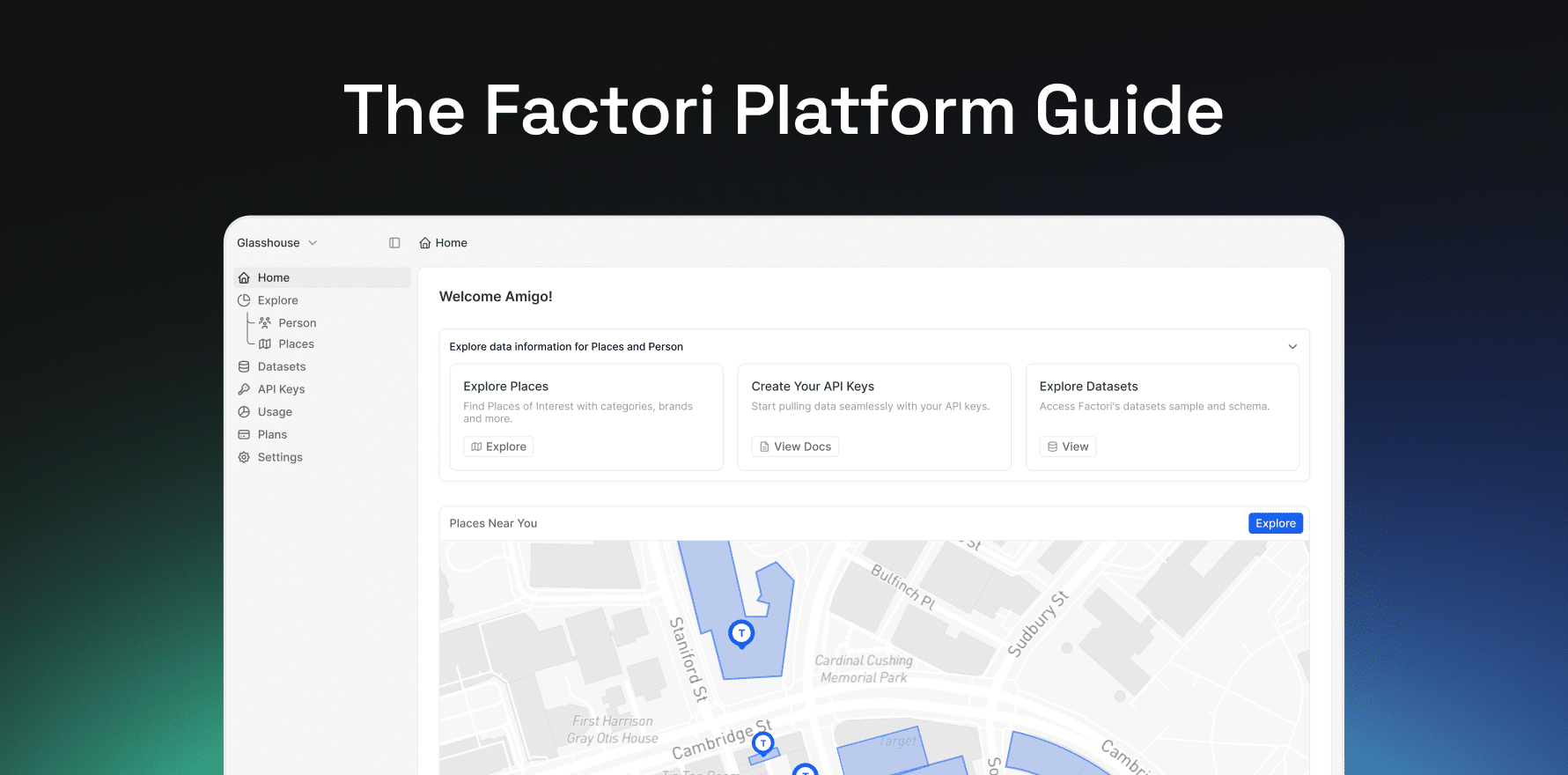
Factori is worth evaluating when POI data is only one part of the external-data requirement. Its Places dataset covers 200M+ POIs across 229 countries and regions, with 6,000+ business and location categories and 50 attributes per location. Depending on the dataset and use case, updates can be delivered daily, weekly, or monthly.
The difference is the wider real-world data stack. Teams can combine Places with mobility, visitation, people, audience, economic, market, business, event, and geographic signals. For example, a retail team can start with competitor locations and then examine visitation patterns, trade areas, or surrounding market conditions.
Factori also supports multiple delivery routes, including Snowflake, Amazon S3, Google Cloud, Azure, APIs, files, and the Factori Platform. This makes it relevant when location data needs to feed existing analytical, modeling, or AI workflows rather than remain inside one dashboard.
Buyers should still validate coverage at the market and category level. Global POI counts are useful for understanding scale, but they do not replace testing for specific brands, attributes, geographic densities, and production requirements.
2. Foursquare
Foursquare has substantial overlap with SafeGraph when POI is the central requirement.
Foursquare reports more than 100 million POIs across more than 200 countries and territories. Its Places products include business information, addresses, categories, parent relationships, chain IDs, and other attributes, with delivery through APIs, files, S3, Azure, GCP, Snowflake, and other environments.
Its API capabilities make it particularly relevant for applications that need nearby search, autocomplete, place matching, geotagging, and other location-aware experiences. Foursquare also provides tools that allow corrections and updates to place records.
That makes Foursquare a strong consideration when SafeGraph data is supporting a customer-facing application rather than only an analytical warehouse.
The evaluation should distinguish bulk POI needs from API-based search. Data attributes, request volumes, delivery cadence, licensing, and downstream use can change the commercial and technical fit significantly.
3. TomTom
TomTom is relevant when POI data needs to operate inside a broader mapping, routing, or navigation stack. Its location services combine place search with geocoding, maps, traffic, routing, and navigation capabilities.
This makes TomTom particularly relevant for automotive, logistics, mobility, delivery, and location-enabled applications.
Teams primarily looking for bulk POI data for enrichment, site selection, modeling, or competitive analysis should compare whether they need TomTom’s broader location infrastructure or a more data-centric provider.
4. Unacast
Unacast belongs on the shortlist when the SafeGraph replacement conversation is really about understanding activity around places.
Its products focus more heavily on foot traffic, visitation, visitor origins, trade areas, and movement patterns. These signals can support retail analysis, commercial real estate, competitive intelligence, site selection, and market planning.
The distinction is important. POI data can tell an analyst where a competitor operates. Mobility data can help estimate how visitation to that location changes and where visitors may be coming from.
These metrics should not be treated as direct transaction counts or revenue. Buyers should understand how visits are identified, normalized, and modeled before using the resulting metrics in forecasting or investment decisions.
5. Veraset
Veraset is another alternative when organizations need mobility data inside their own analytical infrastructure.
Its products include movement, visits, and POI-related data that can support custom visitation analysis, trade areas, attribution, and spatial modeling. This gives data-science teams more flexibility than a fixed analytics interface.
That flexibility also creates more engineering work. Teams may need to manage spatial joins, filtering, normalization, visit definitions, historical consistency, and quality controls themselves.
Veraset therefore makes more sense when the business has the analytical capability to work directly with mobility signals and wants control over the resulting models.
6. Placer.ai
Placer.ai approaches the problem from the analytics side rather than primarily acting as a raw POI replacement.
Its products are designed to help teams analyze visits, properties, trade areas, chains, rankings, demographics, and competitive markets without first building the entire analytics pipeline internally.
That can be attractive for real estate, retail, and strategy teams that want to answer location questions quickly. It is a different decision, however, from purchasing a reusable POI feed that can support models, applications, AI systems, and multiple internal business units.
Before choosing this route, buyers should decide whether the desired output is location intelligence inside a platform or location data that becomes infrastructure for other systems.
How to Compare SafeGraph Alternatives Before You Buy
A vendor comparison should move beyond record counts. SafeGraph itself emphasizes freshness, attributes, geometry, sourcing, and monthly updates as important dimensions of POI quality.
A meaningful evaluation should test:
- Coverage: Are known locations present across the markets and categories you care about?
- Freshness: How quickly are openings, closures and relocations reflected?
- Coordinate accuracy: Does the point represent the actual place rather than a general parcel or street?
- Geometry: Are boundaries available where precise spatial attribution matters?
- Taxonomy: Can provider categories map cleanly into your internal classification?
- Attribute completeness: How consistently are brand, address, website, hours and status fields populated?
- Persistent IDs: Can locations be tracked reliably across releases?
- Delivery: Can data enter Snowflake, Databricks, cloud storage, APIs, or existing pipelines without excessive transformation?
- Licensing: Are analytics, derived outputs, applications, AI workflows, and customer-facing uses covered?
Mobility products require additional checks. Buyers should understand observation density, geographic representativeness, visit methodology, normalization, historical stability, and which metrics are directly observed versus modeled.
Conclusion
The best SafeGraph alternative depends on the role location data plays in your stack. Teams looking for POI and place data may compare Factori, Foursquare, and TomTom, while mobility-focused requirements may point toward providers such as Unacast or Veraset. Placer.ai represents a different approach for teams that want location intelligence through a ready-made analytics environment.
The final decision should come from testing providers against the same real-world sample. Compare coverage, freshness, taxonomy, coordinate accuracy, attribute completeness, delivery, licensing, and methodology in the markets that matter to your business. The strongest provider is not necessarily the one with the largest dataset, but the one that performs most consistently for your actual use case.
FAQs
What is the best SafeGraph alternative for POI data?
There is no universal winner. Factori, Foursquare, and TomTom address different POI and location-data requirements. Buyers should compare them based on geographic coverage, attributes, freshness, geometry, data access, and intended downstream use.
Is Foursquare a direct SafeGraph alternative?
Foursquare has significant overlap with SafeGraph in POI data. It becomes especially relevant when a business needs place search, autocomplete, matching, geotagging, or other location-aware API functionality in addition to bulk POI data.
Are Unacast and Veraset direct SafeGraph replacements?
Not for every use case. They become stronger alternatives when the actual requirement is mobility, visitation, trade areas, or movement analysis rather than a POI master dataset.
What matters most when comparing POI providers?
Coverage alone is not enough. Buyers should validate freshness, coordinate accuracy, category quality, attribute completeness, persistent identifiers, geometry, delivery methods, licensing, and consistency across the exact markets they need.
Should companies test SafeGraph alternatives before buying?
Yes. Use the same known-location sample across every shortlisted provider. Measure missing locations, stale records, duplicate records, coordinate errors, taxonomy differences, and attribute fill rates before choosing a production source.