Retail location intelligence combines geographic, mobility, customer, market, and store-performance data to understand how location affects demand, store performance, and network growth.
For retailers planning dozens or hundreds of locations, the question is not simply whether a market looks attractive. The harder question is whether another store can capture enough incremental demand to justify the capital without weakening the existing network.
Key Takeaway
- Location intelligence and analytics combine spatial data with business and real-world signals to support better location decisions.
- Retailers use it for site selection, trade areas, foot traffic, competitive analysis, expansion, forecasting, and network planning.
- Market size is not the same as reachable demand because accessibility, competition, customer behavior, and trade areas affect what a store can realistically capture.
- High traffic does not automatically mean strong store potential.
- A strong site can still be a weak network decision if it cannibalizes existing locations.
- Location models should be validated against actual store outcomes, not trusted because they produce a score.
What Is Location Intelligence and Analytics?
Location intelligence and analytics is the process of combining geographic data with business and real-world signals to understand how location affects performance.
It goes beyond plotting stores on a map. Retail teams use spatial relationships, movement patterns, customer origins, nearby businesses, demographics, economic conditions, and internal performance data to answer questions such as:
- Which markets have enough demand?
- Which sites can realistically capture that demand?
- Where are competitors strongest?
- How far are customers willing to travel?
- Will a new location add revenue or shift sales from an existing store?
Location intelligence becomes valuable when geography helps explain or improve a commercial decision.
What Powers Retail Location Intelligence?
Retail location intelligence depends on both the analytical tools and the data underneath them.
| Layer | What it contributes |
|---|---|
| GIS and spatial analysis | Mapping, proximity, drive times, catchments, overlap |
| Mobility data | Foot traffic, visitor origins, movement patterns |
| Places and POI data | Stores, competitors, anchors, amenities |
| People and audience data | Population and customer characteristics |
| Economic data | Income, spending power, local market conditions |
| Property data | Site and real estate context |
| Internal business data | Sales, transactions, CRM, profitability |
| AI and machine learning | Pattern detection, forecasting, scoring |
The strongest workflows connect several of these layers rather than relying on one dataset alone.
For example, a retailer can combine trade areas with visitor origins, competitor locations, audience characteristics, and store sales to understand why one location outperforms another.
How Retailers Use Location Intelligence
Site Selection
Site selection starts with market demand but should end with expected store economics.
Population, income, and category spending can indicate whether a market looks attractive. They do not show whether a particular site can capture that demand.
Retailers also need to understand accessibility, competitor locations, nearby businesses, mobility, trade areas, and existing store coverage.
The real question is not whether the site looks busy. It is whether the site can generate enough incremental demand to justify the investment.
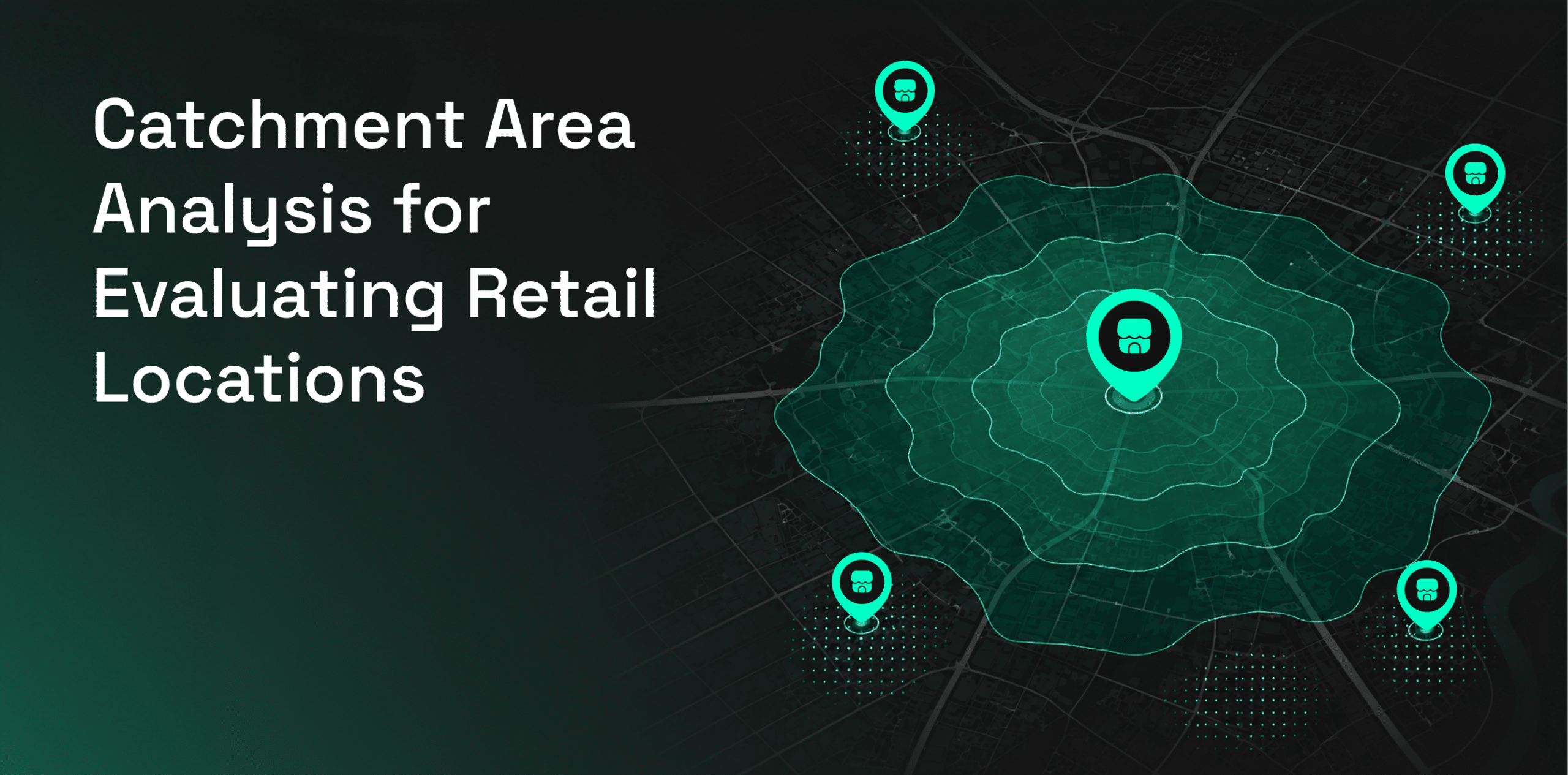
Trade Area Analysis
Fixed-radius rings are convenient, but customers do not move in circles.
Road networks, travel times, highways, shopping destinations, store formats, and customer habits all influence how far people are willing to travel.
Retailers can compare fixed-radius areas, drive times, customer-origin areas, and mobility-derived catchments.
Observed customer origins are especially useful because they show how a location actually draws visitors rather than how far analysts assume customers might travel.
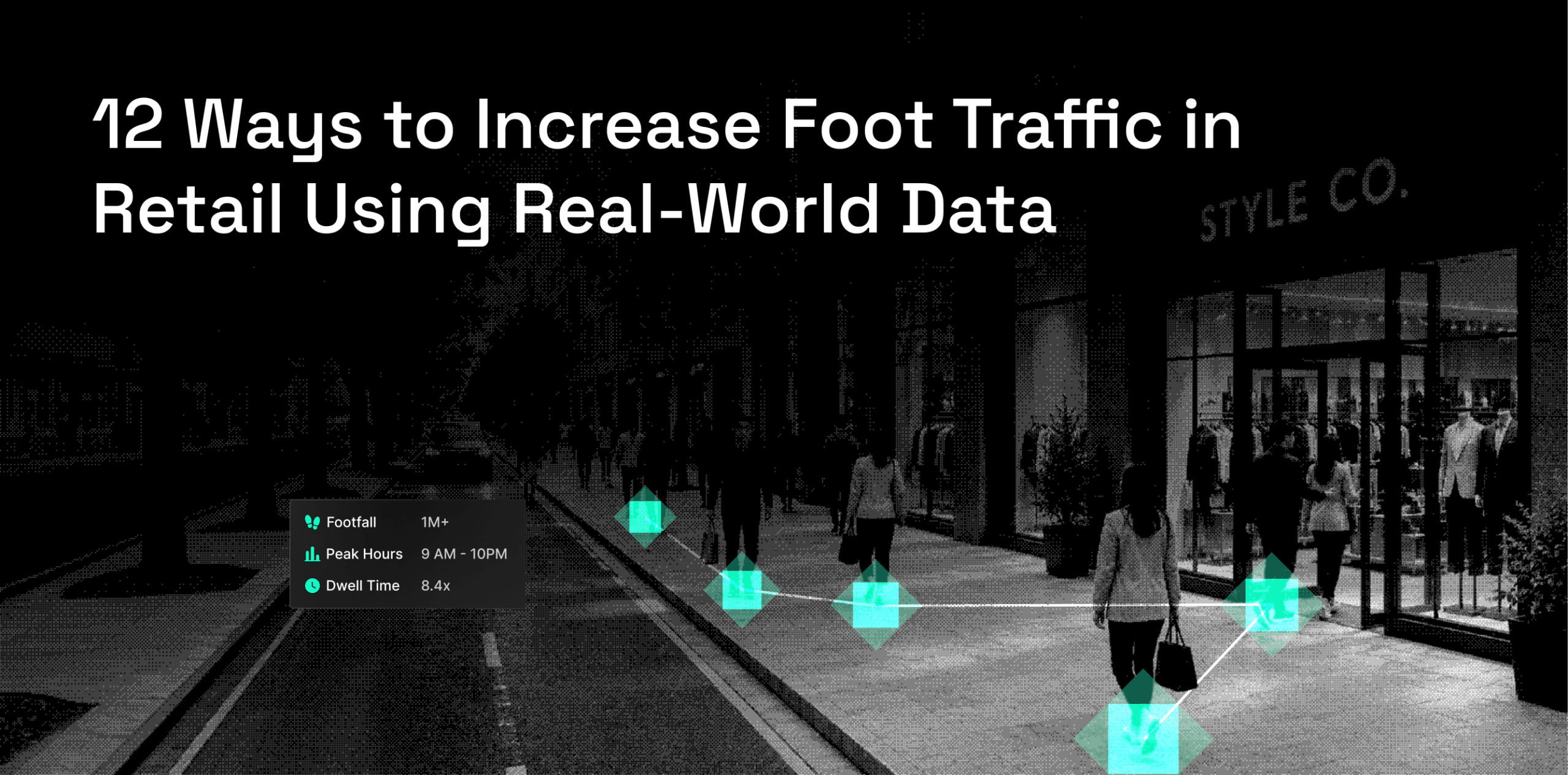
Foot Traffic Analysis
Foot traffic is useful, but raw visit counts should not be treated as store performance.
A high-traffic location may still produce weak sales if the visitors do not match the target customer or most movement is unrelated to the store.
Retailers should connect mobility with transactions, sales, conversion, audience characteristics, and competitor activity.
That helps separate a location problem from a conversion, pricing, assortment, or operational problem.
Competitive Intelligence
POI data can show where competitors operate, but competitor counts alone do not reveal whether a market is attractive.
A market with many competitors may be saturated. It may also contain unusually strong category demand.
Combining POI and mobility data can help retailers compare competitor locations, visitor activity, trade-area overlap, cross-shopping, and nearby complementary businesses.
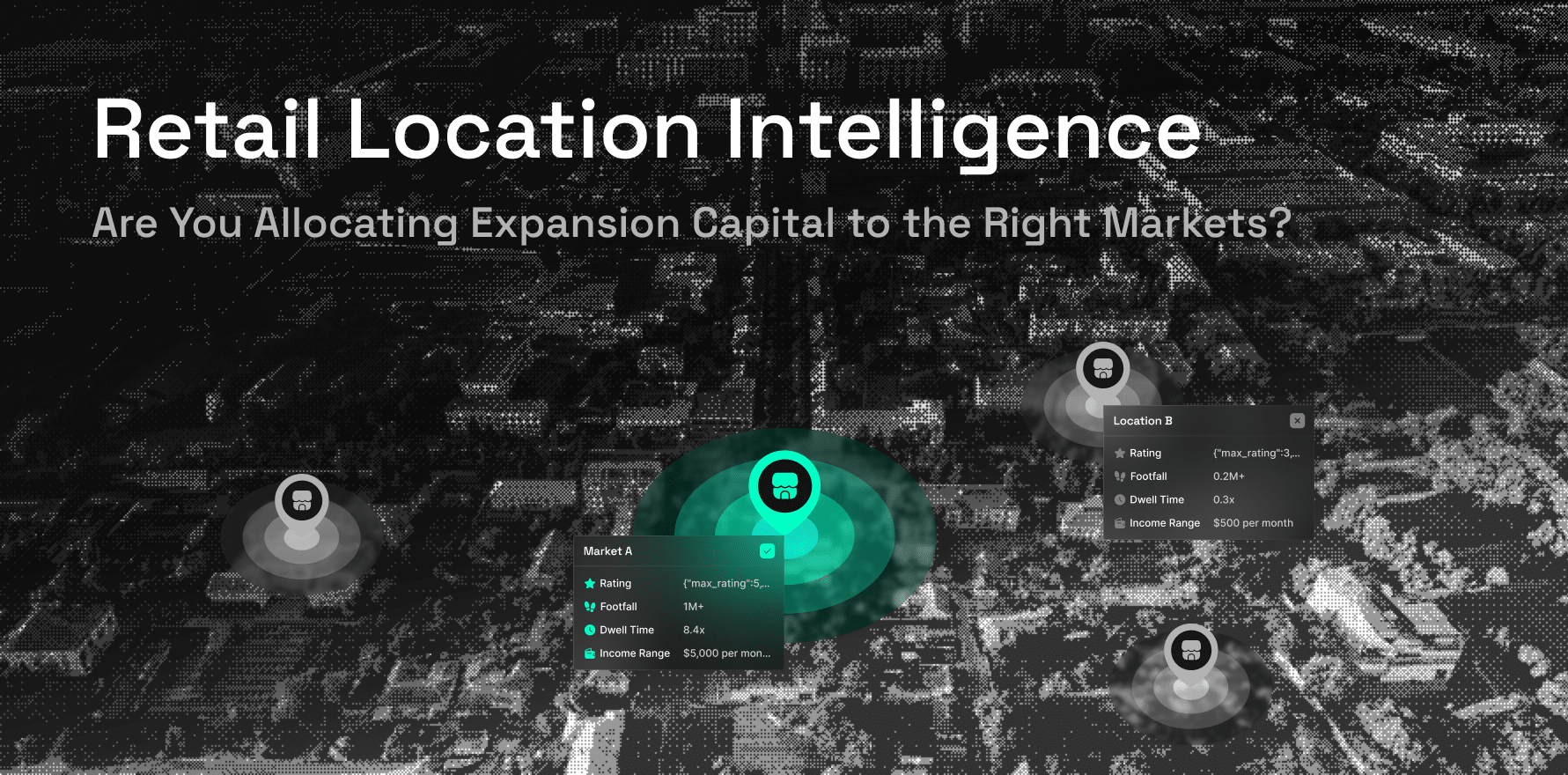
Market Expansion
Location intelligence can also help retailers decide which markets deserve expansion capital before individual sites are shortlisted.
People, economic, mobility, business, and existing-network data can reveal where demand is growing, where competition is intense, and where the current store network leaves meaningful coverage gaps.
The goal is not simply to identify the largest market. It is to find markets where demand is strong relative to competition and existing coverage.
Demand Forecasting
Location intelligence can improve forecasting when external signals explain variation that historical sales alone cannot.
Mobility, local events, economic conditions, surrounding businesses, and market changes can be added to store-level sales data and tested for predictive lift.
The important step is validation. External data should only remain in the model if it improves forecasts on stores or periods the model has not already seen.
Evaluate Markets Through Four Decision Gates
[image]
A useful retail location intelligence process should progressively reduce uncertainty.
| Decision gate | What the retailer needs to know |
|---|---|
| Market attractiveness | Is there enough reachable and relevant demand? |
| Site economics | Can this location capture enough of that demand? |
| Network incrementality | Will the store add demand or redistribute existing sales? |
| Capital efficiency | Is this the best use of expansion capital? |
A large market does not automatically produce a strong site. A strong site does not automatically improve the network.
The analysis should continue until the retailer understands both store potential and network impact.
Market Size Is Not the Same as Reachable Demand
Population, income, and spending are useful starting points, but they describe the market around a site rather than the portion a store can realistically capture.
Retailers need to narrow the analysis from total market demand to reachable demand, and then to the demand the brand can realistically capture.
A market may contain hundreds of thousands of consumers, but highways, competitors, shopping patterns, store coverage, and travel behavior may reduce the effective opportunity.
This is why trade area analysis matters. Catchments become more useful when they reflect observed customer behavior instead of arbitrary distance.
Connect Location Signals to Store Economics
External data matters only when it helps explain or predict a commercial outcome.
A retailer may combine internal performance data such as sales, transactions, basket size, floor area, and profitability with customer, market, and spatial signals.
The objective is not to accumulate more layers.
It is to identify which variables consistently separate strong stores from weak stores and strong markets from weak markets.
For example, raw foot traffic may correlate poorly with sales if much of the traffic is unrelated to the retailer. A smaller volume of visitors from the target catchment may be much more useful.
Evaluate Network Incrementality Before Store Potential
A proposed store should not be evaluated independently from the existing network.
Suppose a new store is forecast to generate $5 million in annual sales, but $1.4 million is expected to shift from existing stores.
The network impact is different from the site’s gross revenue.
A useful way to frame the decision is:
Net network contribution = New demand + Competitive capture – Cannibalized existing demand
Retailers should examine trade-area overlap, cross-visitation, distance decay, existing store coverage, competitor capture, and market saturation before treating the forecast as incremental growth.
Normalize Markets Before Comparing Them
Raw numbers often make larger markets look automatically stronger.
A market with one million monthly visits may appear better than a market with 500,000 visits, but that conclusion can change after accounting for population, competitor density, store count, and category demand.
More useful measures may include visits per location, demand per existing store, competitors per reachable customer, trade-area penetration, and performance relative to the local baseline.
The better question is not “Which market is bigger?” but “Which market offers more opportunity relative to the demand and competition already present?”
How Factori Supports Retail Location Intelligence
Factori provides real-world data that retailers can combine with their existing sales, CRM, GIS, BI, forecasting, and data warehouse systems.
Its data portfolio includes Mobility, Places, People, Audience, Business, Economic, Events, Property, Spend, and other real-world datasets. Factori’s retail offering also connects these signals to decisions such as site selection, forecasting, inventory, local marketing, and store performance.
A site-selection workflow might combine:
Candidate site + People + Places + Mobility + Economic conditions
A store-performance workflow might combine:
POS + Foot traffic + Visitor origins + Competitor activity
An expansion workflow might combine:
Existing stores + Trade areas + Audience + Competitor locations
Factori’s mobility and visit data can also support footfall analysis, market intelligence, and broader geographic analysis across physical locations.
The value is not simply access to more data. It is the ability to connect real-world context to decisions the retailer already makes.
What Retailers Should Validate Before Trusting Location Intelligence
Before using location intelligence to allocate capital, retailers should validate the data and methodology.
Check geographic coverage, POI quality, mobility methodology, normalization, and whether proposed stores add demand or shift existing customers.
Location models should also be tested on held-out stores or future periods.
If a model only explains locations it was trained on, it may not be reliable enough for expansion decisions.
Every New Store Should Improve the Next Decision
Location intelligence should continue after opening.
Compare predicted trade areas with actual visitor origins, expected traffic with observed traffic, projected cannibalization with actual network overlap, and forecast sales with actual performance.
This creates a feedback loop:
Predict → Invest → Measure → Recalibrate
Over time, the retailer builds its own evidence about which markets, audiences, locations, and external signals actually predict performance.
Conclusion
Retail location intelligence is not simply a mapping exercise. It connects geography, customer behavior, competition, mobility, market conditions, and store economics.
The strongest decisions come from understanding reachable demand, site capture, network incrementality, and financial performance together.
Factori supports this process by providing real-world data that retailers can combine with their existing systems and internal performance data.
The goal is not to find the market with the most positive signals.
It is to determine where the next dollar of expansion capital can create the greatest incremental value.
FAQs
What Is Location Intelligence and Analytics?
Location intelligence and analytics combines geographic data with business and real-world signals to understand how location affects performance and decision-making.
What Is Retail Location Intelligence?
Retail location intelligence applies geographic, mobility, customer, market, competitor, and store-performance data to site selection, trade areas, expansion, forecasting, and other retail decisions.
What Data Is Used in Retail Location Intelligence?
Common inputs include Places, Mobility, People, Audience, Economic, Property, Events, sales, transaction, customer, accessibility, and trade-area data.
How Does Retail Location Intelligence Help With Site Selection?
It helps retailers compare market demand, visitor behavior, accessibility, competition, trade areas, site economics, and potential cannibalization before committing to a location.
How Does Factori Support Location Intelligence?
Factori provides real-world datasets across Mobility, Places, People, Business, Economic, Property, Events, Spend, and other signals that can be integrated into retail analytics, GIS, BI, forecasting, and AI workflows.